Every industry has their buzzwords. Some come and stick around forever, some go in the blink of an eye, some are adopted because they’re trendy, some because an industry leader comes out with a book or a TED talk and they introduce the word and everyone starts using it to sound cool.
If you’re clued in to the independent-publishing industry, you might have heard a new buzzword within those circles:
Relevancy
taken from Merriam-Webster.com
In a webinar with Mark Dawson and Janet Margot, Janet used the word several times while talking about Amazon Ads. This isn’t the webinar I’m referring to, as that replay has expired, but this is something similar with Janet, Mark, and Craig Martelle in a video they did for the 20booksto50k group.
Bryan Cohen also adopted the word in the new Amazon Ads profit challenge I’m participating in right now.
And David Gaughran, in an interview on the Six Figure Author podcast, bandied the word about as well.
Relevancy.
It’s a good word. I try to keep my blog posts on this writing/publishing/marketing blog relevant to the audience I’m cultivating. Not many of my readers would appreciate it if all of a sudden I started blogging about the benefits of going barefoot, or why I love living in the Midwest. One too many and my subscribers would start dropping off.
But why is the word suddenly everywhere and how does it pertain to our books?
It starts with the book itself — maybe before you begin to write it. The tropes should be relevant to your genre. The elements such as world building, magical systems, setting, and character arcs should be relevant. I love this quote by someone in one of my Facebook groups:
No one likes to hear genre advice. People write whatever they want without regard to where their book would be placed on a bookshelf because for us indies, there rarely is a real bookshelf for us in a bookstore. But as I take ads course after ads course, the lack of genre bites a lot of people in the butt. They can’t find relevant categories in which to place their books. After you’ve written it, published it, and thrown money at it, it’s a little late to realize that, yeah?
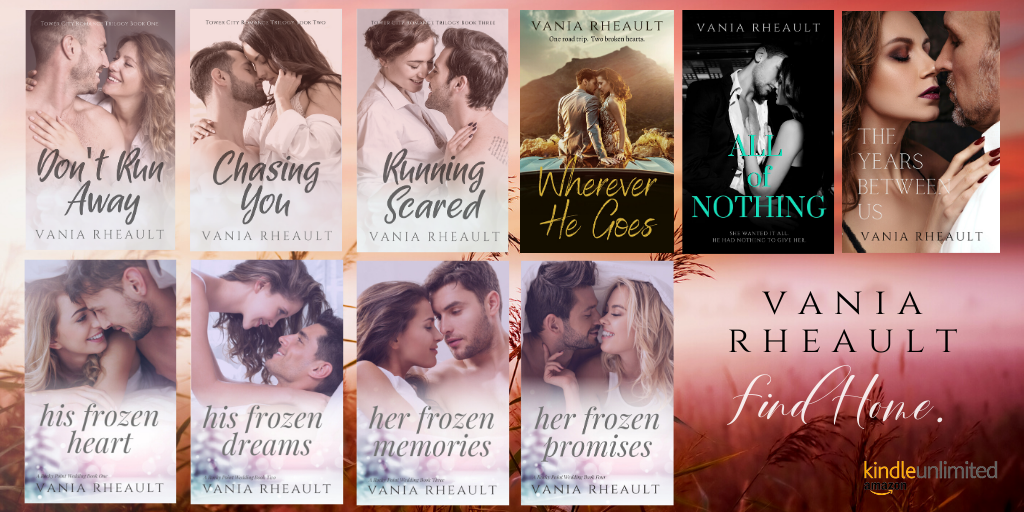
Book cover needs to be relevant to the genre. Such as in romance. As an example, if the couple has all their clothes on, that could indicate the book is sweet romance instead of steamy. If your couple is fully-clothed but they have more sex than bunnies, you run the risk of angering a lot of readers and that could come through in poor reviews.
When you publish and you enter the seven keywords into your metadata (you can use more than that, separate them with a semicolon), those need to be relevant so Amazon knows what your book is about and they can properly steer the right readers toward it. (Trust me, they want to sell your book just as much as you do.)
The categories you choose should be relevant to your book. That makes it easier is for readers when they search books they’re in the mood for. Some scammers will place their books in far-off categories because it takes only a couple of sales to reach bestseller status. If I were to place All of Nothing in say, a self-help category, or gardening, because Jax happens to buy Raven a plant, would that help sales? Possibly gardeners read romance, but placing a book in a category that’s not relevant will eventually do more harm than good, and could make Amazon mad at you.
If you do all that, your book will be relevant to the audience you want to read your book and your ads will be a lot more successful when you’re advertising to the right readers.
If the keywords (for Amazon) and target audience (for Facebook) you choose for ads are relevant, clicks will be cheaper and sales will be higher. If you don’t set up your ads so they are shown to the right readers, it’s like Coke showing ads to a diabetic. It wastes add dollars and wastes both parties’ time. The sugary beverage isn’t relevant to a person who can’t drink it.
This isn’t new information and I know plenty of writers buck the system, and that’s fine. I find it amusing when authors taking ad classes say their book can fit into several genres and they don’t know which categories to choose for their ads. Your book can’t be all things to all readers. The more you drill down who your reader is, the easier time you’ll have marketing your book.
Make a list of relevant comp authors. Those authors are your squad. Those books would sit next to yours at the bookstore. Their readers are your readers.
I have an AS degree in Human Resources, and HR professionals love buzzwords so it was fun for me to all of a sudden hear this word tossed around over and over again in the indie community. It’s a new way of saying what we already know:
What are your thoughts on relevancy? How have you made your book relevant to your genre? How can you fix it if you haven’t? Change your keywords in KDP? Swap out covers? Maybe add a subtitle? Make a list of comp authors and titles for ads?
Sometimes I forget how much fun a writer can have with their characters. In the age of writing and publishing as quickly as possible, we forget that there is a lot we can do to help readers dive into the worlds we create and get to know the characters who live there.
I rarely do this because of the time it takes. Writing a character sheet or character interview isn’t too bad, but when you create an aesthetic you can drop down the rabbit hole of stock photos for days. There’s where I lose time, and eventually, if I can’t find what I’m looking for, I’ll give up and I’m angry about all the time wasted.
But these days there are plenty of opportunities for you to share a character sheet/character interview/aesthetic/mood board, and I’m changing my mind about investing some time in doing this.
I also think that this can help me as a writer: dig deeper into character motivation, what drives them to do what they do, why they fight for what they fight for and get to know them for the simple pleasure that they are my creations.
You can share a character aesthetic on your FB author page, your blog, newsletter, bonus material for newsletter signups, or Instagram. Anyplace really, where readers may find joy in getting to know a bit more about the characters in their favorite books.
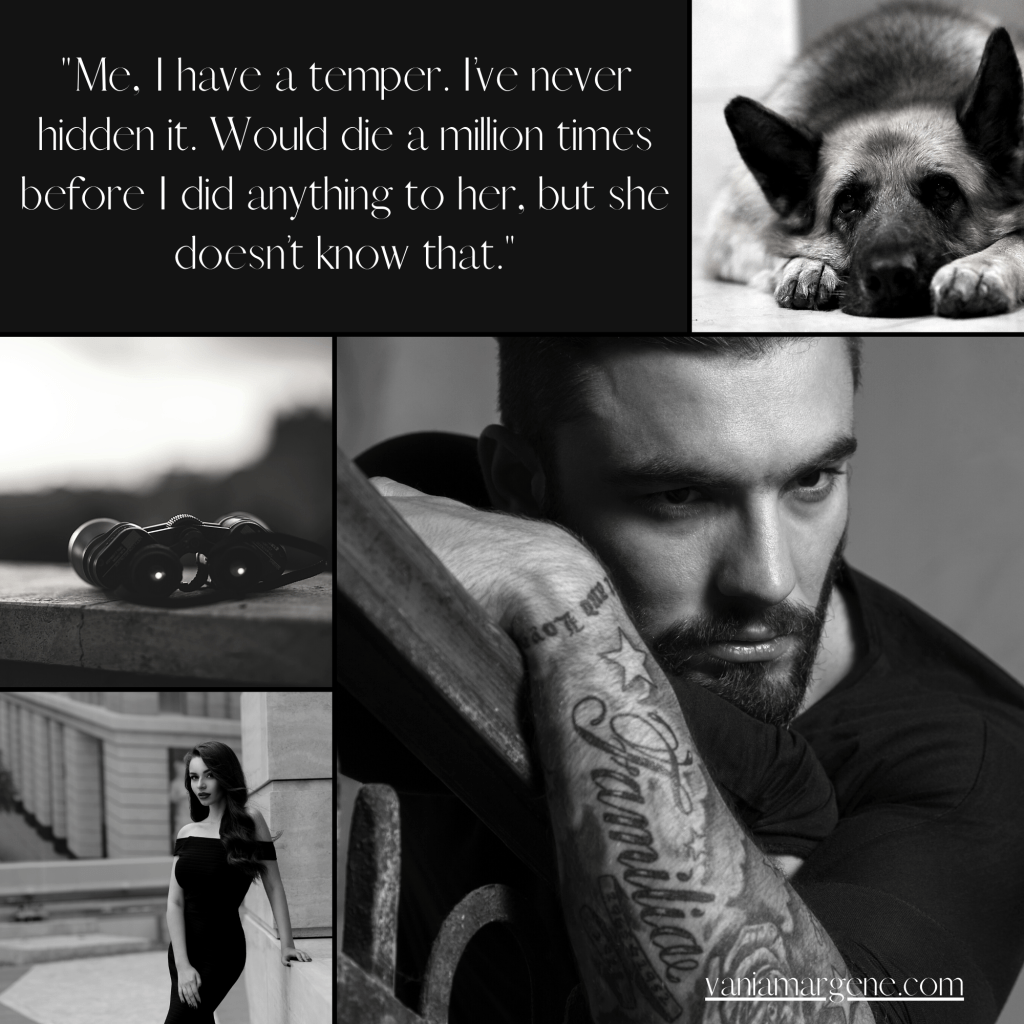
Using Canva, (look under elements and search grids) you can find an aesthetic grid where all you have to do is plug in the pictures. Save room in a box for a quote from your book that showcases your character’s true personality, or book’s release date, or other information you want to showcase.
You can also use Canva to make a character sheet and save it as a PNG or PDF but for today I’ll write into my blog post and use Canva to make Gage Davenport’s aesthetic.
Gage is my main male character in the second trilogy of my King’s Crossing Serial. Books 1-3 are for Zane and Stella, Books 4-6 are centered around Zane’s sister, Zarah, and her love interest, Gage. I love writing Gage. He’s mouthy, but so kind, and he loves Zarah from the second he sees her. Zarah has a lot of issues, though, and some baddies are after her, but there’s no better man to save her than Gage, a private investigator in business with his dad.
Gage Davenport
Age: 37 Occupation: PI in business with my dad Lives in: King’s Crossing, Minnesota Apartment or house: Apartment near the industrial park Pets: A Husky/German Shepard named Baby Favorite food: Anything that doesn’t give me heartburn Vehicle: A brand-new truck that’s almost paid off Love Interest: Don’t ask Family: My parents are divorced. My half brother is deceased. My mother remarried to a guy who’s okay, but I’m not interested in forming much of a relationship with him.
Look, I only have time for a few words. I have to take Zarah back to her place, and you know how long of a drive that is. Two full hours on the road. The way there, I don’t mind so much, on the way back, I miss her like crazy, the pull of it stronger as the miles go by. Are we going to end up together? Doubtful. You know she’s rich, right? And I’m not. That usually doesn’t mix well. You’d look at me and think I don’t have any insecurities, but that’s a big one. That and I hate thinking about Pop not being around anymore. I got a lot of time before that happens, but Pop, Zarah, my dog, Baby, those are the big three in my life. Sorry, Mom. I know you miss me, but you’re only on my case because of what happened two years ago. Like I said, I gotta get going. These late nights are killing me. Ciao.
This didn’t take me as long as it could have. I used all Canva pictures because I’m not looking to make money off this aesthetic. Technically, they’re promoting my books, but I’m not using them for book covers. Like I’ve said in the past, I will always buy all my photos for my covers.
With this serial, I’m going to try to have more fun with it, take the time to post quotes and excerpts of all six books while I’m writing them, formatting them, etc. I don’t know if it will help with sales, but I’m going to do it because I love these characters, and I’m tired of writing book after book without taking the time to smell the roses, so to speak.
Do you make aesthetics for your books and characters? What do you do with them, and where do you share? Let me know!
We talk a lot about burnout, and in these times, it’s even a more important topic. We need to take care of ourselves because this is our passion, our calling, our gift to be able to give our stories to the world, and we don’t ever want to have to stop.
I listened to a podcast episode of The Six-Figure Authors, and they talked about burnout. We all know what it is, but what causes it? I’ve written about it before, but I never thought to look at the reasons why a writer would have burnout besides the simple explanation of working too hard. Jo Lallo, Lindsay Buroker, and Andrea Pearson gave a few of their reasons why burn out occurs and it gives me a new perspective, and also, new ways to combat it.
One of Jo’s reasons for burnout is not seeing results. I didn’t realize how much I related to this until he said it. I jumped headfirst into the publishing industry, and sometimes I feel like I jumped into the wrong end of the pool. Instead of an easy dive into the water, my head met concrete and I’m flailing. This isn’t uncommon for a lot of first-time authors. They think they’re going to make a huge splash with their first book, or they put out a series to the sound of crickets. So they do it again, and again and again all to achieve the same meagre results. I feel that way, especially when I know I can’t sell books unless I buy ads, and then I only sell in books what I spend in ads. If you don’t see some kind of progress, that can create burnout.
Doing the same thing over and over again and expecting different results is also the definition of insanity. We all think writers have to be a little bit insane to take on a career like this, but I don’t think that’s what we have in mind when we call ourselves crazy.
What can you do?
I have to remind myself that this is a long game. A very long game. I mean so long I want to do this for the rest of my life. Success may not have found me yet, but one day it will. Reward yourself for small accomplishments. I’m always on to the next book and I don’t give myself credit for finished projects. I published 300,000 words this year and didn’t do anything special. When book four released, I was already knee-deep in the next book. That’s an awesome mindset, but also consider that writing and publishing a book is no small feat. You should celebrate it – even if it doesn’t sell.
Also realize that things can change and a promo that worked really well last year may not get you the same results now. Indies need to be flexible. We need to try new things. Frustratingly, this may result in losing a bit of money. No one wants to do that, but when you run a business it’s always a risk.
Take a break and assess why you aren’t making any headway. Is the genre you chose to write in not having a moment and therefore there’re no readers? Maybe your covers are off. Maybe you skimped on editing and reviews show that. Maybe you need reviews, period. Running on a hamster wheel won’t encourage you to keep writing. Jump off and try a new path.
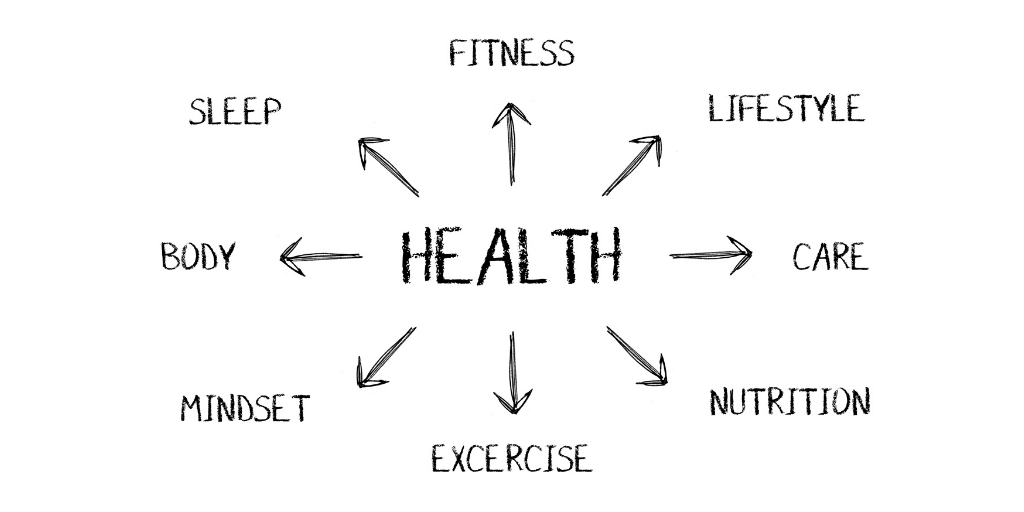
Andrea mentioned her health. You can burn out quickly if you don’t feel good. Maybe you don’t want to take a nap because in two hours you can write 2000 or 3000 words. But remember, if you’re exhausted, if you can’t think straight, how good are those words going to be?
Even though you can’t see it by looking at someone, a lot of people have chronic pain they’re dealing with. Back pain, carpal tunnel. Auto-immune disorders and fibromyalgia. Some have depression, some have so much stress in their personal lives it manifests physically.
What you can do?
Keeping up your health is important. A lot of people are high risk if they catch Covid. A lot of us are sedentary — sitting at our desks 10 hours a day, and it might be even fair to say a lot of us could stand to lose a couple pounds. Burnout can happen if you’re writing when you aren’t feeling well enough to write. Take care of yourself. Eat well, go for walks, stretch your arms to prevent carpal tunnel. Meditate. Your writing will sound better if you feel better.
If you have a chronic illness, know your boundaries. Andrea says she needs lots of sleep, and we know that’s always easier said than done, especially if we have children or pets to take care of. She has to work out to keep her weight at a manageable level to help a condition she has from getting out of control, and we know even if you don’t have a health issue that exercise can help; it’s good for you regardless.
Use adaptive equipment. I use voice-to-text a lot more than I have in the past. Stand while you type instead of sitting if you can. Take frequent breaks and drink lots of water. We don’t talk a lot about ergonomics, but if you have a bad back or neck pain, sitting properly can make a difference between getting those words down, or having to stop. I know as a woman without a room of her own in which to write, it’s a constant struggle to find a comfortable way to type every day.
I’ve mentioned Aidy Award a few times in my blog posts. She’s a successful romance writer, and she posts in the romance group I’m in. Recently she shared a video of carpal tunnel stretches that have helped me. Since I’ve had surgery on my left arm, I may not ever feel 100% because I’m of the mind that getting cut open can do more harm than good. So far while it hasn’t taken all of my pain away, I feel better now than before but not perfect. But I do these stretches every day, and maybe you can make them part of your routine too. They help!
Lindsay brought up one reason for burnout that I never thought of before — doing parts of the writing business you don’t want to do. Not everyone can afford a virtual assistant and we’re stuck doing things we don’t want to do. Writing a blurb, formatting books, running promos, setting up ads. It’s drudge work and nothing turns an offer author off faster than knowing you have back matter to change. It’s a bore checking and answering email or keeping up with social media when you’re just not feeling it.
What can you do?
Take a day and get it all done. Lindsay call these admin days. Know you aren’t going to write. Make a list, make a cup of coffee, turn on some music and just get it done. We love to procrastinate and bury our heads in the sand, but that won’t get that blurb written or a Facebook ad set up. Sometimes you have to set aside a couple of hours to go through stock photos, because not every indie can afford to hire out for covers, or if you can, you want to give your designer an idea of what you like.
I haven’t updated my website in a while, and I haven’t added my new books to my Books page. I have over 600 emails sitting in my inbox. It’s such a drag. But reward yourself when you’re done. Dig into that new book. Order your dinner in. Take a bath. Go for a walk.
Having to do admin work over and over again comes with the territory, but there will always be days when there is more to do than others, like a book launch. Sometimes when I blog I’ll do two or three at a time and that will free up my week. Scheduling tools can be a big help, and when I go heavy with Twitter, I use Hootsuite. Sometimes you do have to pick and choose where you want to put your energy and just add what you’re putting off to the next to-do list.
Listening to the podcast was eye-opening and interesting. When we think of burnout we automatically think we’re working too hard, but that’s not always the case. Being able to pinpoint what’s going on can help us take care of the issue, or go about it in a different way. Try a promo site you haven’t tried before or kill your ads and cleanse your palate. Find new keywords and try again.
There are aspects to being an indie writer we just are not going to like. Recognizing the cause of burnout is one step in the right direction.
What causes your burnout? Let me know!
If you want to watch the podcast for other ideas and tips to keep burnout at bay, you can watch it here. Thanks for checking in!
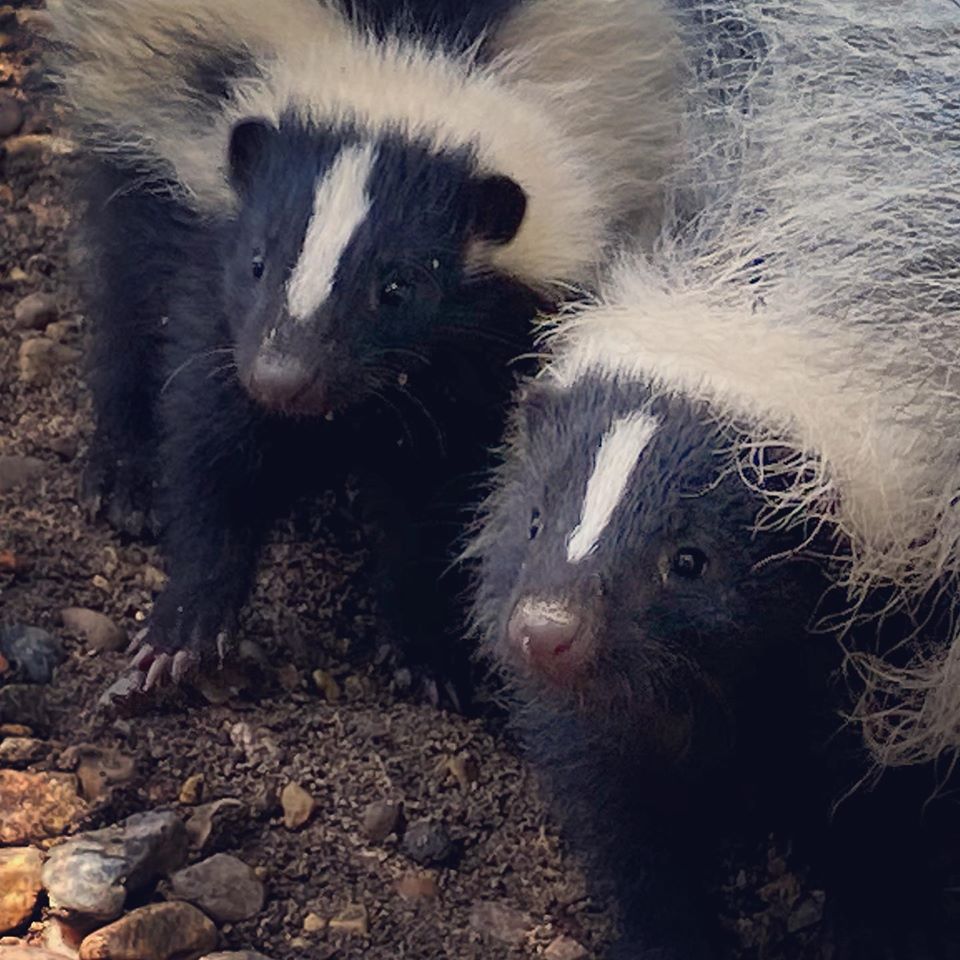
Well, it’s July and saying the world is crumbling around us is an understatement to say the least. COVID-19 is going crazy, we have a president who doesn’t seem to care, and the whole thing is really scary. My fiancé was supposed to move up from Georgia this summer, but he can’t if he can’t get a job up here. He has something steady where he’s at, and we’re thinking he won’t move until this coronavirus stuff is under control. And who knows how long that will take? I try not to be political on this blog–there are authors who will say anything they want and if you don’t like it, deal with it. I’ve never been that kind of author to treat my social media that way. It’s always more fun to share pictures of baby skunks anyway. But this COVID stuff is . . . people are dying, people don’t have jobs, people don’t know where their next rent payment is coming from. It’s terrifying, and it feels almost petty to go on and talk about books. But I keep trying to find the light at the end of the tunnel. When all this is over (and “over” means different things for different people) I don’t want to look back and realize that I didn’t get anything done. I’m trying to press through the best way I know how, and that’s keeping my mindset in the publishing game.
This image is from For Fox Sake Wildlife Rescue in Tennessee. I pulled it off their FB page. They rehab animals and put them safely back into the wild. I love looking at their photos and give when I can. You can support them here.
Why isn’t my book selling?
This question bothers me so much because it’s usually obvious. There’s someone on Twitter and he constantly laments that no one is buying his book. But his book doesn’t meet industry standards. The trim size is wrong, his book doesn’t have a professional cover–to the point the book’s title and his author name aren’t even on it! The insides are a mess. I don’t understand this because I have told him what he needs to do to fix it, and he says it’s his first book and didn’t expect anything from it. THEN STOP TRYING TO SELL IT. He seems to have plenty of people on Twitter who would be willing to help him, for free, even, if he would just ask for a little help. His tweets are a bore. Put in the work, or don’t bother.
But I like it this way.
I ran into someone else in a FB group who said she doesn’t full-justify her paperbacks because she doesn’t like how it looks. I’m having a hard time wrapping my head around that since first of all, it shouldn’t matter what you like or don’t like–full-justification is industry standard for a paperback. When an indie won’t follow industry standards (like the person on Twitter up above as well) it makes them look petty and immature. Are you really running your business while being so trite? And then we still wonder why there are people who won’t buy indie. It’s rather ridiculous to me that a person chooses to go indie for the creative freedom, and that’s what they’re going to do with it. I’ve read lots of indie books and their paperback books look AMAZING. Why not strive for that instead of cutting corners then complaining about it? Just a thought.
In other news, because this isn’t going to be a bitch session, I’m 35k into the 4th book of my series. I was scared to start this book, and I took me a week to hunker in, do some outlining, and actually start. But now that I have, it’s going well, and as always, I didn’t need to worry about word count. I usually do, but first person takes up a lot of room, if you know what I mean, and it’s a lot easier to meet word count. I understand the appeal of indies writing first person. It’s quick, it’s easy, it’s not complicated. I’ve even gotten some feedback that says my first person sounds better than my third person books. What? I’m flattered, and I like writing in it, but I started this first person stuff on a whim and I’m not sure if it’s what I want to keep writing. It’s interesting, though.
June Amazon Ads
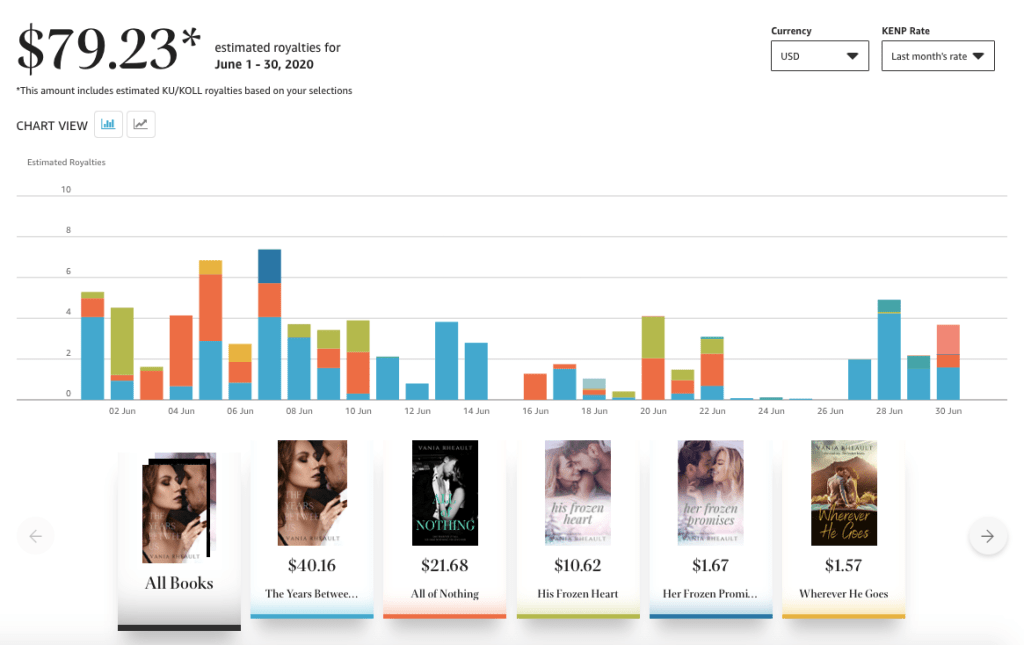
I turned my ads off on June 26th because I was in the red four dollars. I wanted to see if I could catch up with page reads and I did:
My ad spend was $79.85. I am selling some books, which is fun, but you can see that most of my royalties are from KU, which is fine; that’s why I’m in the program.
And I have to say, changing out the cover to The Years Between Us was probably the smartest thing I ever did. I never would be selling so many books with the old cover. Just a lesson to never be so set in your ways or what you think should be working when it’s easy to try something else.
I’m interested in seeing that people are reading the last book in my series, so I decided to look at my KU read-through for A Rocky Point Wedding for the month of June.
For His Frozen Heart, the first in the series had 1,557 pages read.
His Frozen Dreams had 361.
Her Frozen Memories had 355, and Her Frozen Promises had 5.
Lots of people have told me that it’s too soon to decide if the series is a wash. Especially since the last book has only been out a month, and I haven’t done much promo for the series as a whole. But while I was finishing it up, I knew books one and two weren’t as strong as books three and four, and that’s such a bummer. I’ve heard it’s common, though. As you get to know your characters the writing is deeper and richer and the plots get a little more involved since the readers know the characters better and you are more comfortable as a writer to draw them into the conflict. It’s definitely something I’ll keep in mind if I write another series. The first person one feels different and I can’t explain how. Maybe because the first three books follow the same couple and I don’t have to worry about introducing new characters.
Anyway, if you’re going to fumble along, you can expect to scrape your knees.
I think I’ll end here and get some writing in. I hope you all have a wonderful weekend ahead!
So if any of you follow Mark Dawson or you’re concerned about marketing strategies, or you were thinking about taking an ads course, or if you’re in any writing groups at all on Facebook, you know that Mark Dawson’s Ads for Authors course closed last week. Whenever Mark opens up his course, I have a huge case of the nerves. Why? Because everyone raves about this course. How helpful it is. How it’s a lifetime pass to ads and all your questions and all of the answers until you die. You can’t be an author and learn how to sell your books without it. After hearing it’s God’s gift to sales, you’ll run out and sign up, right? Well, the next time it opens is in the winter, and you’ll need that time to save up the fee, because you know why I haven’t signed up? It’s $849.00. You read that correctly. It’s almost a $1,000. And if you take the cheapest payment plan, it does cost over $1,000 dollars payable over two years’ time.
You know how indies say, “I can’t afford a cover, or a professional edit, etc, etc, etc, because I’ll never earn my money back?” Yeah. That. How many books would I have to sell to earn back $849? That’s the whole point of the ads course, right? To learn how to make that kind of money? Sure.
So how about this one? In Mark’s SPF University, there’s a course on how to write a bestseller by Suzy K. Quinn. People have raved over this, and I’m always wanting to work on the craft part of being an author. Some would say working on craft is the most important part of being a writer because it always starts with a good book. But her class is a whopping $297.00. People say they learn so much from that class. But hey, that’s two car payments for me. Or half a month’s rent.
And I’m not picking on Mark Dawson. John Truby also has a writing class. He gave a intro talk about it at the 20booksto50k conference in November last year. And you can watch it here.
And that’s just classes. We haven’t talked tools yet.
Bookbrush. A platinum yearly fee with them is $250.00. Canva. A yearly membership with them is $120.00 a year. But if you compare the two, you get quite a lot more with Bookbrush, as you should since it’s double the cost. There there’s Vellum, and if you don’t have a Mac you have to run it through Macincloud, and if you do want a Mac, well, everyone knows how much they cost.
Never mind paying for clicks on Amazon Advertising, and the same goes for running Facebook ads and Bookbub ads. (Don’t bother with running ads on a platform you don’t understand. You might as well give me your money. I’ll use it to buy promos.)
Can we add newsletter providers too?
Oh, I forgot about website hosting and a domain name. Maybe a business upgrade on WordPress.
A yearly subscription to Microsoft Office 365.
Forgot coffee. And booze. Are you even a writer if you’re not drinking something like a fish?
Let’s just say that indies have a lot of resources and not all of them cheap, ah, budget-friendly.
How much does it cost to be a writer? Well, nothing. I mean, literally 0 dollars. It takes no money to be a writer. Maybe two dollars. Grab a pen and notebook from the dollar store. Or scrounge your kids’ school supplies for things they didn’t use after everything moved to online learning because of COVID-19.
There’s a joke in the running world that running is the most expensive free sport there is. Shoes, race fees, GPS watches, the rest of the gear. The list is almost as long as what a writer needs to be an author. Being an author is the most expensive free thing you can do right? Tell that to my $150.00/pair Brooks running shoes so I don’t get tendonitis in my ankles.
But how much money does it really take to invest in your business?
The problem is, not anyone is going to know but you.
I had a friend step back from writing. She’s focusing on her family. That’s great; she has to do what’s best for her. And while she’s never said she won’t come back into the writing/indie space, what she did invest in will just sit while she decides what she wants to do. She bought a Mac, she purchased Vellum. She bought a yearly subscription to Canva Pro. Granted, that can run out, but I don’t know how much of her paid year will go to waste while she’s not using it. She purchased her domain name for a blog she took down. I gave her a free developmental edit of her book, so there’s something, but she paid for a cover for a book that will sink in the Amazon store because she won’t be promoting it (and by promoting it, I really mean writing the next book) while she takes a break.
So how much money should you spend? Start small. I pay for Word. I don’t use a writing software like Scrivner. But you don’t have to purchase Word, either, though the .docx is compatible with Vellum and other conversion websites as well as KDP. There are free options like Open Office or Google Docs.
There are some things indie professionals say you can’t skimp on like a professional edit, or a decent book cover. And that’s true. You don’t have anything if you don’t have a good book. That’s why there’re craft classes out there. But you don’t have to pay $300.00 for a class. There are a ton of craft books, and all you need is to invest some time into reading them. In fact, there are a lot of free resources on YouTube if you learn better listening to a speaker. Brian Sanderson has a set of lectures on Youtube people say are really good, and you can get started here. And over the years John Truby has spoken about craft and you can watch those YouTube videos for free. I’ve shared several talks I’ve enjoyed from the 20booksto50k conference in Vegas last year. The group puts those on YouTube for free too. Chris Fox’s channel is valuable, as is David Gaughran’s new channel.
I suggest narrowing down what you need at the moment you need it. If you only have one book out, probably you don’t need an $800.00 ads course. If you only have one book chances are working on craft would suit where you are in your career a lot better than learning an ad platform or any kind of marketing strategy.
I have fear of missing out, and a lot of writers I know do too. It’s tough not to want the newest brightest thing. Especially when all your groups on Facebook are raving about it. I can’t afford Mark Dawson’s class, and if you can’t either, there’s no point in feeling bad about it. It is what it is. I’ve learned a lot taking Bryan Cohen’s free ad challenges, and he doesn’t push you to pay for his class. I break even with my ads, and that’s okay. I’m not losing money and I’m picking up new readers. At this stage in my career, that’s a win for me.
Having all the tools and technology won’t make you a writer and I have a feeling that was what my friend was aiming for. She was collecting the tools of the trade, but in two years wrote only 60,000 words. For some indies, that’s a word total per month.
Think about what your goals are, what you want out of your career and when you want them. My fiancé bought me a Mac and purchased Vellum for me. I format a lot of books, and pay my fiancé’s kindness forward and will format free for others. Like I said, I pay for Word. It’s my main (umm, only) writing software and I use it every day. I pay for Canva. I bought Publisher Rocket because I do experiment with ads (and right now those small ads are my main source of sales). I’m ashamed to say I threw $40.00 at something I don’t even know what it is or how it will help me. All I know is she said it was her final offer because she wasn’t going to sell it anymore, and I swallowed it hook, line, and, sinker. Some kind of author toolbox website that I probably will never be able to find because I was too busy throwing money at her to pay attention to what I was buying.
It happens, and probably more frequently than we want to admit. The panic sucks. The fear of missing out on something that will make us a bestseller. And we especially panic when we think everyone else but us has the magic bullet.
A good rule of thumb is to exhaust all the free possibilities before going to paid. Newsetter providers have tutorials. So do lots of people on YouTube wanting to help you. Podcasts have been a great way to learn things, and I like to multi-task. Listen while you’re doing chores, or running errands, or taking a walk. I use my phone to take notes if they mention something of interest I don’t want to forget.
No matter how you learn what you learn, probably the one thing you’re going to need to invest is time, and in a lot of cases, that time is better spent writing.
Minnesota has been going through a heatwave, and I’ve never been more glad than when I emailed our property management last week and had them look at our air conditioner. The maintenance man cleaned it out and now we hold steady at about 71F in our apartment. I don’t mind the heat, and I’ll go walk in it or run errands without bitching, but only if I can find some relief when I’m tired of baking my brains out. Trying to sleep when your bedroom is 85F is tough. And trying to write without any sleep is tougher yet. Am I right? First world problems at their finest, I suppose.
Health Issues.
I had a scare last week when a new brand of coffee made me sick to my stomach, and I mean, SICK. I drink a lot of coffee, and for a handful of days I felt so terrible I thought I had stomach cancer. Luckily I put two and two together and after I switched back to an old brand, I felt a lot better. I’ve also started wearing my splints again. I wear my elbow compression sleeves off and on to keep the nerves in my elbows in check, but I forgot about my wrist splints, and wearing those again have helped my pain, too. For a little bit, between my back pain and my stomach issues, I was feeling pretty miserable. But I’m back up to 98%, and as a friend said, after you hit 40, 98% is about as well as you can hope for. I know I’ll always have carpal tunnel issues, and like anyone else with a chronic health problem, it’s easy to get lost in a mini pity-party. But I took a walk yesterday and a cyclist zoomed past me on the trail. This guy had a prosthetic arm that attached at his shoulder, and it shut me up real quick. I’m sure he’d trade a bit of carpal tunnel pain to have his body whole, and it’s always a gentle reminder to be thankful for what you have.
Back to the writing part of it.
In writing news, I finished the second read-through of the last book in my first person trilogy. I’m so happy with this trilogy, and the writing went very smoothly. Now I’m worried about how the second trilogy is going to go, but I want to start writing the first book soon. While I write, I’m going to go ahead and format the first three (and hahahaha, do their covers) and order the proofs. There’s no rush to get these done. While I was going to do a pen name for these books, I’ve decided that yes, I won’t publish under Vania Rheault, but I don’t want to distance myself using a whole different name like I was thinking about. So I’ll publish these under VM Rheault. It won’t be a secret I wrote these, but I do want to keep them separated from my 3rd person books. I’m thinking more about my brand this time around and every book under VM Rheault will be a lot more consistent with feel and sub-genre than my other books. Not sure if this will help sales, but I’ve been sniffing around my FB groups learning, and it’s time to apply what I’ve picked up and see if it helps me too.
Last month, I ran a handful of ads to my Tower City Romance Trilogy Box Set and I got a few nibbles but no sales, so I shut the ads off. It included the sequel novella I wrote a couple months ago when I re-edited the trilogy, but because I didn’t sell any of the box set, I published the novella separately this morning. There’s no point in keeping it exclusive material for a set that’s not selling. I can throw some low-bid ads at the first book and see if anything happens. I have it set up as a paperback too, but the cover needs tweaking. I’ll do that later this week, I suppose, though I doubt anyone is going to want to buy the paperback. It won’t be worth the price. It’s a substantial novella as far as they go (29,500 words), but it was still too slim to put text on the spine (at least, KDP couldn’t center it correctly and I finally just took it off rather than fight with the uploading system on KDP and the PDF). But it will be available, so I guess it doesn’t matter in the end.
This morning I also set up a freebooksy for book one of my Rocky Point Wedding series. I was thinking about doing a Christmas in July type thing, so I was able to tailor the ad copy in that general direction. Whether it will hit or miss remains to be seen, but I have that set up for the middle of July and my free promo days are already set up on Amazon. I actually did okay buying a freekbooksy a couple years ago for the first book in my Tower City Romance trilogy. I made back the cost of the promo and then some in KU page reads, and I can’t remember how many downloads my book got, but I made it quite high (in the top ten) in the free steamy contemporary romance category. I’m hoping I do better this time around with an extra book and better writing. I haven’t calculated read through for my series yet, since the last book has only been out two weeks, but people are buying it, so I’m hoping this series has better read-through potential. I just checked because I was curious, and I noticed that the last book in my series wasn’t enrolled in KU. Sigh. I can only blame myself for not checking, and I hate to think what that has done to potential page reads when the first three are in KU and the last wasn’t. Everything else is, but at least I figured it out before the promo went live next month. Live and learn, folks. Live and learn.
Newsletters.
I’m still looking into starting my newsletter. I’ve decided to go with MailChimp since Jane Friedman and Mark Dawson use it. That was probably one of the hardest decisions because there are so many newsletter providers out there and they all have their own sets of pros and cons. But if heavy-hitters like Jane and Mark use MailChimp, then it should be good enough for me. I did have a newsletter set up with them a couple years ago, but I never sent out anything, not even to myself as a tryout. I wasn’t as research-savvy as I am now though, and I’ll be watching plenty of tutorials on how to set up a newsletter effectively. And I’ll probably need to blow off the dust on my author email account. I’m not worried about content, just the over all learning the platform and setting things up so my emails are sent smoothly. Everything is a learning process. I’ll also be typing out a novelette that I wrote at work over the course of a few weeks, and though it’s got kind of an ambiguous ending, I’m considering using it as a reader magnet. I have to type it out though first–20 handwritten pages front and back. I think that equals about 15,000 words give or take. Not terrible, and written in first person present, so it’s a lead-in to my pen name. Now I’ll have to look into group promos to build my list but that’s more research and a post for another day.
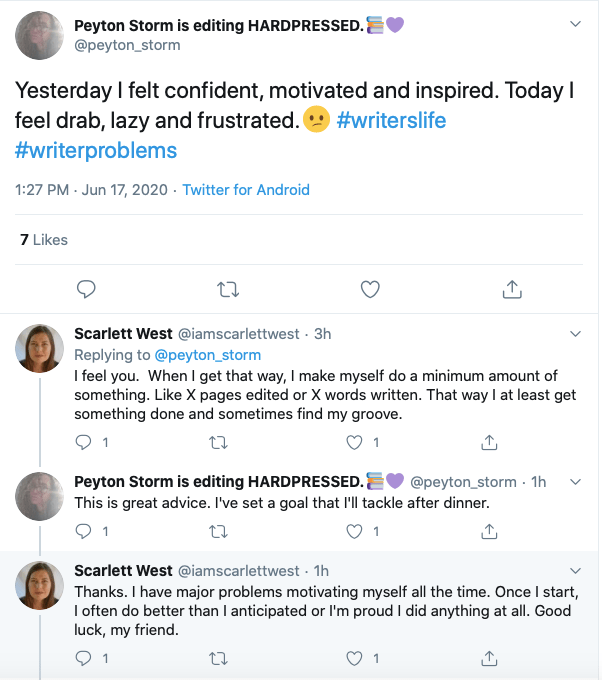
How is everyone doing? Getting stuff done writing-wise? This is a great tip from my friends Petyon and Scarlett on Twitter:
I would definitely encourage you to follow these lovely ladies on Twitter! Until next time, everyone. 🙂
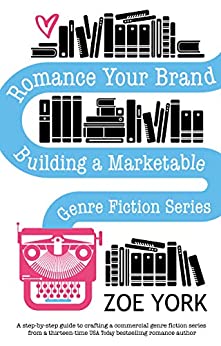
I love reading nonfiction by indie authors. It’s like being able to pick their brains without actually bothering them. An author shared a screenshot of the books on her Kindle in one of the Facebook groups I’m in, and Zoe’s book caught my eye. Zoe is a well-known in the indie publishing space as a contemporary romance writer. I first heard of her when she was a contributor of the now defunct podcast Self-Publishing Round Table, one of the first podcasts I listened to about self-publishing.
I was excited to see that she started writing nonfiction and I purchased her book right away.
I’ve written two series: one trilogy and another with four books. They don’t sell that great, but though to be fair, I don’t promote them much, either, and I thought Zoe could share some things that worked for her.
She goes through the reasons why a series is good–namely read-through and creating a world fans can fall in love with. I already know that, which is why I tortured myself all of 2019 writing one. It’s not to say I didn’t enjoy it, but there are things you have to consider like consistency and bringing other characters into the story of the main couple because they’re all friends and people simply don’t disappear when you don’t need them at the moment.
Zoe goes into some of the planning, encouraging you to draw a map of where your series is going to take place. She writes small-town romance, and my Rocky Point Wedding Series is placed in a small town, too. I knew my series wasn’t going to be very long — I don’t have an attention span for several books, so I trusted myself to keep Rocky Point’s details in my head without writing them down. But if you plan to write 5+ books, it may be advantageous to treat your setting like a character and write a detailed sheet to keep facts straight.
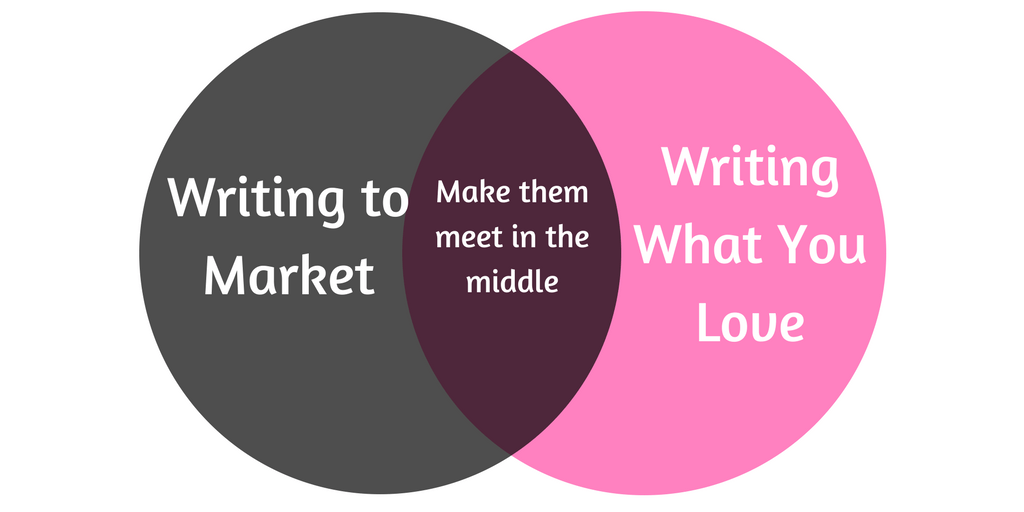
Other tips she offers are keywords, naming your series, and plotting out the books. This is where my ears perked up so to speak because Zoe is a genre fiction author. She subscribes to the Venn Diagram where you need to write to market while writing what you love and finding that sweet spot to sustain a lucrative, but happy and satisfying, career for yourself.
When I plotted my series, I started with setting first. For me that’s the easy part. I set the books in a fictional small town in Minnesota based on my hometown. I even gave my town the same attributes — along the Canadian border, a shut-down paper mill, and a similar Main Street. I’ll probably always set my stories in Minnesota. I love the seasons and the variety they can bring to the plots.
Then I move onto characters. I think this is where I dropped the ball and Zoe opened my eyes that actually when I plan out my books I don’t keep tropes in mind.
Every romance novel is based on a trope or two, and while you might scoff or want to deny it because your books are better than that drivel, I need to remind you readers love tropes. The kind of trope the book contains is why the reader chooses to read your book.
While plotting my series I forgot that, and it’s why my books aren’t as strong as they could and should be. Of course my books contain tropes, but I assign the tropes after the fact when I should be planning my stories around them. Knowing the tropes I want to include beforehand will give my books a stronger spine.
What are some romance tropes? These are from Zoe’s book:
friends with with benefits
married to the enemy
marriage of convenience
enemies to lovers
fish out of water (new town, fresh start)
forced proximity
bad boy
ugly duckling
unrequited love
friends to lovers
strangers to lovers
There are more, these is only a sample. A Google search can come up with a couple more:
forbidden love
age gap
secret baby
fake date
fake marriage
You can have a lot of fun with tropes. Take forced proximity. Maybe two strangers have to share a shelter during a tornado, or the elevator stalls (that’s pretty popular) or there’s only one bed (another that’s popular). Anything where the characters need to spend a lot of time together in a close space with no chance of escape. Like a cabin during a blizzard.
Zoe encourages you to list the tropes as you plan the books in your series and I’m going to start doing that with all my books. For now I can list the tropes that my books do contain (I can list them for marketing and ad copy purposes) and going forward use new tropes as I plot.
Knowing what tropes your books includes can help with blurb-writing and writing ad copy. As Jami Albright says, tropes sell. If you can make the tropes easy for readers to see, you’ll be more apt to make a sale.
Writing a series takes a bit of planning. At least the first few books so you can fit the pieces of each book together like a puzzle. Some series can go on for a while see (Robyn Carr) and there is no way to plan twenty books at one time. But if you can list the elements you want to include in the first few hopefully consistency won’t be too big of an issue and you (and your characters) can find a groove.
Zoe’s book gave me a new perspective and I feel there are things any genre writer could benefit from. I encourage you to pick it up. You’ll be glad you did.
A note about sub-genre and tropes.
Some writers blur the line between sub-genre and tropes. The easiest way to explain the two is to give an example.
Take Aidy Award’s books. She writes curvy-girl romance. That’s her sub-genre. You know when you grab one of her books the heroine will be voluptuous. But that can’t be the plot. The plot will contain tropes that pertain to genres that aren’t only curvy-girl. Like close proximity or enemies to lovers.
Billionaire romance is another example. Maybe every single male character an author writes will be a billionaire, but those characters will have their own plots that contain their own tropes.
I have noticed that some of the bigger in the writers like Aidy focus on one sub-genre. Then they have fun with the tropes. They have an easier time branding their books and that helps marketing and sales. It’s something to think about moving forward.
I have a friend who constantly struggles with social media. She hates it, but not for the idea it’s a time-suck. For now we can all agree that with the JK Rowling stuff, the #publishingpaidme hashtag that’s gone crazy on Twitter, police brutality, COVID-19, and our president, things on social media are more than just a dumpster fire. It’s a raging, out-of-control forest fire. Think Australia. Really, let’s think about Australia since we haven’t heard anything about their fires in quite some time, but they’ll be dealing with damage control for years.
As a writer and author, we can agree that social media is a necessity. BUT as a writer and author, social media isn’t necessary in the way we’re told it is at the beginning of our careers. Namely, we need to be on social media to sell books. This is only partly true, and in the part of it that is true, it takes a lot of scrambling on our end to make it happen. In my 2020 predictions blog post from a few months back, I quoted Mark Coker (the founder of Smashwords) as saying that Amazon ads have stolen the writers’ platform. Why work for reach when you can buy it? Why work for reach when it’s EASIER to buy it? I know for the books I’ve sold in the past year, it’s due to buying ads on Amazon.
And yet. Is social media worthless?
Let’s take a look at social media from an author’s standpoint. Just a quick one, since I’ll start off by saying I’m not doing this but I know I should be. One of the only ways to use social media as an author is to set up a Facebook Author Page. (Ads aside since you need an author page if you want to run FB ads for your book.) The idea is having someplace for your readers to find you. Like your page. Interact with you. Some authors form groups instead of pages, but the downside to a group is that you’re constantly moderating and making sure posters are behaving. That doesn’t sound like fun (and a true time-suck), but an author page is doable. Especially since FB offers a scheduling option for your posts. A downside to this is you’re building your castle on someone else’s property. We know Zuckerberg changes his policies all the time and we’re told it’s better to send your readers to your website or newsletter. The problem with those two options is it’s harder to interact with you. So an FB author page is probably going to be the best thing you can do to use social media to help sell your books. Recommend books in the genre you write in. Host giveaways and post about your books. I’ve seen lots of robust FB author pages with lots of engagement. I don’t give my author page enough love but I should start.
Twitter is bad for selling books and I don’t promo on there. I follow a few industry leaders and retweet the articles I find useful to me. That’s about all I do.
Instagram can be a fun place to hang out, but when you’re a writer, you get sucked into the social circle of other writers. So you’re not going to be selling books on there unless you can crack out of the writer/author bubble and find readers. I don’t post on Instagram with the idea I’m going to sell books. You can run ads on Instagram, but besides paying for exposure, I’ve never sold books buying ad space on Instagram. If you wanna see pictures of my cats, look me up.
So, social media isn’t the best for authors. Unless you’re into content marketing and you’re constantly posting snippets of your books. That might not be a valid option if you’re a slow writer, because by the time you release your book, you’ll have posted every single line already. It’s good for non-fiction. But I’m not a non-fiction writer, and I’m not an authority on anything, nor do I want to be.
So, what is social media good for if you can’t sell books?
This is where my friend, I think, throws the baby out with the bathwater when she cuts herself off from social media.
As a PUBLISHER, there are a ton of benefits of being online. Facebook is where I learn 99.9% of marketing and keeping an ear to the ground when it comes to the industry. My friend says– and I’ve heard this from others too–is why would she need to know about marketing, publishing, or anything in-between if she doesn’t have books out? Isn’t writing the most important part of it?
Sure, you need to be writing to be a writer, to eventually be an author.
But.
What are you gonna do when you’re done with that book? How are you going to learn ads? How are you going to know where to promo your book? You’ve cut yourself off from marketing and publishing groups and now you don’t know what the current trends are. Best practices?
If you cut yourself off from author groups on FB, when you’re done with your book and you start up your social media again, you think you you’re just going to join these groups, guns blazing, demand answers to all your questions because you needed the answers yesterday because your book launches tomorrow and you don’t know what you’re doing? I’ve seen people do that in some of these groups. Some of them are met with kindness and people will walk these authors through what they’re doing to sell books. Many others, though, are ignored because it’s evident that they expect other people to do their work for them. Networking and keeping apprised of industry news is a process. It’s an ongoing process. I’ve said before that being an author/publisher is no different than other professions. Would you want to go to a doctor that didn’t keep up with the newest (and maybe better) treatments? Do you want your children to go to school and be taught by a teacher who doesn’t keep her certification up to date? Do you want to be represented by an attorney who doesn’t keep up with changes to the law? Maybe you don’t feel your publishing company is that important, but suddenly you’ll feel like it is when you want to buy promotions for your book and don’t know where to buy them. And even suckier, don’t know who to ask because you’ve taken yourself out of the game.
I LIKE knowing what’s going on with the publishing industry. I like keeping up with Amazon changes, new aggregators, what IngramSpark is doing. Even if I don’t need the information, I’ve been able to help others, and that’s what networking is all about. My blog would be pretty useless if I didn’t keep my head in the game and pass along information to you.
What are some of the best groups I’ve joined on Facebook?
Six Figure Authors.https://www.facebook.com/groups/504063143655523/ It’s moderated by Lindsay Buroker, Andrea Pearson, and Jo Lallo. It accompanies their podcast by the same name, but you don’t have to listen to the podcast to benefit from the group. Though the podcast is awesome and a lot of the discussions are based on a podcast topic.
Mark Dawson’s SPF Community.https://www.facebook.com/groups/SPFsecretgroup/ I like this group because Mark Dawson is very protective of Amazon and won’t let anyone talk shit about them. Amazon did indie authors a great service with the Kindle, CreateSpace (back in the day) and KDP. I don’t know where indie publishing would be without them. I also just love the conversations on there about publishing and marketing.
Level Up Romance Writers.https://www.facebook.com/groups/LevelUpRomanceWriters/ Moderated by Dylann Crush, this group is for marketing romance. There are so many generous writers in that group, and it’s a place where I have started to post more and get to know people there.
20Booksto50k.https://www.facebook.com/groups/20Booksto50k/ There are a lot of generous people here, too. They are more than happy to tell you how they are selling books. Craig Martelle is pretty strict with what is allowed and every post is moderated, but I mainly lurk and soak up information.
Vellum Users.https://www.facebook.com/groups/VellumUsers/ I format my books (and sometimes for others) with Vellum. This group is for questions about the software if you run into an issue, or if you want to ask if something you want to do formatting-wise is available. Jody Skinner and Erica Alexander are in touch with Brad and Brad (the creators of Vellum) and they both know their stuff. I learn something new about software capability every day.
Indie Cover Project.https://www.facebook.com/groups/20CoversTo50k/ I’ve gotten feedback about covers from here before. You can develop an eye just by looking at what other authors are doing with their covers and reading the suggestions and critiques. This is a great place for blurb help, too.
Book Cover Design 101. https://www.facebook.com/groups/bookcoverdesign101/ This is a great group if you want to learn tips on how to do your own covers. I find a lot of my fonts here when people post deals. There are wonderful people part of this group and very happy to help you if you have a technical question. Both this group and the Indie Cover Project can point you in the right direction if you want to order a premade or custom cover instead of doing your own.
Launching Indie. https://www.facebook.com/groups/launchingindie/ Cecilia Mecca is amazing. She’s so generous and loves to know the best way to do anything with marketing. I heard her speak at the Sell More Books Show Summit last year.
There are other groups I’m a part of, about 40 if you want me to be honest, and not all of them have the same level of information as these do. I’m the most active in the ones listed above, when I’m on Facebook, at any rate.
My friend has told me she shies away from social media for mental health reasons. There’s not much I can say about that except I have told her in the past that if she’s having issues, to find help, like anyone should. I don’t spend a lot of time on social media because of my carpal tunnel. If I’m online I like to make my time worth it either by blogging or if I’m on the computer at all, writing and editing my books.
When it comes to social media and your business, they go hand in hand whether you want to admit it or not. The main trouble I see a lot of writers have these days is separating their writer self from their author/publisher self. Engaging with writers while at the same time hoping to find readers. It doesn’t work like that. We tend to join a clique and follow that clique from platform to platform, but that’s not going to sell books.
I take social media for what it is. A place where I can network and find resources for my business.
And I hope you can, too.
Do you have a Facebook group you benefit from? Let me know. Have a thriving Facebook Author Page? Link it in the comments!
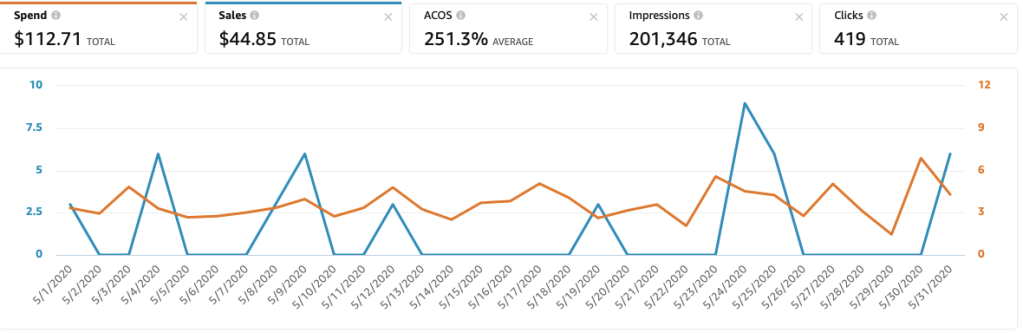
Because I have nothing else to talk about, let’s see how my ads did for the month of May. Right now I’m running ads for four books: All of Nothing, Wherever He Goes, The Years Between Us, and His Frozen Heart. I actually came in ahead last month, making about $60.00 after ad spend. That’s not terrible–breaking even for me so more than acceptable at this point–and I’m aware that it’s more than what some people are making on their books right now.
Before I get into the numbers, I’ll tell you that my daily ad budget is always $5.00, and that my bid per click is always between .25-.35. I never EVER go with Amazon’s suggested bid. I know click bid can depend heavily on genre, and everyone always says how competitive romance is. But I’m not willing to up my bid on the off chance that it will make me more money. Right now all I’m concerned with is tweaking my covers, blurbs, and look inside so that my books are profitable, and my lower bid per click is working. I get impressions and I get clicks and that’s more than enough for now. There is plenty to worry about without hoping Amazon’s suggested bid won’t blow your grocery budget for the month.
My ad spend for the month of May:
Don’t let the spend versus sales fool you. If your books are in KU, the sales don’t include KU page reads. Sales are readers who buy the ebook/paperback. And in this case, I didn’t sell any paperbacks.
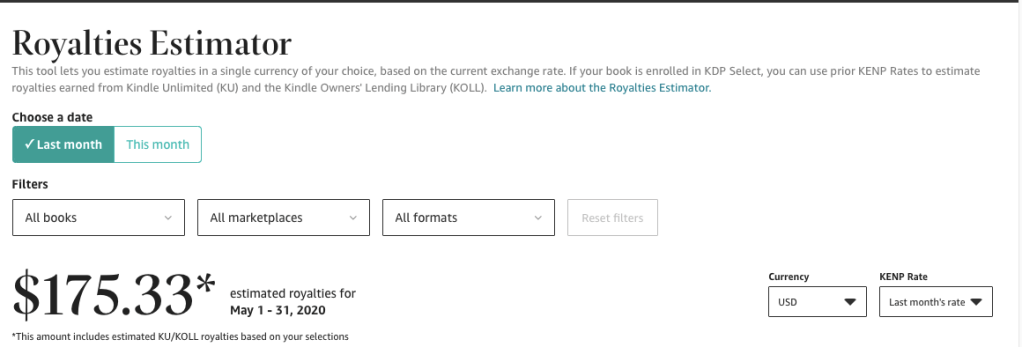
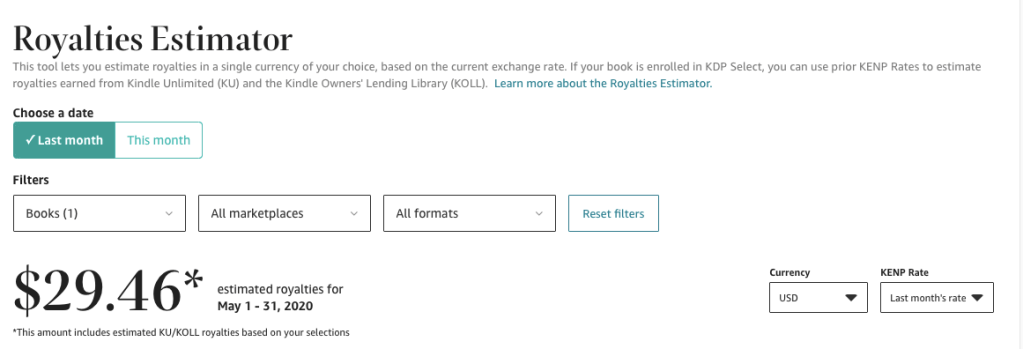
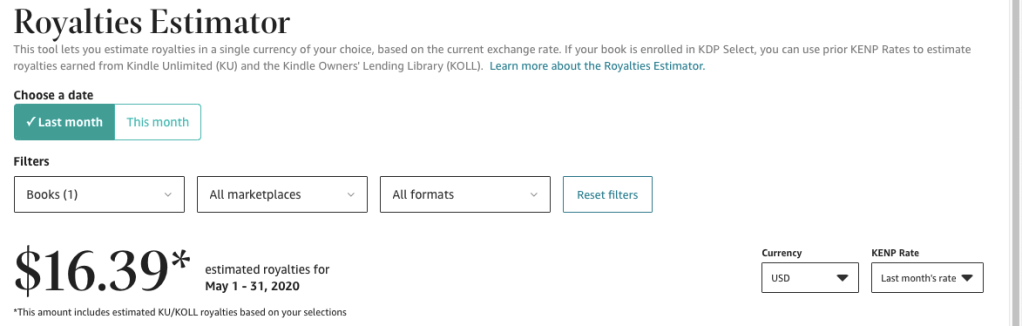
Here are the royalties:
Using the royalties estimator from the KDP reports dashboard is the easiest way to look at your royalties. Some people use BookReport, a Google Chrome extension, but I haven’t put Chrome on my Mac.
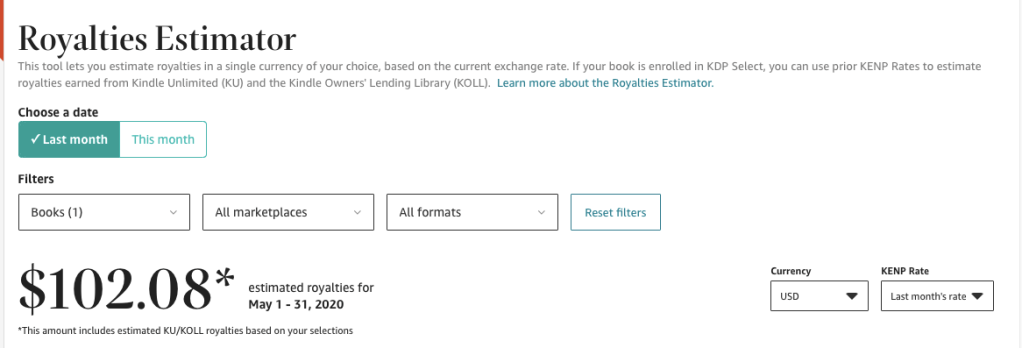
I took screenshots of the royalties vs. ads for each book individually. I don’t normally look at that–so long as I’m not wasting money, I don’t mind which book is making more than the others. You can see All of Nothing made the most–and also spent the most. Wherever He Goes is the unpopular one of the group, and maybe a new blurb could help. But I’ve already rewritten it, and at this point I’m done going back.
My numbers might not add up 100% just because I do make a couple cents here and there on other books, but these are the main four I run ads for. You can see that All of Nothing is the leader in sales. Sales for that book allows me to lose money on ads for the others. Is that smart? Probably not–all your ads should run in the black, but I’m just playing around and experimenting.
I’m happy to see that The Years Between Us is doing better with the new cover and blurb. People are actually reading it and in the past few days I have been selling the ebook; people aren’t only reading it in KU. I wish they’d buy the paperback because the new cover looks gorgeous in print.
Anyway, so that’s how I’ve done for the month of May. So far for June I’m in the black, but just by a few dollars. I may not be making a ton of money, but I’m picking up new readers, and that feels good. The last book in my series launched at the end of May, so I don’t have any reports yet on how my read-through is for the four books. I think next month I may plan a Christmas-in-July promotion and buy a BargainBooksy promo and see if I put His Frozen Heart on sale for .99 if I can get some read-through for that series. I’ll be playing around with ads for the next little while because I won’t have anything coming out for a few months.
What I know I learned from Bryan Cohen’s free ad challenge that he does every once in a while. He gives out such useful information, and he’s even usually around to answer questions. I can’t say enough good things about the guy, and I really encourage you to sign up for his challenge in July. It makes a big difference if you know how to use an ad platform before plunking down the money on experimentation. Trust me, there’s a lot to experiment with (like ad copy) without worrying about wasting money on ad spend because you don’t know what you’re doing. If you want to sign up for the challenge next month, you can find Bryan’s sign up link here. I don’t get anything if you sign up. I learned a lot from his classes and homework, and I know you will too!
Thanks for reading, and I hope you’re all having a wonderful June so far!
By the time you read this, I’ll be done going through my backlist. The loss of some of my Vellum files spurred me on to the idea that if I was going to reformat them to get my files back, I might as well re-edit them too.
While I haven’t written anything fresh in quite some time, I’ve re-edited and reconstructed the Vellum files of seven books. It was a lot of work, but I’m glad I took the time. I found tiny inconsistencies, typos, and in some earlier books, hammered out telling, and for some reason in On the Corner of 1700 Hamilton, lots of passive voice. (That is a weird speculative fiction kind of book, and I’m not sure where my mindset was when I wrote it. The other day someone borrowed it in KU, read one page earning me .01 cent, and returned it [I’m assuming they returned it because they didn’t read anymore.] I can’t say that I blame them any.)
I can see how I’ve grown as a writer and where I can still improve.
But probably the hardest thing for me is finally letting these books go. They are the best they are going to be. It’s a little scary because no writer wants to put subpar work out into the world, and when we put out books with spelling errors, typos, or plot holes that’s what we do.
My anxiety comes from thinking my books have them (even though they could be 100% clean) and I need to let that worry go. I had a moment of panic when I was fixing something in Wherever He Goes. I thought I fixed it and moved on. Later, I went back to reread what I had edited and I discovered autocorrect had changed a word I misspelled to something completely different than what I had intended. Even the word misspelled would have been better than what autocorrect inserted instead.
Suddenly, my life flash before my eyes and I envisioned my whole book full of autocorrected words rendering my pages to a book full of gibberish.
That isn’t likely to happen, but it’s enough to give any author hives. But no matter how many times we go over our books with a fine-tooth comb, chances of putting out a 100% error-free book are slim to none.
There will always be something to change and you get to the point where it’s not a change for the better–it’s only different.
There is a certain peace in knowing these books are as good as I can make them for the skills I have right at this minute. I fully believe that as writers we will never stop growing. We’ll try for twistier plots, more points of view, we’ll get better at breadcrumbing backstory and clues, and we won’t info dump at the beginning of stories. Our eyes will get sharper and we’ll catch more of our own mistakes and we’ll realize we have crutch words and weed them out before handing off our stuff to an editor.
We’ll refine our editing process and grow more efficient. Our first drafts will be cleaner.
When I was editing my Tower City trilogy, I came to two realizations: my writing from two years ago wasn’t as bad as I had thought, but my story (particularly the first book) was just as lackluster as I’d try to deny myself.
To be kind, you can call these books “quiet.” Internal conflict, some stuff going on, but not a lot of character growth, if you know what I mean, and if you don’t, in editor-speak that means not completely formed character arcs. I didn’t understand how to tie in past demons with the present story. What I did know came from instinct and a lifetime of reading romances. Sometimes the “beats” are ingrained and you know by feel what needs to go where. Some might say that’s skill, or talent, but I call it luck and it’s what made Don’t Run Away a half-way decent read as my first contemporary romance book.
In the second book, I had “Let’s meet an ex in a public place” scene like in the first book, and I don’t know if it was bad memory, or if I didn’t care, but at least I stopped that in my other books.
Part of the reformatting included doing a new box set for the trilogy and I wrote a “Where are they now” novella for the end. It was easy to write because I was fortunate to have written what I did in the original books. The novella practically wrote itself.
Now, even though the novella won’t make up for the slow start of book one, at least I can confidently brush my hands of that whole thing. They are re-edited, I changed the covers last year, and all the couples have a new happily ever after. There’s nothing more that I can, or even want, to do with those characters.
They are finally on their own.
Chasing perfect will never end well. Sometimes you’re at a point in your writing life where you can’t give it to yourself no matter how hard you try. Sure, I could write a better book one now, but what is the point when I could use my developing skills to write an entirely new book? If it were part of a ten-book series it might be worth it for the read-through, and if that’s you, then maybe it would be worth your time.
Like anything, your mileage may vary.
Some may see the time I took as a waste, but I disagree. If I found peace of mind in these two and a half months of going back and making sure my books were the best I can do as of Spring 2020, then it was worth it to me, but the trick now is to leave them alone and focus on the new.
My books aren’t dumpster fires. Maybe they aren’t 100% perfect, but no book is. I need to accept that, let my anxiety go that there are things that could be fixed. There probably are, but I need to forget about that and market my books with confidence.
Chasing perfect is an unattainable goal.
Maybe there are tiny fires in the form of an errant apostrophe, or a number I typed out that didn’t need to be, but I need to shrug those little things off, pull up a log, and grab my marshmallows.
A little fire doesn’t have to be a bad thing.
If you want to hear a talk about chasing perfection, Kristine Kathyrn Rusch has a great one she gave at 20booksto50k Vegas last year in 2019.





















 Vania Margene Rheault