October through the end of the year goals.Whatever.

Everyone is doing October/end of year goals, so I thought I would, too.

I don’t have many.

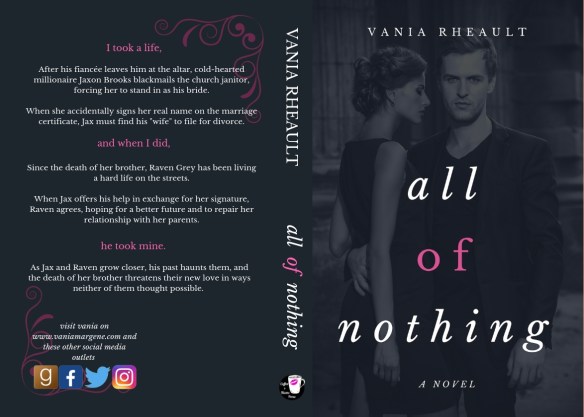
  1. Finish All of Nothing. This includes finishing the editing, writing the blurb, doing the full cover for the paperback, formatting for both Kindle and paperback. Sending it out for betas and hopefully publish by Halloween. It was my target goal from the beginning, with Thanksgiving being the ultimate maximum amount of time I wanted to take. It looks like Halloween is more than doable–at least for the Kindle. Using KDP Print for the paperback takes longer, just for the simple fact ordering and waiting for a proof is a lot more time consuming than it used to be through CreateSpace. If you’re launching a paperback by a certain date, be prepared and give yourself plenty of time for the KDP Print hassle.

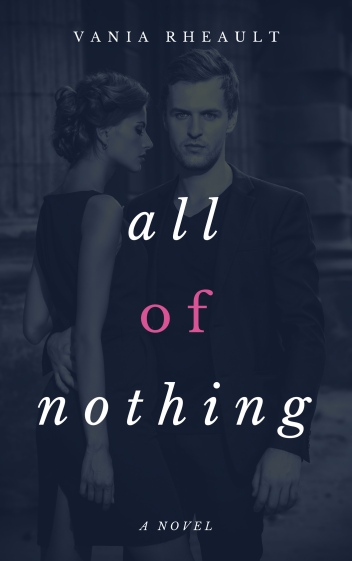
    Here’s the working cover I made in Canva. We’ll see if I stick with it.

    allofnothing
    Made with a Canva template and a photo I purchased from CanstockPhoto, it’s a simple cover which I hope conveys the darkness of the story.  No chick lit for this author. 😛

  2. I have 2,000 words into my next book (a beautiful May/December romance that will be a counter to the dark romance I’m editing now) already written, and a few pages longhand that I need to type up. I would at least like to get the handwritten stuff typed up this month. I would love to get the whole thing written and published by March of next year. I have a bookselling summit I’m attending in May, and the more in my backlist, the better.
  3. I did a Happy Book Reviews feature for Wherever He Goes that I am not terribly impressed with. I’ll do a full blog post on how it turned out. But for now, it’s safe to say, don’t waste your money. If it sounds too good to be true, it probably is.
  4. In my other blog post about marketing, I said I was writing a non-fiction book on self-editing. I’m going to be working hard on that in the coming months, and hopefully have that ready to go by no later than this summer. My fiction comes first, and I want my new book to be ready by the summit, but depending on my health (see number 5) I’d like to get the editing how-to book done by June.
  5. I have carpal tunnel and I’ll be going for a nerve test this Thursday. My carpal tunnel runs from my elbows into my neck, shoulder blades, and back. Meaning, I’m in a ton of pain a lot of the time. I let it go too long. I know. And I’m paying for it now. But the truth is, I’ll more than likely be having surgery and the recovery time for both arms will set me back. I know voice-to-text can be a life-saver to some, and I may still be able to blog that way for a bit, but chances are, I won’t be able to work on my fiction for a while. The break is much needed, but not that wanted. We’ll see how it goes.
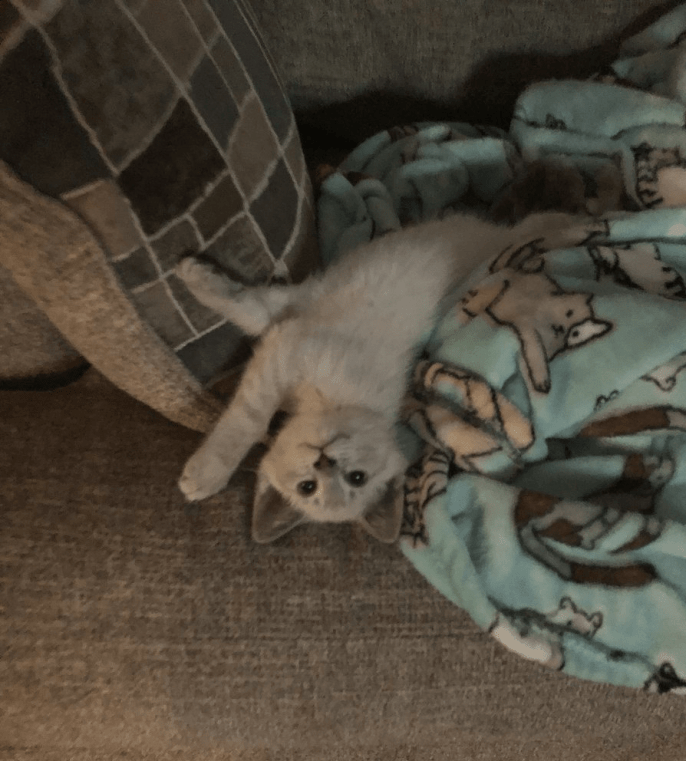
  6. These are lofty goals when I have a new kitty to play with! My husband moved out, and the kids and I replaced him with a new kitten named Blaze. It wasn’t really like that (LOL) but it’s hard to resist playing with her, or snuggling with her when she’s sleeping. She’ll be a good recovery pal. Here’s a pic:

    blaze
    It’s tough not to share pictures of her all the time, so if you follow me over on Instagram, you can see a lot more of her. 🙂

Those are pretty lofty goals for the next few months, but I’m hoping it’s nothing I can’t get accomplished. All of Nothing is the big item on my plate right now, along with keeping this blog going with indie news and writing tips.

Also, since I will be working on my editing book, if there is anything you struggle with when it comes to self-editing LET ME KNOW! I would love love love to include anything and everything indie writers struggle with.

Happy Fall, Everyone!

book and fall leaves

Whine a Little . . . Over There

There’s been lots of whining on Twitter lately. More specifically, authors whining about not seeing books sales. Even more specifically, authors not seeing their books sell.

Maybe it’s because we’re in the dog days of summer, or people aren’t looking forward to school starting, or the crap we’re all going to have to deal with when THE HOLIDAYS start in full-swing October first.Dog Days of Summer

But whatever it is, it needs to stop. Because YOU, and nobody else but you, can make sales happen for your book.

Mostly, this is on Twitter. I can say it louder for the people in the back. TWITTER ISN’T FOR SELLING BOOKS. If you’re a member of Writer Twitter, you’re a member of WRITER Twitter. There’s a reason why it’s called that. Because we’re writers. Join READER Twitter. It’s gotta be there somewhere. Maybe #amreading is wedged between #IhateTrump and #turtlesareweird. If you’re convinced Twitter is the only way to sell books, or it’s the only way you want to try, break into the #amreading crowd. Or try. I’ll leave a light on for ya.

But if you want to take stab at moving books instead of whining about it, explore these ideas. First though, you need to take a look at your book.

  • Cover needs to be decent. Needs to depict the genre, needs to fit in, but stand out (in a good way.) Join an FB cover group and get some critiques. Taking a second look at your cover and if it’s not up to snuff, fix it. It’s killing your sales before they start.
    Books to consider:

    Cover Design and YOU!: Dos, Don’ts, and Choices
    Why Does My Book Not Sell? 20 Simple Fixes (Writer’s Craft)

  • Make your blurb awesome! This is easier said than done. Bryan Cohen is great at this. He teaches webinars and he runs a business doing this. And he makes very good money doing it. But he shares his knowledge, so don’t just moan you don’t know how to do it. Read about it. You’re a writer. Research. Here’s his book. He breaks it down so you can do it, too. With his guidance, I write my blurbs in half an hour. Here’s a Book Description Critique with Bryan Cohen hosted by Reedsy. Watch it.
  • Make sure you have a decent title. No one told me this before I published, and now my very first book has a stupid title I can’t change because I don’t want to waste the money I spent on my ISBN number. If you don’t have any reviews and didn’t purchase your ISBN number, you can change your title. Changing your title and ISBN number will lose you reviews so if you only have one from your best friend Angie, she’ll probably post it again if you republish with a better title.
    Grab some ideas from Dave Chesson; he’s got some good ones.
  • Make sure your “look insides” (first sample pages) are decent. This can make or break you if all the other parts about your book are spot on. If you don’t have a solid POV, if you have typos, if your formatting is messed up, the best cover in the world won’t save you. Try to get your hook within the first few pages of your book so it’s included in the look inside. Turn that browser into a buyer!

Now that we covered that and your book is up to par, you’ll need to ask yourself what you’re doing to help your book sell. Tweeting every day isn’t going to help. So what can you do to spike sales?

  • Are you spending any money?  You have to spend money to make money. I’m not kidding. Lots of people are like, “I don’t have any money to put toward selling my book.” Then you’re not going to sell your books. No business has ever opened that didn’t need seed money. Investors. Start-up money. You buy stock for your shelves, you fork over for rental space. You pay for wages for your employees before you’ve even sold one thing. Your book isn’t any different. Nobody ever went into business for themselves because they needed money yesterday. Starting a business is a lifelong endeavor. What can you put your money toward?

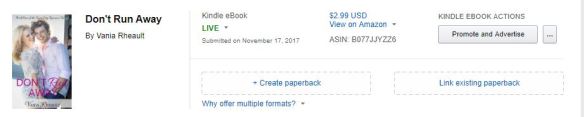
    *Pay for promos. I spent 80 dollars to give away 4,000 copies of Don’t Run Away in a free book promo for FreeBooksy. It got me some reviews, and lots of KU reads for the whole trilogy. I made my money back and then some.

    *Pay for giveaways. Goodreads did away with their free giveaways but because you have to pay, the market for giveaways isn’t so saturated. People have debated as to whether or not it’s a good thing, but I think it is. I haven’t tried them yet, but in the spirit of trying one new thing with each new release, I’ll be trying it when I publish All of Nothing this fall. Read about them here.

    *Pay for ads on Amazon. This isn’t as scary as it sounds. I’ve been blogging about my experience. It won’t break the bank to give it a try, but it’s important to do it correctly. Brian Meeks has a wonderful book about it. Amazon changed the platform a bit, so his instructions are already outdated even though his book is only a year old. But his advice is still as good as gold, and just as valuable.

    *Pay for ads on Facebook. These are trickier than Amazon ads. At least, I’ve read that they are. I haven’t tried Facebook ads, and if you don’t have the money to spare, I would suggest going with Amazon ads first. I’ve spent under five dollars experimenting with Amazon Ads. But if you want to try FB ads, again, do it correctly. Michael Cooper has a super great book about it. It’s important to try ads correctly, otherwise you’ll blow through money, claim they don’t work, and you may write off a great way to let people know about your books!

    *Pay for a blog tour. I used to hear a lot about these two years ago when I joined Twitter, but not so much anymore. You don’t have to pay someone to set up a blog tour, but if you pay a legit person they’ll know the best blogs to submit your book to. I’ve never tried one of these. They’re time-consuming. Either you have to fill out an interview sheet or compose a guest post for that blog. If you’re doing a full tour, that could consist of anywhere between 5 to 20 or even more blog sites. That’s a lot of guest blogging and interviews when maybe you should be writing your next book.

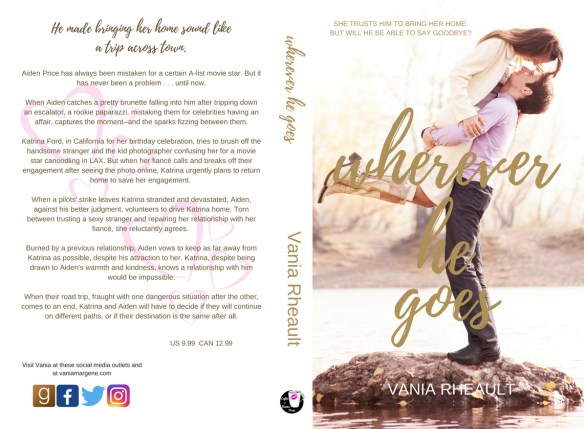
    *Reviews. If you do this in a legitimate fashion, this can be a coup for you. I have not tried it because the service I wanted to try distributes the books to readers through BookFunnel and that goes against KDP Select’s terms of service. I pulled Wherever He Goes out of Select to try this review service, and it comes out September 3rd. It wasn’t doing well in KU anyway, so I didn’t see the harm in trying. I’m going to try Happy Book Reviews. I’ve heard good things and so-so things about results. But if you have a good book with a good blurb and good cover, and the plot/genre isn’t too weird, you may get good results. Give it a shot.

  • Are you writing more books? The best marketing you can do is release new books. Lots of debate on quality versus quantity, but if you just can’t scrape up the cash to put toward your book’s promo, at least writing and releasing is free. *As free as you can get without spending money on cover, editing, etc. I’ve heard you drop off the Amazon algorithms after three months, so you want to release something every three months. Try releasing tie-in novellas. Or just dig in your heels and write the next book. I see lots of people trying to build careers on one book, and that only works if you write a non-fiction book and your career is already based on that book. Readers expect more from you. Keep them happy.
  • Offer to guest blog on other people’s websites in your genre. Ask “up.” Someone in your genre who has more followers than you. Someone whose website gets a bit more traction than yours. This is where your tweeting should come in handy–you’ve made connections, don’t be afraid to ask. Most people would love to host a guest blogger. It frees up their schedule for the week. But make sure your book is up to snuff or they’ll turn you down. And be prepared to giveaway a book. That seems counterproductive to sales, but lots of bloggers want to reward their readers for showing up.
  • Think local. Ask your town’s newspaper’s lifestyle section to do an article on you. If you have local small magazines, ask them to do a profile. Ask your indie bookstore if you can do a signing, or if they’ll sell your book. Heck, maybe get together with a couple of indies in your area and ask Barnes and Noble if they’re willing to do an Indie Night. Asking is hard. We’re introverts at heart, but even if the answer is no, at least you can say you tried.
  • Take a hard look at your book. Besides the cover, the editing, the blurb, the title, ask yourself, is this something someone would want to read? Especially if this is your first book. Indies like to experiment when they’re starting out. We’re finding our niche; we’re finding our passion. Experimenting with your hamster detective series is cool, but can you get sales? Maybe not. So take a hard look at your book before you throw money at it. It may not do any good. And that’s the sad truth. If you can be honest with yourself and say yes, my book has readers, all I have to do is fine them, then good luck!

Whining about lack of sales isn’t going to help you sell books. After a while it becomes annoying, and you end up tarnishing your reputation. If your first book isn’t working, then move on. Write something else. Write something better. We get better at our craft with every book we write.

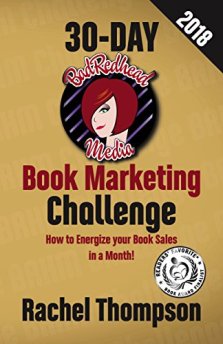
book marketing challengeRachel Thompson says we don’t get traction with our careers until we have at least 6-10 books under our belts. As the self-publishing industry gets more competitive, that number may get higher. If you’d like to read her awesome book about marketing, you can look for it here.

Book sales are subjective. What works for you may not work for someone else.

The best advice I can give you is write well, and publish often. Stay consistent. Build your brand on a genre you love to write.

Sales take time.

Have patience, and good luck!


buy image for blog


Changing Your Book Over From CreateSpace to KDP Print

This is the big bad everyone is talking about–moving your books over.

Do you want to move your books from CreateSpace to KDP print? I think, yes. Because if you’ve been following what CreateSpace has been doing (ie, cutting staff, removing services) then you know that Amazon is in the slow process of getting rid of it. Not that anyone from Amazon has admitted it.

If you’ve been avoiding it because you think it’s going to be hard, don’t worry! It will be fine. I did it just to see how it would go, and I ended up doing half my books.

Let me tell you how.

First, you go to your dashboard on KDP. The one you check when you want to see your lack of sales.

Then, what you need to do is find the corresponding book that you have on Kindle, and choose Create Paperback.

blog going from cs to kdpp5


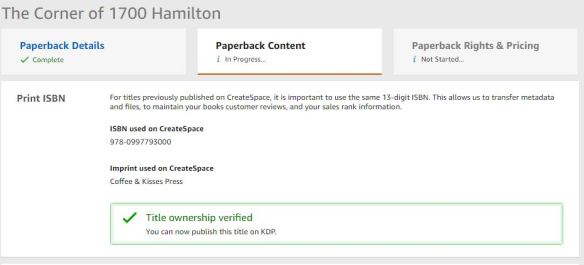
After that, there is a place for you to enter the ISBN number you used for CreateSpace. Log into your CreateSpace account and copy and paste the ISBN number from your paperback into the space.  After you type in the number, you have to hit ENTER, and the yellow button will highlight so you can click it. I don’t have a screenshot of that, but just take my word for it. They tell you in pretty green that yes, you are the owner of the title. 🙂 Thanks, KDP Print!

blog going from cs to kdpp

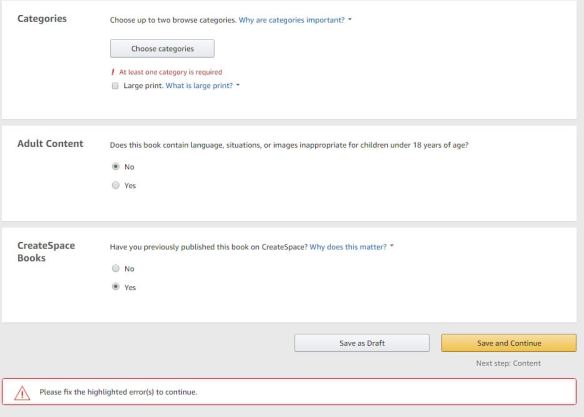
The categories don’t come with your manuscript or your cover, so you need to choose the categories over again. I didn’t, and I got the error message.

blog going from cs to kdpp4

Choose the option “you have published this book on CreateSpace.” That’s the whole point to this exercise.

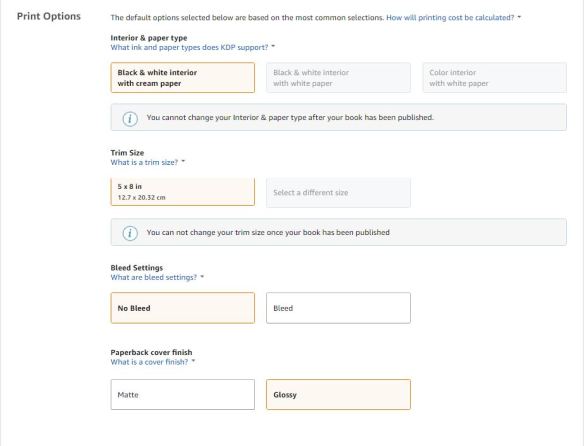
Also, another good thing to know is you can’t change your trim size and your interior since those things are attached to your ISBN number.

blog going from cs to kdpp2

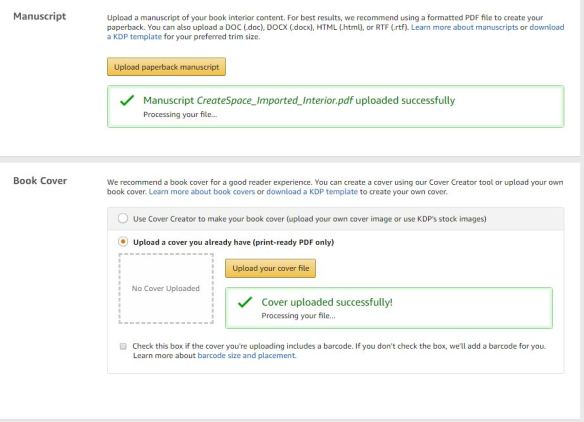
But after that, you’ll see that everything has ported over:

blog going from cs to kdpp3

After the cover and manuscript are processed, you can take a look at it through the online viewer. I open it just to be sure, because KDP Print is a lot more clear on cover and manuscript requirements.

There is one thing I found out the hard way:

If CreateSpace tweaked your cover in any way to make it passable for publication, those changes do not carry over. 

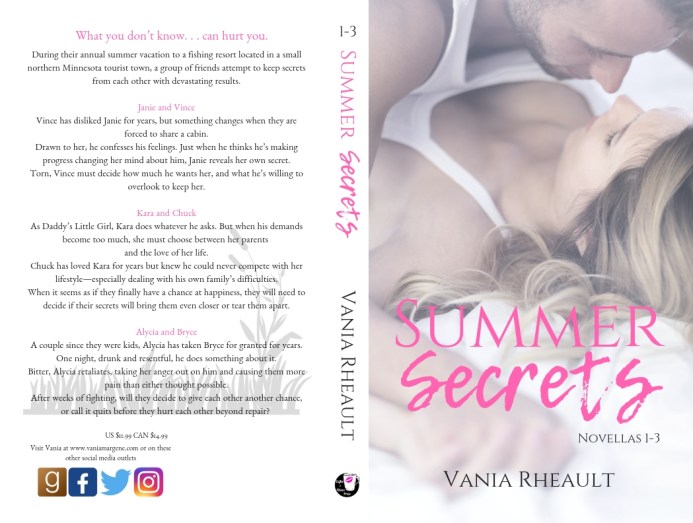
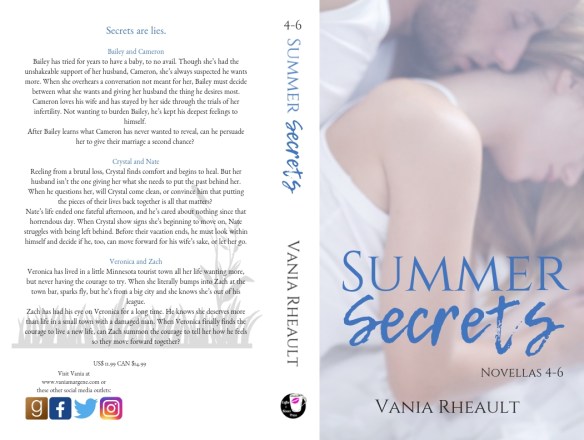
Apparently, when I did my covers for Summer Secrets, I did them wrong, and the lovely customer service people at CreateSpace fixed them for me. They didn’t bother to tell me I was doing them incorrectly. When I did a cover for one of my books in my trilogy, I called them for something completely unrelated, but the rep I spoke with pointed out that error as well. I thought since they were publishable, I wouldn’t have a problem, but I did.

I wouldn’t bring this up except for the fact that I don’t know how may covers CreateSpace helped along with no notice to the author. Is it bad? No, not at all. But if they tweaked your cover and KDP Print tells you something is wrong now, I hope you have the skills to do what CreateSpace did to fix it in the first place. Or if you hired a designer, you’ll have to ask them to make the changes.

Don’t worry if KDP Print tells you something is wrong–they get very precise when pointing out the errors. They won’t leave you guessing, and they let you know right away–in the information bar on the left-hand side of the online viewer.

It was just a surprise to me that KDP Print didn’t approve my covers when CreateSpace had published them.

You won’t know right away if they pass, even if there aren’t any errors in the online viewer–they do go into review, and you’ll get an email saying if they pass or not. And if they don’t, the email will explain why. But it is faster than the 24 hour time period that CreateSpace used to take. I got my emails back in 12 hours. The online viewer is similar to the one on CreateSpace. Sometimes it seems like it will take forever for the viewer to populate your content, but I just hit REFRESH and that seems to do the trick to get it moving.

Don’t forget to hit SAVE AND PUBLISH.

And that’s all there is to it, really. I messed with the insides of 1700, so I ordered a new proof, just to be sure.

The link to order the proof is small, and it’s on the bottom of the page, so you’ll have to keep an eye out for it if you want to order a new proof.

I didn’t mess with the insides of Summer Secrets, so I didn’t order a proof of either of those. Proofs take a lot longer to come than they did using CreateSpace, and author copies, too. Definitely plan extra time into your publishing schedule.

All in all, I was happy with the experience. It will go smoothly for you if don’t have cover issues and if you don’t change anything with the interior. Although, now is a good time to do those changes, if that’s what you were going to do at some point. All you would have to do is upload the new file and replace the ported file from CreateSpace with the file you made changes to.

Always order a proof if you make interior changes, unless you are prepared to flip through every page with the online viewer.

KDP offers instructions and offers advice, and you can read about that here.

Otherwise, there’s not much else to tell you. I plan to do the trilogy soon. Oh, and if you’re selling paperbacks like hotcakes right now, you probably don’t want to do this until your sales die down because as you switch over, your paperbacks aren’t available for purchase.

If you’re worried, try not to be. I was a new author when I did my covers, but I’m better at it now. If you used a cover designer or in any way were more experienced than me when publishing your book, you’ll be just fine.

Jump, don’t be pushed.

Good luck!


buy image for blog


How Free is Self-Publishing?

It costs absolutely nothing to publish a book. Nothing.

free

There are free word processing programs like Google Docs. You can use a library’s internet and computer. Platforms like Draft2Digital and Amazon’s KDP will provide you with some kind of book identification number so you don’t have to buy ISBNs for your books.

All you need to do is write, make a cover in Canva using their free website, use a free for commercial use picture from Pixabay, Pexels, or Unsplash, and you are a published author. All for free.

But when isn’t that a good idea?

Do you know Amazon has over 7 billion books in their Kindle store? And writers publish more every day.

So not only are you competing with everyone you know on Writer Twitter, you are competing with writers who are not on Twitter, big time indies who don’t have much time for social media. You’re competing with traditionally published authors, and those authors range from anywhere between The Big Five to tiny university presses.

You’re competing with writers from the US, Canada, (do you know how many writers I know who live in London, Ontario? A lot!) the UK, Australia, and many other countries.

Over 7 billion books.

Okay. What what is this blog post really about now that I’ve made you feel like crap?

Spending money.

Self-publishing is free.

Until it isn’t.

I do everything myself. For my trilogy, and Wherever He Goes, I wrote them, edited them. I formatted them and did the covers. The orangy hue on the third is my fault. I didn’t have the skill to fix it. It doesn’t look bad on screen, but the paperback could look better. That’s just the way it is, and I accept that.

What can you pay for when you self-publish?

  • Editing
  • Formatting
  • Cover

Those are the three big ones. But we can go further:

  • Beta Readers/Critique Partners/Book Coaches/Book Doulas
  • Blurb writing
  • Reviews/Arc review services like NetGalley
  • Advertising, ie, Facebook ads, Amazon ads, Promotions
  • ISBNs
  • Paperbacks for giveaways
  • Giveaway fees like on Goodreads

No one is saying you have to pay for all of that–or any of it.

It’s up to your discretion how much money you want to pump into your books.

See, this is the problem. No one wants to admit that they publish their books to sell them. Which leads an author not spending one dime on their books.

They are publishing for themselves. I repeat this over and over again like a broken record:

If you only publish for yourself you have no right to complain if your books do not sell.

But if you can admit you want people to pay to read your work then you have to take a hard look at your book.

Is the cover you made yourself doing the job?

Is your blurb up to snuff or is it confusing and off-putting?

Are there typos in the first few pages of the Look Inside?

If you can’t put out quality work yourself, then you’re going to need help.

It’s that simple.

And that difficult because saying you need help is a lot easier than being able to afford said help.

That being said, you can teach yourself how to do these things.

If you just shut down on me, it’s because you don’t want to take the time to learn. That’s okay. I wear clothes every day. That doesn’t mean I want to learn how to sew.

But what I’m trying to tell you is that you must find a happy medium between doing things for yourself and hiring out the help you need to make your book desirable to readers.

Because remember, readers have 7 billion choices.

Listen, my books aren’t pretty. Use the look Inside Feature for any of my books and you’ll see basic formatting. The embellishments are non-existent.

That’s fine. I taught myself enough to get by, and that’s good enough for me.

Readers aren’t going to care if you have fancy chapter headings if your story sucks.

So, being I’ve published a few things, I can suggest where you should put your money–if you have any, or where you should ask for favors from friends–if you have any. Just kidding!

  1. Editing. If you’re a newbie writer, this means a developmental edit as well as a line edit and proofing. Plot holes, flat characters. Developmental editing can be more of a job for a critique partner or someone from your writing group. Ask someone who reads your genre so they have a handle on the tropes and feel for the type of genre your book is in. Once you have a stellar story and a solid look inside sample, you need a good cover.
  2. Cover. Canva.com offers design classes. You need to train your eye and learn what makes a good cover. It can make or break your book. Plus, if you push your book in any way, ads, promos, giveaways, your cover will be the selling point. Look at your genre on Amazon. Look at templates. Try to duplicate them yourself in Canva. You may need to spring for a photo, but that’s not as expensive as you might think. I buy mine on canstockphoto.com for seven dollars apiece. Photos are even cheaper if you buy a credit package.

    A word of warning though. I write romance, and slapping some text onto a smiling couple is a lot different than making a cover for an Urban Fantasy novel. Fantasy, of any kind, requires a certain kind of cover. Negotiating a price with someone on Fiverr is a lot better than publishing a book that does not have an appropriate cover. Your sales will stop before they even start. I’m sorry, but that’s just the way it is.

    Sometimes you can find a pre-made template that’s cheap.

    Sometimes you can even find a photo on a photo site that is already doctored to how you need/want it to be. Set aside hours, days, if not weeks, to click through pictures. I’m barely 20,000 words into my next book and I’m already looking at photos.

  3. Formatting. Formatting for Kindle takes five minutes. All you need to do is set the options in Word so when you upload it into KDP it converts correctly. If you go wide and you use Draft2Digital, you don’t even have to do that. (Smashwords is a different story, and your Word file has to be formatted correctly or it won’t convert through their “meatgrinder” and they won’t publish your book.) Draft2Digital seems easier to work with, but I’m in KDP Select and haven’t used either of those services.


What is the cost of self-publishing? It can cost as much or as little as you want to put into it.

Someone opening a business always needs to invest. Paying for services is investing in your book business.

I used to think that I didn’t want to invest in my books because I may never get that money back. But that was incorrect thinking.

If my books are well-written, have a nice cover, and are formatted as to not turn anyone off from reading it, eventually, I will see that money returned to me by way of sales.

My books will be sold for years and years.  As I slowly make a name for myself, my sales will increase. It will take time, but I’m in it for the long haul, and I have patience.

I’ve put money toward my books by way of taking the time to learn how to do things for myself. I read lots of editing books. I read tons of blog posts about what makes a good cover. I’ve practiced making covers. I’ve learned to format my files. It took time. But time is money. I’ll eventually see dividends on the time I invested in my books.

time is money

It’s a personal choice.


This blog post begins a self-publishing series about how you can do most of these things by yourself if you want, and where to look if you don’t. I’ll give you the resources I used to learn and you can decide for yourself if it’s easier for you to hire out, or if you can’t afford it, where you can spend time learning things on your own.

Look for my next blog post about editing resources.

Thanks for reading!


Thoughts on the RWA

rwa header

I’m a member of the Romance Writers of America. I like being part of a group of people with similar interests. I was especially proud to belong when they stepped up to bat during #cockygate. (For those interested in following along with the hashtag on Twitter, look here.) I feel it’s an organization that has my best interests at heart as a writer and author and wants to help me succeed. In fact, I’ve been a member for a while now, and I haven’t even started to explore all the resources they offer their members.

I was listening to the Sell More Books Show and they featured a blog post by Allison Brennan who left the RWA because she felt like the organization operated more for indie writers than traditionally published romance authors.

While I don’t have a problem with the RWA operating this way because I am an indie author, I did notice this, too, as I paged through the Romance Writers Report. I’ve read articles about marketing, discoverability. How to work with editors and book cover designers. These articles are written with the self-publishing author in mind (trad-pubbed authors don’t have to worry about editing their own books, or hiring their own cover designer). Even in the June issue I have on hand, some of the articles include:

  • Romance Law School is Now in Session: How to include law in your fiction in a realistic manner.
  • Fifty Ways to Show the Spark without the Heat
  • Proofreading Hats

I’m not saying traditionally published authors don’t need how-to articles like these, but I am saying that indie or new writers could find more value in them. I suppose a veteran writer could use the Fifty Ways article for writing prompts, or read the Romance Law School is Now in Session article for ideas on how to write a new series featuring a lawyer. But the Report also features ads, and they are geared to the indie writer–lots of editing, proofreading, and formatting ads no traditional published author is going to need.

So the question is, is this the right move for the RWA?

They want to support all their members, and if indie membership outweighs traditionally published author membership, then perhaps it is a good direction for them to take.

However, it feels like there are more organizations aimed at supporting indie writers than ever before. The Alliance for Independent Authors is very supportive offering an array of services from podcasts to a services directory where an author can find professional editors, cover designers, and formatting professionals. There are other organizations as well, such as the Independent Book Publishers Association.

There is support for us indies. So does Allison have a point? Where do traditionally published authors go for support if they find RWA lacking? Do they even need support? After all, they are where a lot of us hope to be someday. Is the RWA pushing them from the nest because they are ready to fly? Do traditionally published authors get enough writing and publishing support from their publishing houses and their agents? Where do they go for networking opportunities if they are slowly being ousted from the organization?

Allison does make a good point, too: if all the traditionally published authors leave the RWA because they don’t feel RWA has anything more to offer, what becomes of us who look up the traditionally-published authors? Who would judge the RWA contests? Who would be our mentors? Who would be our professional critique partners and our chapter leaders?

But let’s be honest, here, too. If the RWA wants to support writers, and by support, I mean, help them make (more) money, then self-publishing is a viable way to go. At least for romance. (If you want to read about indie romance authors dominating the self-publishing industry, click here.)

To me, it makes a lot of sense for RWA to shift. After all, the distinction between traditional and indie publishing is blurring more and more every day. And a lot of traditionally published authors are still the ones who do a lot for their books: marketing, platform building. Some authors have to set up blog tours, book signings, that kind of thing.

Being a traditionally published author today doesn’t even guarantee you’ll end up on a bookshelf. Maybe a virtual bookshelf, but the chances of seeing your book at Barnes and Noble shrink every day. I took a quick peek at Harlequin’s mail service, and if you subscribed to every line and subscribed to the maximum they mailed you in that line every month, you would receive 86 books a month. It isn’t possible that every book would find shelf space, even for just four weeks.

So what does it mean to be traditionally published? To pass the gatekeepers? Is this Allison’s main guff with RWA supporting indies? Perhaps she wants the RWA to nurture us to being published traditionally. But not one way is going to be the right way for everyone.

The publishing landscape is changing. Maybe Allison Brennan doesn’t want to see it. Maybe she sees indies as her competition, not her colleagues. Maybe she sees herself as better because she’s traditionally published. The problem is, that way of thinking divides indies from the traditionally published authors, and that’s just not the way things are anymore.

One day traditional publishing won’t give Allison what she needs, and then she’ll need the RWA to help her gain her footing in a constantly changing publishing landscape that she’s refused to acknowledge.

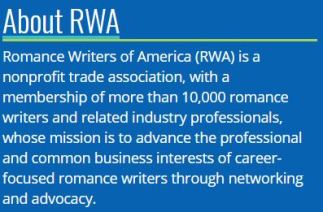
rwa missionRomance writers are all the same. We all want the same thing. To write quality books and make a reader swoon over a happily ever after. And the RWA supports that, no matter how those stories are published.

Issues like #cockygate affect all of us, and we all need an organization like RWA to have our backs.

I’m proud to belong.

How Do You Create Well-Rounded Characters?

From time to time I’ll read a book written by an indie author. I like to see what’s going on in the world of self-publishing and what my competition friends are writing. But I’ve happened upon a common theme–new authors don’t understand the concept of three-dimensional characters. Or if they do, they can’t correctly express it on the page.

What do we mean when we say readers want a well-rounded character?

When you read editing books, (and shame on you if you aren’t!) you’ll read a section on show, not tell. Show me your Female Main Character is tough, don’t just tell me she is.

angry-2878934_1920

This is so much harder than it sounds because you need to begin your character-building from page one and continue the building through the entire book.

Say your FMC is moving, and she drops a box on her foot. Or she’s hanging a picture and she slams her thumb with a hammer. She doesn’t cry. She’s tough. You’ve shown us she can hurt and not give in to tears.

So what?

That means nothing to the reader. We want to know why. Why is she tough?

Did her father beat her mother whenever she cried, so your FMC has trained herself not to cry? Maybe her father beat your FMC for being weak. (Gotta love some horrific backstory, right?)

This makes your character tough. Now we have a reason. How does that tie in with the story? Because it always has to tie in. Your characters’ traits need to blend into the internal conflict and external conflict.

Your characters’ traits are involved in your characters’ emotional growth. And your characters’ emotional growth is propelled forward by the plot.

Readers need the emotional arc to care and invest in your characters, their lives, and their problems.

Let’s have a quick example:

Felicity is starting a new life. She’s tough–life has made her that way. She grew up watching her father beat her mother. Her new apartment in a new city is a fresh start.

She clicks with a mover who delivers her new furniture. He has a temper, and after dating she realizes he has anger management issues. He reminds Felicity of her father. She gets scared of him, though he would never hurt her, or anyone, for that matter.

We have some fabulous internal conflict now:

  1. Felicity is tough on the outside, but as you write her backstory and weave it into the plot, we’ll see she’s actually vulnerable on the inside.
  2. The man she falls in love with brings her back to fearful and unhappy times.
  3. He loves her, but can’t control his rage enough to make her feel safe around him.
  4. She needs to learn that not every man she meets is like her father.
  5. He needs to learn he has to calm down and get help or they have no future.

This isn’t enough for a full plot, of course. Maybe someone is after her (she’s running from something/someone) and she has to trust him despite being scared of him.

Maybe he already knows who she is, and he was assigned to protect her–but he knows if he can’t control his temper, she won’t trust him and he won’t be able to do his job.

At any rate, we have reasons and backstory. (I focused on Felicity, but we see that our MMC has issues as well, and you could make up a fabulous backstory for him, too.) We have an explanation as to why they behave the way they do.

Your characters are people who have traits that have been cultivated by events in their lives.

For your reader, it’s not enough to make your FMC a bitch, or moody, or pissy. Readers need reasons tied to backstory and internal conflict, or all they have is an unlikeable main character.

Even your villains need reasons for being evil. Some of the best villains are characters readers feel sorry for, even relate to.

Jaime Lannister is a good example. Everyone despised him for pushing Bran out the window in A Song of Fire and Ice. But when his hand was cut off in A Storm of Swords, we almost feel sorry for him. And, possibly, everyone wanted a romantic relationship to develop between him and Brienne. Even though there wasn’t a character less deserving. (Oh, that was only me? Sorry. Must be my romantic coming out in me, again.)

Make your character a bitch, and all she is is a bitch. Make your character a bitch with reasons, feelings, and a desire to change, or she’ll lose what matters most, and you have internal conflict and a character growth arc.

The best books are both plot-driven and character-driven.

Readers want change–to go on a journey with your characters. They need internal/emotional growth while going with your characters from point A to point B.

Some of the writers I’ve read have the plot down, but haven’t yet perfected revealing backstory, explaining why the characters behave the way they do.

Sometimes this can be easily solved by getting to know your characters better. Spend time with them. What are their hopes, fears, ambitions, and flaws?

An author will have a difficult time introducing their characters if they don’t know who their own characters are. And if the writer doesn’t know, the reader sure as hell won’t.

Traits, negative or otherwise, does not a well-rounded character make.

For more tips on writing a well-rounded character check out WRITERS HELPING WRITERS®. The assortment of books for traits and emotions can go a long way to helping you figure out who your characters are and how to write them in a way readers can understand and empathize with.


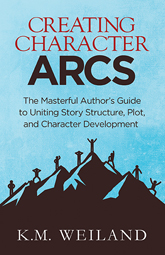
Creating Character Arcs is another good book written by KM Weiland. Check out her blog here. She dishes out fantastic tips on writing, and I own all of her nonfiction books.  Happy writing!
Creating-Character-Arcs-165

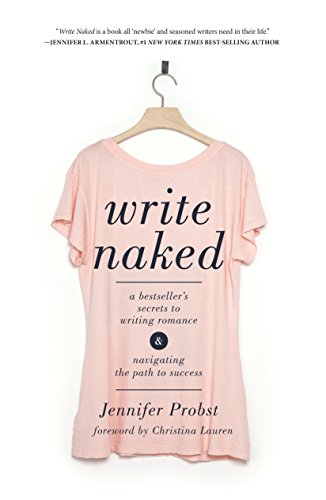
Write Naked: A Bestseller’s Secrets to Writing Romance & Navigating the Path to Success by Jennifer Probst–A book review

Every writer could use a guidebook, a map, perhaps a mentor who can say, “If it were me I do this.”

I read Write Naked: A Bestseller’s Secrets to Writing Romance & Navigating the Path to Success last year, but as a series of book reviews I’m starting for my blog, I pulled it out again and reread some of my favorite chapters.write naked

In Write Naked, Jennifer Probst takes you through from the beginning of her career, when she didn’t think she would make it, to present time, when indeed she has made it, evidence being she’s able to add best-selling author after her name.

It’s gratifying to know that even a best-selling author has fears, flaws, and has made mistakes, but being she has made it to the other side, she also gives us tips and tricks to overcome our fears and if you really want this thing called a writing career, what to do to achieve it.

Some of my favorite chapters include:

Chapter 4
Green With Envy
Jennifer acknowledges that yes, writing is a community, but that community is steeped in jealousy, cruelty, and fear. I see it on Twitter. I read it in a poor book review by another author, sometimes even a malicious review. I see it in the passive-aggressive interactions between me and my other writer friends. Pretty soon you don’t know whom to trust, who really is happy for you and your success. Jennifer writes a chapter on this–a very honest and forthcoming chapter. She says on page 34 of the paperback  . . .  “jealousy . . .  is an endless vicious cycle.” Don’t let it consume you; there will always be someone doing better than you, and you will always be doing better than someone else.

Chapter 5
The Write Path
1. You’ll make mistakes. Costly mistakes.
2. Overnight success is never overnight.
3. Once you reach the top, there is nowhere to go but down.

This may seem like a downer of a chapter, and perhaps it is. Jennifer reminds you that a writer’s journey is tough. There is a reason why writing is compared to running a marathon or climbing a mountain. Your journey takes a ton of preparation–years of writing, years of learning the craft, refining your work. It takes many books. One foot in front of the other for years. Then what do you do when you reach the top of the mountain? When you bury a flagpole in the summit and can call yourself a success? You climb down and do it all over again.

Chapter 8
Trademarks of Bestselling Authors
There are no shortcuts. Sit down, do the work. But what is the work? Jennifer, along with other romance authors, gives you an idea of what it takes to get where they are. This chapter includes writing advice, networking tips, and thinking about writing as a career, not a hobby.

Chapter 12
The Indie Revolution
Jennifer did publish as an indie author, and she gives her readers a few tips on how to publish a good book. You may not like what she has to say, but all of her advice has merit. Probably the biggest takeaway from this chapter is indies need to remember they are writing for readers. You want and need them to like your books. Publish accordingly.

Toward the end of the book, say the last third or fourth, Jennifer goes into what makes a romance book an addicting read. Snappy first lines, lovable characters. Setting up and delivering on a hook, keeping up the sexual tension, keeping your middle from sagging. She touches very briefly on all these and more, so if you think you have any of these issues in your own writing, find other craft books to study with, because these chapters tell you what I know many don’t want to hear – write a good book and keep reader expectations in mind as you write. As with any genre, there are tropes and rules you must follow, or all you’ll do is make your reader mad, and that could result in a bad review.

Jennifer’s last chapter is Happy Endings. She coaches you on how to end your book on the best note possible. But finishing one book isn’t the end! There will always be another book to write, another mountain to climb, another race to run.

Jennifer-Probst-2-1Jennifer won her gold medal, and she tries for another every time she sits down to write.
I recommend reading this book in its entirety, and I pull it out every now and again for a pick-me-up or a reality check.

You can find it on Amazon here.

Thanks for reading! Do you have any books from authors you like to read that give you tips or a much-needed reality check? Let me know!


Happy writing Vania Margene


Your First Novel–Book Review

Writing a novel is daunting. Not only because of how long (many words) a novel can typically be, but because of all the components a novel contains. And if your novel is missing any of those pieces, a reader may not enjoy it which could translate into a poor review. Worse, if you plan to query, if your novel doesn’t have all the parts an agent or acquiring editor is looking for, your book will never be picked up.your first novel

One of the biggest problems a writer can face is writing a book and not knowing their novel is missing pieces.

I have never queried any of my books, and may not ever query anything I write, but I still found Your First Novel to be a very informative read. Written by an agent and a published author, (Ann Rittenberg, Laura Whitcomb, Camille Goldin, Dennis Lehane (Foreword), Your First Novel walks you through the writing and querying process.

The first half of the book explains what a good book needs to contain in order to catch the eye of an agent or editor. If you don’t plan on querying, that’s okay. Your first book still needs to have all those elements or you may find your book has flat characters, not enough of a plot, or both. Remember–your agent wants what a reader wants–a good story told well.

Part two contains information about what to do with your book once it’s written. There are chapters such as What a Literary Agent Does–and Why, and Before You Submit your Manuscript.The authors of this book offer information a writer could find useful if querying for the first time–or helpful hints on what to fix if querying didn’t go how an author envisioned (rejection letters).

There are pieces of advice a writer may take offense to, such as on page 163 of the paperback. The first couple sentences of Chapter 12 read, “As any seasoned novelist will tell you, most first novels are not actually first novels. The real first novel is locked away in a drawer, never to see the light of day.” Or on page 166, “Agents and editors should not be your first readers.”

This book isn’t for a writer with delicate sensibilities or are too precious about their work. The authors of this book want to help you find an agent and get your book published, or self-publish the best book you can. Sometimes that’s more than holding your hand and giving you advice. Sometimes that’s giving you a kick in the ass and telling you to do the work.

Writing a book and signing an agent takes a lot of time and hard work. One of my favorite parts of this book are all the resources it contains. From websites and online articles to more books, there is always something to learn about writing/craft and the publishing industry, and the authors of this book give you a long list to start work through. Keep your ear to the ground–you never know what you’ll hear about that could help your career.

Will this book help you write the best book you can and land an agent? I don’t know, but I do know it’s a good place to start.

Buy Your First Novel on Amazon here.

Other articles on querying:

How Do You Know When You’re Ready to Submit?
By: Chuck Sambuchino

How Do You Know When Your Book is Ready?
BY KRISTINA ADAMS

Are You Ready to Contact an Agent? Take This Short Quiz and Find Out

Basic Rundown of Terms and What They Mean

It seems as if there is a lot of confusion in the way people post things online referring to who is what and what they do, and I see this mostly on Facebook. Let me clear up some confusion for any new writers who may be looking to self-publish in the near future. Here are a few basic terms and companies described.

  • CreateSpace
    CreateSpace is the paperback publishing arm of Amazon. This is where you go to create a paperback of your book, if you’re not choosing one from a myriad of other options. You can find free templates for your cover, and free formatted templates for the interior. They are free. You don’t need an account to download these. They also have a Cover Creator with templates and font/font placement. Choose a photo (available for commercial use) and the creator will create a cover in accordance with your book’s measurements. They also have a CreateSpace Community. If you have questions, they have most likely been answered 1,000 times already.
  • KDP
    KDP stands for Kindle Direct Publishing. This the Kindle arm of Amazon. Some people only publish on Kindle (or e-reader/tablet if they go wide {see definition below}.) The set up is much easier than putting together a paperback. Just format your file, upload your cover art, fill out all the fields for price, etc, and you’re done. Your ebook will be published on Amazon in 12 hours. They say to give them 3-5 days, but it has *never* taken that long.
  • KDP Select
    KDP Select is OPTIONAL. When you enroll your book into this program, you are promising Amazon you are not selling your e-book anywhere else, in three month blocks. That means you are not published on Nook, iBooks, Google Play, Kobo, or anywhere else e-books are sold, including your own website, during that time frame. This does not have anything to do with your paperback, and you don’t have to enroll in Select even if you don’t plan to publish your e-book elsewhere. It seems people use KDP and Select interchangeably, and this is not accurate. If you enroll in Select, your book will be enrolled in Kindle Unlimited, or KU. Readers with KU subscriptions can read your book as part of their subscription costs, and Amazon will still pay you for the page reads. If you want to know more about Kindle Unlimited, look here. You can unenroll any time, but KDP makes you finish out your three months, so plan ahead if you want to begin selling your books on other platforms.
  • KDP Print
    KDP Print is the paperback arm of Kindle Direct Publishing. With CreateSpace closing their online store and the creation of KDP Print, it is rumored that eventually Amazon will shut down CreateSpace. Why have two services doing the same thing? I’ve looked around KDP Print, and the submission process is similar. Even the downloadable templates are the same. The only difference is how your purchase your author copies. There was a lot of complaining at first, because KDP Print didn’t offer the same things as CreateSpace does. They are slowly changing that, though, and to me, that’s another indication that soon you won’t have a choice between the two. I only hope their customer service remains the same. I’ve had to call CreateSpace customer service on occasion, and I have always received polite and helpful service.
  • Going Wide
    Going wide means that you are not selling your e-books only on Amazon. That’s it. Lots of people don’t understand what this means, or they get confused because they don’t realize there is more than one place to sell books. There are a lot of opinions on this topic and you need to do what’s best for you and your writing and marketing plan. Currently, I’m in Select, but I feel as I add more to my backlist, I will expand. It’s never good to have all your eggs in one basket, but it may be a while before I have more than one egg.You have a couple options on how to go wide: You can upload your file to all the places yourself. Kobo recommends you upload directly to them so you can take advantage of marketing opportunities. But you can’t upload directly to iBooks unless you have a Mac and can download the necessary apps. Most people use a 3rd party aggregator such as Draft2Digital to distribute their e-books. But be aware if you do this, your royalties are lower. You pay D2D to distribute, but then you also pay the vendor for selling your book.
  • IngramSpark
    IngramSpark is the other company indies use to publish their paperbacks. They have better distribution (CreateSpace uses them to distribute) and The Alliance for Independent Authors suggests you use CreateSpace to sell your book on Amazon and use IngramSpark for other distribution. CreateSpace will give you a free ISBN number, which is why a lot of indies go that route, and CreateSpace is free (besides taking their cut of your royalties) and IngramSpark is not. Also, IngramSpark makes you purchase your ISBN through Bowker. If you decide to purchase one from Bowker, however, you can use that one for both IngramSpark and CreateSpace. That is another personal choice, and you will have to do your research and see what is best for you. If you plan to do any book signings, IngramSpark is the way to go. That way a Barnes and Noble can order your book from IngramSpark and return any that you do not sell at your signing. The cost is on you, for returned books, but bookstores do not like to deal with CreateSpace, as they view Amazon as a competitor.
  • BookBaby, Lulu
    If it all seems too much for you and you just want to upload your book and walk away, there are reputable self-publishing companies who will help you. Though I haven’t used BookBaby or Lulu, I have heard they treat you well, and don’t pressure you to buy services and products you can’t afford. Be aware that if a company offers “editing” that they do a light proofread or line edit only, and if you want developmental editing or a deeper sweep of your MS, you will need to hire that out before you submit your book to these companies. These companies are legitimate as far as I am aware. Joanna Penn even had the founder of BookBaby on as a guest on her podcast, and Joanna would never endorse a company that is not on the up-and-up. She is a member of the Alliance for Independent Authors and they are committed to helping the indie-publishing industry.These are not to be confused with other self-publishing companies run by Author Solutions. Companies such as Author House, Xlibris, and iUniverse are listed on the Writer Beware website, and you should use extreme caution when deciding with whom you will publish.

    Thanks for reading this quick guide. If you’re new to the writing and publishing scene, it may seem overwhelming, and there is never a lack of information on the internet. As always, check and double-check before you make any decisions, and always, always, be careful if you decide to pay someone for a service. It’s nice to think you can trust people you meet online, but in reality, the only person you can, and should, trust is yourself.

    Tell me what you think! And let me know how I can help.

Happy writing Vania Margene

Results of my ad with Freebooksy

I figured with a few books out now, I should do a little marketing. I’ve been against it, claiming I needed a backlist before I started putting money into my career, but I thought since my trilogy was done, I could do a little promotion.

I’ve heard about various book marketing websites where you pay for exposure, and that’s what Freebooksy is. Essentially, you’re paying to advertise your book in their newsletter for one day. There are other promotions run by the people of Freebooksy if you don’t want to to go free with your book, but I did because 1) it didn’t bother me to give my book away and 2) I was hoping for a little read-through since the other two books were available.

My trilogy is enrolled in KDP Select, and I had never used any of my free days for any of my books before, so I went ahead and chose five days for my book to be free, then I went on Freebooksy and chose a day that I wanted my book in their newsletter. In the future, if I do this again, I’ll plan ahead to give myself time to promote the promotion.

A rep reached out to me, and she was very nice, but she wanted to put my book in the sweet category romance newsletter. I replied that it didn’t belong there as the book had four open door sex scenes. I’m not sure why she wanted to do that, unless she mistook my cover. Nikki and Dane do look cute together, but I didn’t choose to put a steamy couple on the cover because there is a fine line between contemporary romance with sex, and erotica. I didn’t want anyone mistaking my trilogy for erotica. I’ve written erotica, had my “taste” so to speak, and I’m more comfortable writing contemporary romance.

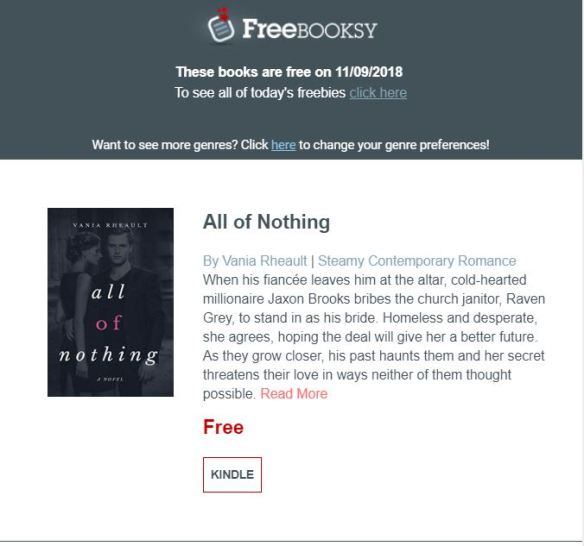
Anyway, this is what the ad looked like that went into their newsletter:

freebooksyad

You’re the one who writes the blurb, and I was afraid I didn’t spend enough time on it. You only get so many characters, and it’s difficult to try to convey what the book is about and still make it interesting in that short space.

My book was free from February 6th to the 10th. I started getting downloads even before my book went out in the newsletter. In total, while my book was free, I gave away 4,458. Between February 6th and today, February 15th, I have sold fifteen of Book 2 and six of Book 3, so you can see there was a small amount of buy-through (not necessarily read-through), and I lowered the prices of those books to .99 to go with the free promotion. Also, my page reads for Kindle Unlimited for all my titles went up from 0 to this:

page reads for KU

It’s not the best, of course, since even all those lines only represent $25.00 in sales. If you do the math, that’s a horrible ROI, at least, on paper.

Return on investment comes in many different forms, monetary being only one of them. I’m hoping now that I’ve given away so many books, people will remember my name, I’ll begin to foster some lifelong readers for future books.

My sales ranking did go up for a little bit, and I can give you a snapshot of those, though I didn’t take a picture every time my book moved up in ranks. And as everyone congratulated me, going up in rank in *free* books looks nice, but it’s not the same as going up in the paid lists.

awesome stats!3

These are the best stats the book got. I don’t know if it did much more than earn me a few bragging rights, but there it is.

Amazon did a nice thing, too and put my books together in an ad on my Author page.

tower city box set

You can’t buy them that way–I haven’t created the box set yet, and that is on my to-do list after I figure out my stupid cover for book three. (Yeah, still wrestling with it to get it exactly how I want it in paperback.)

If you were to ask me the best part about this whole promotion thing, I would have to say that it’s that people are starting to read my work. We all want people to read our stuff, but when they actually do, it’s nerve-wracking. So far I’ve been getting decent reviews. They’ve been saying my editing is solid, and there hasn’t been a complaint about formatting, which is a relief since I do all my own formatting myself.

criticism-3083100_1920

Overall, I would say the experience was a positive one.

If I were to give any advice to someone doing this I would say:

  1. Have more than one book out. I did prove that if you spend money advertising one book, you’re really advertising your whole backlist. Not many people bought books 2 and 3 who downloaded book 1, but it was enough I was happy they were available.
  2. Having a good cover is no joke. It doesn’t seem like a big deal when no one is looking at your books, but the minute you realize people are going to be choosing your book among a selection, suddenly you’re hoping it’s good enough. Be sure it is.
  3. Have a decent blurb. I shortened mine from what I wrote for Amazon, and I worried I didn’t spend enough time on it. Had I spent more time on it, maybe I could have gotten even more downloads.
  4. Have people willing to spread the word. I don’t know how many downloads came from my Twitter followers, or my followers willing to tweet about it. I don’t know how many downloads came from the people who liked my FB Author Page. I was also naughty and told everyone on my personal FB page that my book was free, and I know it’s against TOS to do that. I only did it once, on the day the newsletter went out. And I was lucky a few people shared that post.

I won’t be doing this again anytime soon, but it was fun to try something new and to get my feet wet. A little snowflake can cause an avalanche, and I’m hoping this is true in my case. But now that my trilogy is over and done, I need to relegate it to my backlist and move forward. I’m 31,000 words into a new WIP, and I can’t wait to share with you!

Happy writing Vania Margene