Thursday Thoughts: Social Media

1,396 words
7 minutes read time

sell phone with chalk drawings depicting social media icons like cloud, envelope, speaking bubble and envelope. different colors: yellow, teal, and purple. text says, thursday thoughts: social media

So, a couple things caught my eye this morning while I was having coffee trying to wake up. Thursdays are my Mondays and I don’t always handle the mornings as gracefully as I should. Becca Syme says maybe not opening social media (or checking your sales dashboard) the minute you open your eyes could help, but for now this is my way of easing into my day.

The first thing I saw this morning was this lovely Thread by Holly June Smith (typed out in Alt text):
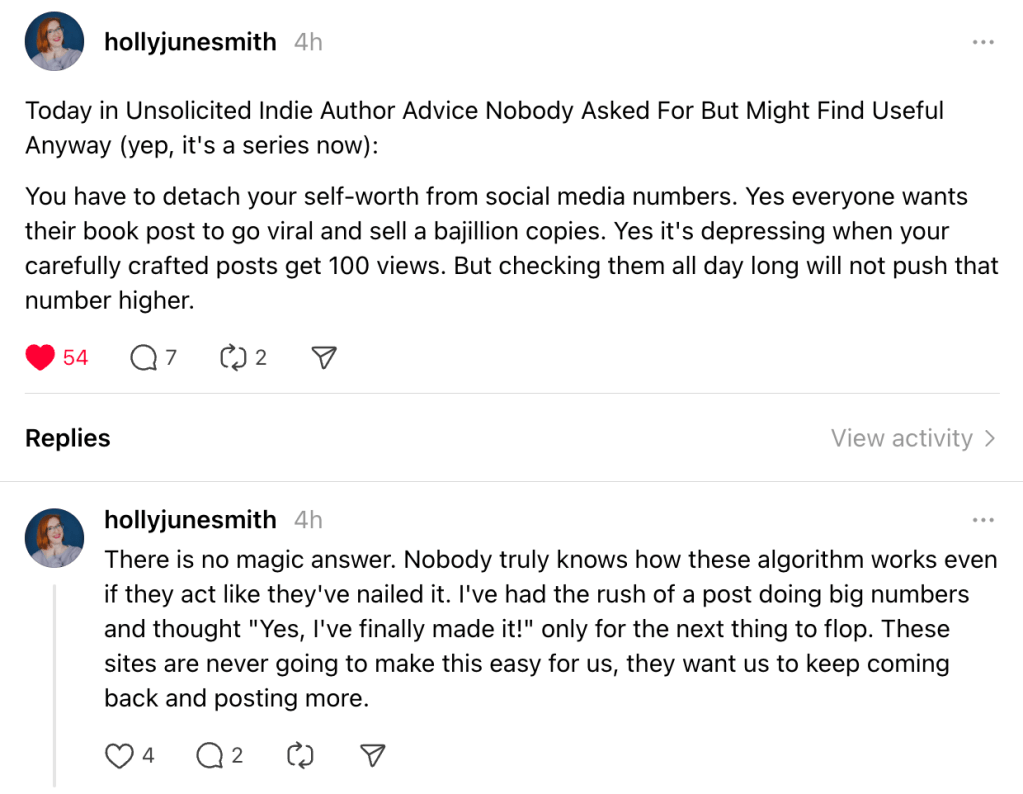
Snapshot of a thread:

Hollyjunesmith
Today in Unsolicited Indie Author Advice Nobody Asked For But Might Find Useful Anyway (yep, it's a series now):
You have to detach your self-worth from social media numbers. Yes everyone wants their book post to go viral and sell a bajillion copies. Yes it's depressing when your carefully crafted posts get 100 views. But checking them all day long will not push that number higher.
There is no magic answer. Nobody truly knows how these algorithm works even if they act like they've nailed it. I've had the rush of a post doing big numbers and thought "Yes, I've finally made it!" only for the next thing to flop. These sites are never going to make this easy for us, they want us to keep coming back and posting more.
Snapshot of a Thread:

Hollyjunesmith
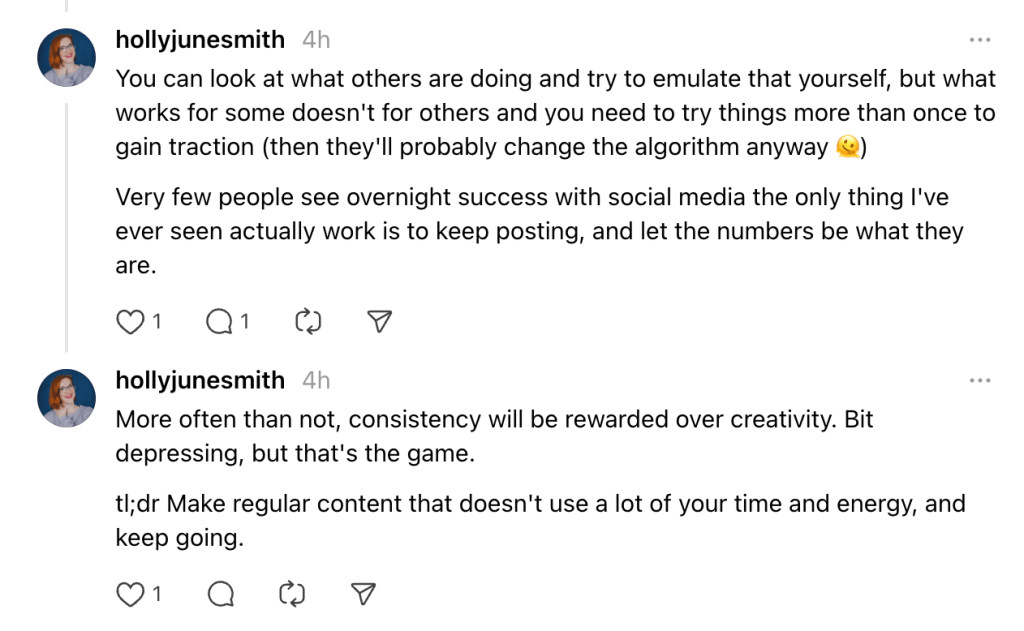
You can look at what others are doing and try to emulate that yourself, but what works for some doesn't for others and you need to try things more than once to gain traction (then they'll probably change the algorithm anyway 🫠)
Very few people see overnight success with social media the only thing I've ever seen actually work is to keep posting, and let the numbers be what they are.
More often than not, consistency will be rewarded over creativity. Bit depressing, but that's the game.

tl;dr Make regular content that doesn't use a lot of your time and energy, and keep going.

I really love this and what I needed to hear because underneath all the blog posts I write about doing better, complaining about low views when I do actually post, and just overall wondering if social media really moves the needle at all, is the fact I have a really difficult time posting. Even on my personal Facebook profile, I rarely post anything. I don’t care much about “checking in” when I go somewhere or telling people about my day. I don’t take pictures of my breakfast, and if I take a picture of a boozy drink like the one I ordered last night when I went out with my sister…
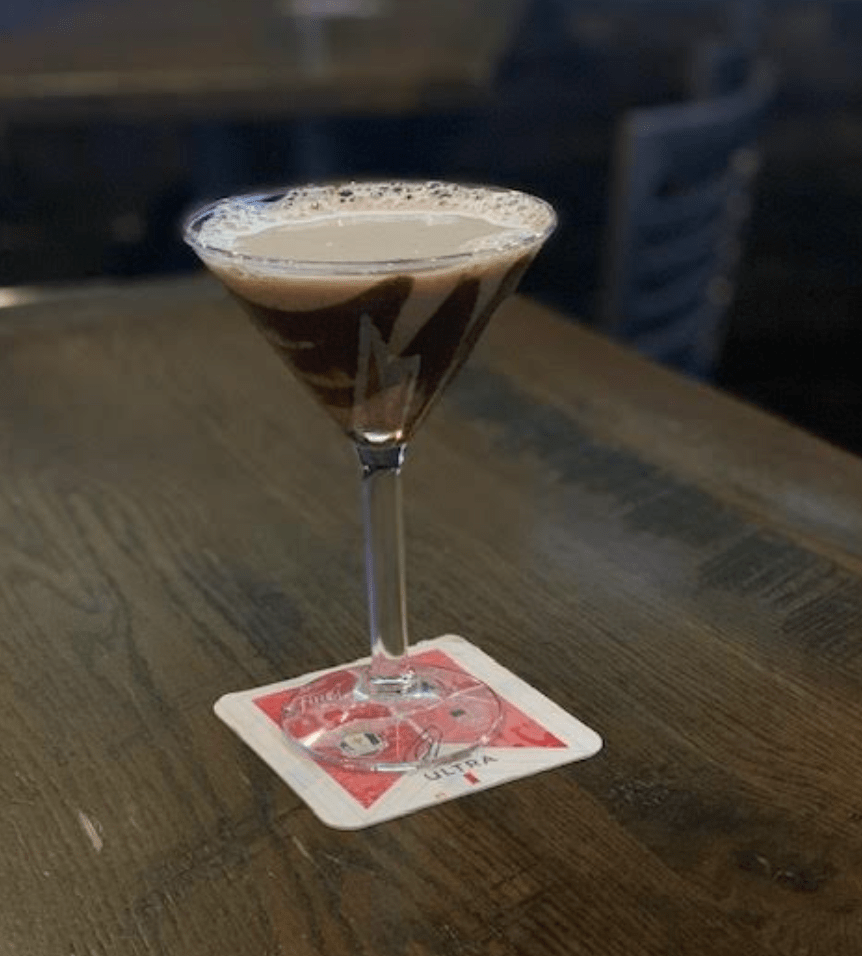
Southtown Pourhouse, Fargo, ND

…I usually forget to post it and delete it off my phone later. I learned years ago on Twitter that followers don’t add up to a whole lot.

Then right after I saw Holly June’s perfect thread I read someone’s bragging about her social media growth. It made me feel crappy for about two minutes because while she can brag about how quickly her account grew, I have a lot of things I’m proud of that (in my opinion) are more important than that.

If you ever feel down because your social media growth isn’t what you want it to be, remember what’s important. Here’s a list and you are welcome to print it out and tape it somewhere to remind yourself that there are more important things than follower count.
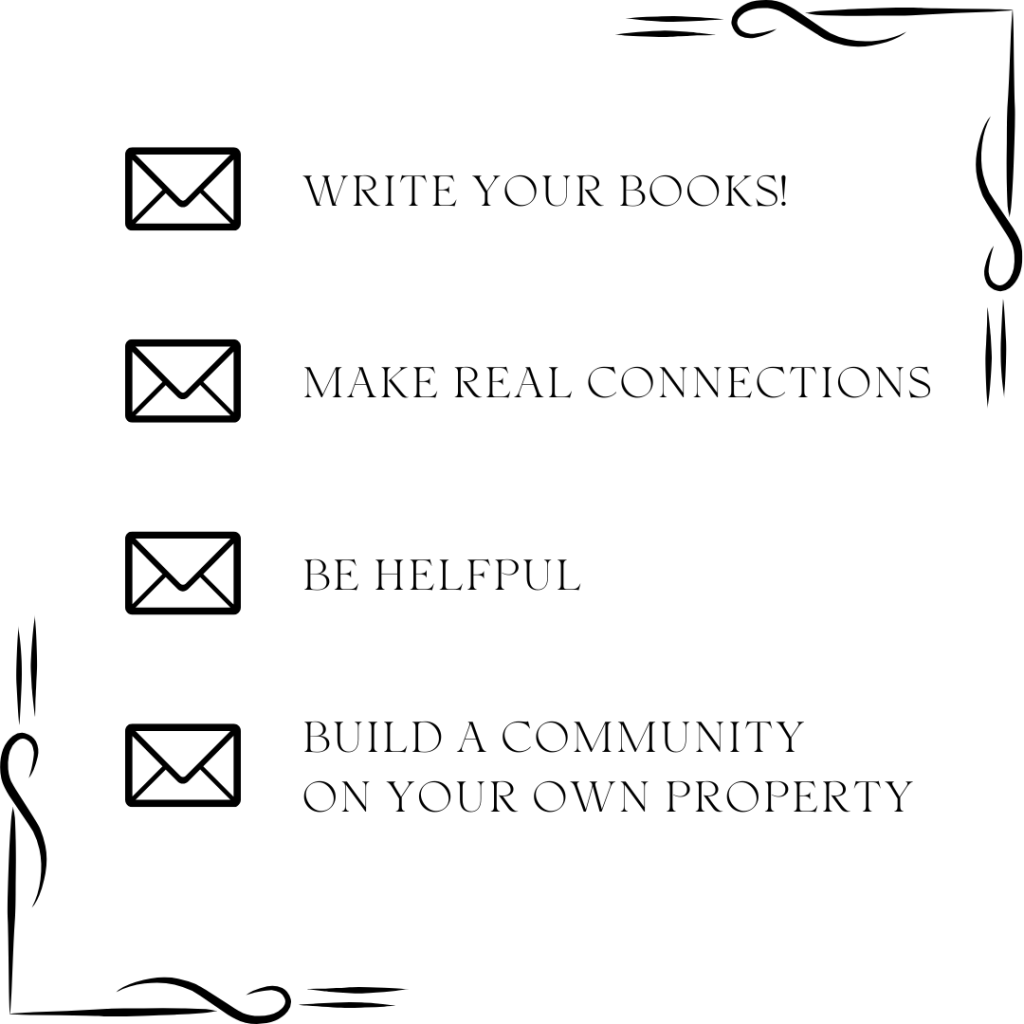
write your books
make real connections
be helpful
build a community on your own property

each with an envelop  black filigree in corners of graphic

Write your books!
Remember why you got into this game to begin with. Everyone is talking about what will happen when TikTok gets banned, and when you have 40k followers and use that platform to sell books, yeah, it’s going to be a devastating development. I’m still pretty optimistic that TikTok won’t go away anytime soon (I’ll believe it when I see it), but social media platforms and the billionaires who own them are fickle beasts and one way to control that is to keep your eyes on your own paper and write your books. Your books will always be there no matter what kind of social media disappears and what takes its place. I’d rather say I wrote three books this year than say I gained 50 followers or whatever. Remember what’s important. Besides, even if you do have a ton of followers, they can’t buy what’s not there.

Make real connections.
Personally, the only reason I know of to have social media is to make personal, genuine connections. Obviously, 100% of my online friends I’ve met through social media. Though, some have reached out to me through this blog and we stay in touch through email or the messages part of a platform like Instagram. Network with others in your genre, build bridges with those you can help and who can help you. That’s what social media is really for. (I’ve said for years if you’re not connecting with other authors and using it to find out important book news, you’re using Facebook wrong.) I’ve been friends with a handful of people for several years that I met on Twitter and I wouldn’t have met them if I hadn’t be a part of that platform.

Be helpful.
It’s going to sound dumb, but helping my friends and other authors is probably the most important part of this whole thing. I learned how to do book covers, I have Vellum and learned how to use it. Now I help other authors who can’t afford to hire out those services. I edit for people when I can. I beta read. I like helping people and between that and writing my books, publishing them and hearing feedback from readers that they loved the story, those are the two most important reasons why I keep writing and publishing. It’s why I keep coming back to this blog every Monday. Just the other day I got a message on Instagram from someone who thanked me for writing the Canva tutorial on how to make a full paperback wrap. I’d rather have someone reach out and thank me for giving her the tools she needed to publish her book than a million followers.

Build a community on property you own.
I can’t stress this enough. Like the future of TikTok and what Musk did with Twitter, you never know the outcome of some of these platforms. Some seem to be around to stay, but for every platform that hangs on, there are more that don’t like MySpace and Google +. As an author, even if you don’t want to hear it, build your reading community on land you own and that way it doesn’t matter what social media does or doesn’t do. Create a website, blog on it if you want so you can build SEO. Start a newsletter. Collect those email addresses and back them up often so no matter what happens to your aggregator, your readers are yours to keep. Sometimes we put our energy into the wrong place. I’m not saying building a following anywhere, like TT or your Facebook author page, is a bad move, but also have a plan B, because just like we say about Bezos, they don’t care about you. The last thing Mark Zuckerberg cares about is your book business. You have to take it upon yourself to find a way to stay in touch with your readers that doesn’t depend on anyone else. If you have an FB page, frequently remind them to sign up for your blog or newsletter or as an alternative, tell them to follow your author page on Amazon. Amazon may not be around forever either, but if they don’t want to give you their email address, I think a follow over there is the next best thing. Now that Zuck owns Instagram, Threads, and Facebook, when their servers go down, ALL that goes down. Having a way to reach your readers that doesn’t depend on someone else is a must. It really is.

You can get down looking at other authors’ follower counts, but behind the scenes, those followers might not be doing anything for them anyway. I know my followers on Twitter didn’t, but I also made friends and that’s what really counts. Post if you want, find joy in sharing your work with others. I’m not saying having a social media account and trying to gain followers isn’t valid, it can be in this world of being online, but it’s definitely not the end all be all of your publishing journey. I have to remind myself of that when I see others’ social media accounts exploding and mine is a stagnant mess. But I’ve accomplished a lot in the past year. I’ve finished a 6-book series and started publishing those books. I’m editing a standalone that sounds so good, and the cover I’m tweaking is a perfect match. I’ve picked up a reading and formatting project I’m going to start working on soon.

I’m on social media. I like talking to other authors, talking shop, supporting them in bite-sized Threads pieces. I’m trying to like posting on my FB author page, even if my reach is bad and my engagement isn’t any better. But with anything, what you put into it is what you’ll get out of it, so I’ll keep posting my favorite lines out of my books, talking about my books, and my life as an author. If those posts find fans, they do, and if not, that’s okay. I’ll keep editing Loss and Damages, and it will be a solid addition to the backlist I’ve written over the years.

And unless I’m starving, my breakfast won’t have anything to do with it.

Come back on Monday. I’ll have my usual post and I’ll be talking about the 2025 Written Word Media publishing predictions. Have a good weekend!

Thursday Author Update

Words: 1539
Time to read: 8 minutes

I thought I would write quick update being that this will be the last one of 2023. Next Monday on Christmas Day I’ll post my year-end recap and on New Year’s Day, I’ve decided to take the day off. After that, I’ll post what I want to accomplish in 2024 and fall back into my usual posting schedule.

Mainly all I’ve been doing is editing my King’s Crossing series. I got through number one and added almost two thousand words. Some of the scenes were sparse and I filled them in. That is what is happening with book two–I’m only halfway through and have already added 1500 words. It’s really interesting reading these since they were the first books I wrote when I switched to first person, but not only that, I can tell I pantsed a lot of the plot (she just said what?!). I’m going slower than I’d like, but I have to make sure these are the way I want them to be before I publish. Like my rockstars, I’m not going back to edit them ever again, and though I know perfection isn’t obtainable, I want to make sure they are done to the best of my ability. So even though I said I would like to start publishing them in March, I might not be able to do that. I was hoping to get through each book in two weeks’ time, but there are some chapters that are so long that it takes me days to get through them.

Which leads me to this question: How long should a chapter be?

My most recent chapter I edited was 14,000 words long. There is one chapter in one of the later books that is 21,000 words long, and no, I didn’t accidentally add a zero.

When I started with the idea of dual POV, I didn’t think much beyond that I simply knew what it was, that’s how contemporary romances were being written and that they were selling. I had read books in dual POV like Sylvia Day’s Crossfire Series, and I never thought much about length of chapters. As long as there is stuff going on that moves the plot along, and the chapters are fast-paced and don’t drag, why should it matter how long a chapter is? I’ve read a couple books where the book is “dual” but we don’t hear from the male POV for chapters into the book. There was one book I read that took so long to get to his, I wasn’t even sure if his POV was included and I almost did not finish (DNF). I like the man’s POV more than the woman’s and I always have. I think that reflects in my writing too, where I wouldn’t be surprised if there is more male POV in my books than female. Writing that made me curious, and here’s the breakdown of A Heartache for Christmas:

Sawyer’s POV: 54,114
Chapter one, 1,611
Chapter three, 3,681
Chapter five, 8,152
Chapter seven, 7,266
Chapter nine, 4,894
Chapter eleven, 10,691
Chapter thirteen, 4,354
Chapter fifteen, 10,305
Chapter seventeen, 3,160

Evie’s POV: 43,050
Chapter two, 878
Chapter four, 5,907
Chapter six, 4,355
Chapter eight, 6,302
Chapter ten, 6,772
Chapter twelve, 8,930
Chapter fourteen, 2,750
Chapter sixteen, 7,156

As you can see, I started writing long chapters and never stopped. I gave Sawyer 11,064 more words, but in this case, it makes sense because he was solving a mystery and needed the page time. This also goes along with how I used to write my 3rd person books. I never wrote in chapters, only scene breaks, and then I would chop up my book in editing. I couldn’t think in chapters and maybe I still don’t. I end a POV when it needs to be ended and not any sooner to stay in line with some arbitrary chapter-length rule. Because if you have a POV that needs five chapters to be told, why are you cutting up that POV? It doesn’t make any sense, but then, I guess you don’t have a 95k word book with only sixteen chapters in it. Is there a wrong way? I think the only wrong way cutting up something into such small parts is if the reader doesn’t have time to get invested. Your readers have to care about your characters–that’s nonnegotiable. They can’t do that if they’re not given the time to do so.

Anyway, so when I’m dealing with a 14,000 word chapter where parts need to be beefed up a bit here and there and then I have to go back and read, not only to make sure I didn’t add any typos but to make sure that what I added blends into what was previously there and what came before it, then yeah, the editing process slows way down. Unfortunately. But, on the bright side, I am still loving these books, and I’m enjoying the process. These will probably be the biggest project I’ll ever tackle. I’m not really interested in writing this big of a project again, and I have no idea how these are going to be received. I hope these sell well, even boost-my-career-to-the-next-level well, but these will take a time and money commitment from a potential reader and you just never know. No one wants to write books that no one will read, and there are no guarantees.

As for what else I’m doing, that series will consume all my attention, my every free second, until they’re done. I’m still aware I need to redo their covers too, as the more I read these books the more convinced I am that the covers they have now don’t and won’t do them justice. I’ve been playing with hiring GetCovers to do them. They are inexpensive and after I get my tax refund in February could afford to cover six books, but I’ve heard you get the best results if you find the elements (stock photos) you want them to use. Finding the male models is what takes the longest and if I’m going to do that on my own, I might as well do the whole thing myself. But I have plenty of time to play with that–I just need to remind myself that experimenting with cover concepts is just as important as the editing. Thank God the blurbs are done, though I’ll go over them one more to be sure they sound okay.

Be sure to check next week for my year-end recap. My rockstars boosted me up a bit, so hopefully I’ll have more to report. I hope you all have a wonderful Christmas if you celebrate! I’m having my sister and ex-husband over and I’m cooking turkey, cheesy hashbrowns (we had mashed potatoes and gravy for Thanksgiving), green bean casserole, and the yummy cheddar biscuits from Red Lobster you can buy as a mix. It will be a small meal, but difficult to orchestrate as everything needs oven time and I only have one. Oh well. It will work out. I managed on Thanksgiving.

One last thing before I sign off for this week…there has been lots said about Bryan Cohen and his free Amazon ads course that he hosts. Some call him a scammer and only wants to recruit people into his Amazon Ads School, some say he doesn’t know what he’s talking about when it comes to Amazon ads, (calling his method throwing spaghetti at the wall and seeing what sticks) some say if he’s not selling books not to listen to him (something I don’t believe because a lot more goes into selling books than knowing how to use an ad platform) but I’ve joined in with the challenge many times, and if you want a free way to learn Amazon ads, Bryan is the one to teach you to do it. There are many strategies to experiment with when it comes to Amazon ads, or any ad platform for that matter, and Bryan teaches you one way. For free. He goes into a lot more than just how to set up an ad. He goes through and makes sure you understand if your book is ready to throw money at it (and a lot of times people find out the answer is no) and teaches you how to write hooks and more. I’m not saying his way is the end-all, be-all way. There are plenty of people out there who do ads like Robert Ryan, Janet Margo, and Ricardo Fayet (from Reedsy), but if you join in with the challenge, you have a ton of help and people to bounce ideas off of in the Facebook group. You can use Bryan’s free course as a springboard for getting your feet wet, and then move on to other strategies by other people. Anyway, so I just wanted to throw that out there, and if you were planning to learn Amazon Ads in 2024, then you can sign up for Bryan’s course that’s starting on January 17th and decide for yourself if his spaghetti deserves a plate at your table. You can sign up here. https://learn.bestpageforward.net/jan24/ (These are not affiliate links.)

Enjoy the rest of the week and have a restful weekend!

The authorpreneur I am versus where I was five years ago.

It’s never fair to compare yourself to where you were five years ago, or more precisely, four and a half years ago, unless you haven’t changed and you can’t see in your rearview mirror through all the regret of wasted time.

16114241When I joined Writer Twitter, I was writing a huge epic fantasy and I thought I needed to be on social media to sell those books. Independent publishing was always a no-brainer, even when I didn’t know exactly what it was, and how I’d heard of it, I have no idea. Probably the one thing that pushed me along was a friend from work who was majoring in publishing at our local university. She gave me one of her textbooks, APE: Author, Publisher, Entrepreneur–How to Publish a Book, by Shawn Welch and Guy Kawasaki. It was my first taste of independent publishing, and being independently published fed into my control-freak nature. (I try to keep that under wraps, so don’t be surprised if it’s the first you’ve heard of it.) I don’t recommend the book now–this industry moves too fast for a book that’s eight years old to hold much relevance.

41ZRJBd-fUL

These are delightfully naughty stories, and I highly recommend them!

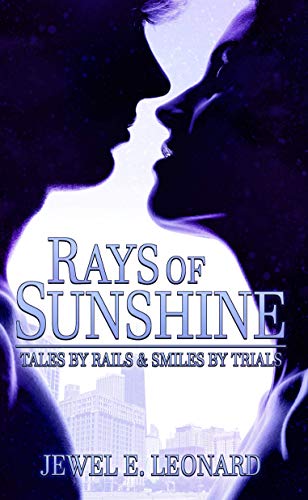
Back then, I was a wide-eyed, starry-eyed girl. People were publishing, they knew a helluva a lot more than I did, and they made the industry sound exciting. I wanted in. I read indie. Lots of indie. Bought lots of indie paperbacks, some from people who don’t write anymore or who have dropped off the grid because other things got in the way. I held books in my hands from people I knew, actually talked to online, and I wanted to hold my books too. One of the very first books I read was by Jewel E. Leonard, Rays of Sunshine. She did everything herself. Her husband helped her with the cover, but she wrote it and edited it, formatted the insides. She was my inspiration, and I started 1700 to publish like she did. (And can you read a blog post I wrote about writing to write and writing to publish here.)

Except, I had no idea how much work it would be to be let in. Because if it’s something that I’ve repeated on this blog for as long as I’ve been blogging, is that behind the cover designers and editors, the huge Twitter accounts, behind the shop talk, and Twitter chats, and blog tours and cover reveals, is this very one important thing. None of that matters if you haven’t written a good book. 

And this isn’t going to be another one of those blog posts. Everyone is going to publish crap. No one is immune from it, and very few are exempt. I’m no exception.

But the thing that probably saved me was the fact that I didn’t know it was crap. I went on my merry way, writing and writing and writing, and publishing and publishing and publishing and blogging about it, too! It was cool. I was a loser who didn’t know I was a loser.

Eventually, I got better. It’s just something that happens if you write enough words. You get better. Since I’ve started publishing, not including the fantasy still on a memory stick that I go back and forth between deciding to edit or not, I’ve written 1,227,000 words. Some of those aren’t published yet, as they belong to a first person trilogy that I haven’t edited. I’m going to write the sister trilogy to that before I release them. But they are written, and I’ll include them in my word count.

That figure isn’t to brag. I know I have a lot of time, and I do use the time I’m given.

But I think back to almost five years ago and how much the industry has changed. I did my book covers in Word. I used a free photo for The Corner of 1700 Hamilton, which I learned is a huge no-no. I formatted my documents myself using the templates KDP still has available though Vellum is so easy to get your hands on these days.

Besides the few people I had help me in the beginning, once I got the hang of writing again, I started editing my own books and for others.

There is something to be said for going back to basics. I learned a lot. I learned what a cover consists of, what bleed means. I can spot extra spaces between words in sentences in a manuscript and how not to put two spaces after a period. I know how terribly a Tab can screw up formatting, and even still today, I’m still learning how important it is to back up files (thanks disappearing Vellum files).

I’ve always moved forward, never gone back too often. Dean Wesley Smith calls this “overwhelming” your book. I call it burying it. But that’s hard to do if you want all your books to count. I say The Corner of 1700 Hamilton and my erotica novellas don’t count toward my backlist, but they have my name on them. They count. Even if I’ll never promote them. I put them out there, they are mine, and I own them.

For me, the glitz and glamour of being an independent author has gone away. You can scroll through writer twitter and maybe see some of those writers who haven’t published yet interacting with other writers with the same wide-eyed look. It’s not that I’ve become jaded–I still get teary-eyed whenever I finish a book and press publish–but it’s not long after that I’m on to the next thing, because there will always be another story.

What is this blog post about? It was supposed to be about how I revamped The Corner of 1700 Hamilton, but I’ll save it for another day.

I guess being quarantined has made me a bit nostalgic. I’ve come a long way in four and a half years. I’ve cried over lost files and bad reviews, I’ve virtually high-fived other authors and shared in their successes. I’ve shaken my head at others who keep making the same mistakes, and I feel bad for them because I don’t see their careers going anywhere. I know authors who are still working on the same story as the one when we met. This isn’t the career for those who can’t be tenacious, who can’t look ahead, who can’t see what they want in ten years and put in the work now. This industry isn’t for the faint of heart. Or for the weak.

I’ve come a long way in the almost five years I published 1700, and I plan to go even further in the next five. I WILL have a bestseller. Just wait and see.

What have you accomplished in the last five years? How has the industry changed since you’ve joined the writing community?

Let me know!


I read more than just Jewel’s book when I first joined Writer Twitter. Take a peek at the books I read that I very much enjoyed, and that I still recommend today. If you’re interested, click on the cover and it will bring you to Amazon. Some of them are in KU if you have a subscription. Some of the publishing dates reflect earlier dates, and I can only take that to mean that the authors have gone in, made changes, and republished. That’s one of the perks of being your own publisher. 🙂

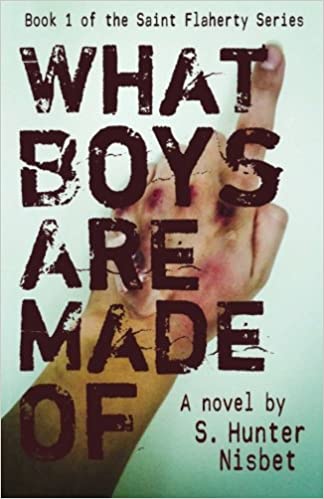
I can’t link you to What Boys Are Made Of and the other books in the series because I think Stephanie is redoing them. It’s too bad she unpublished while relaunching them though, because they were really good. Probably some of the best indie work I’ve ever read. I hope she gets them put back up really soon. They deserve to be out in the world.

51xSbxNCXCL._SX322_BO1,204,203,200_


Entropy is the first in a trilogy, and I’ve read them all. I’ve mentioned before Joshua helped me by beta-reading Don’t Run Away, and we formed a friendship after meeting on Twitter. He has quite a few books in his backlist now, and if you want to read his next book, Perplexity, he’s blogging the scenes for a little entertainment due to COVID-19. You can find his blog, Perplexitybook.com, here.

41-CcnUwF5L

I love Aila with all my heart, and she knows her stuff. She introduced me to Canva, knows her way around IngramSpark, and is all around a fantastic writer. Sex, Love, and Technicalities is the first in a duet, and I helped her edit the second (which is why I’m attached to it, not because I helped her write it). Aila and I have been friends for a really long time.

51SHmVSUYlL

One of the first indie books I read was David’s Lonely Deceptions. Originally published as a novella trilogy, Austin Macauley squished them together and published them as a whole. Not that I would recommend going with a vanity press, David was fortunate and they paid him, not the other way around. Just recently he wrote the sequel and sent it off to Austin so the books would be consistent (they gave him an advance for that book also). Right now he’s working on something new that will be published under a pen name because he says he’s tired of people thinking he’s a doctor. LOL

41AoQWMhVBL

Tom is another writer who kind of fell off the grid, though I think he’s active on Goodreads. I haven’t spoken to him in years, but I’ve read all of his books, and he was one of my first Writer Twitter friends. I think Jewel introduced us. His books are hilarious, but dark, and I recommend empathetic all the time. It’s laugh-out-loud good.

5127jCie4nL


Choosing Amazon to self-publish. What’s so bad about it? My answer? Nothing.

amazon love hateWarning! Lots of thoughts that are a bit scattered, but I try to keep them coherent at least. I’ll blame writer’s brain and the fact that I’m almost done with book three of my series. Yay!

Okay . . . carry on.


If you read my blog here in there, you’ll know my feelings toward Amazon are complicated, with a capital C.

But I’m not alone.

There are lots of people who think Amazon is either a devil or an angel, depending on who you talk to, and if it’s on Monday, Wednesday, or Friday. (On Sunday you might find a select few in church praying for Jeff Bezos’s soul.)

Dean Koontz’s book deal with Amazon only added gasoline to this already wicked fire. Was he smart? Greedy? Some accused him of starting the toppling of the traditional publishing model, although a few other bigger-named authors have inked deals with Amazon too, like Sylvia Day, with less scrutiny.

Everyone is quick to point fingers, but the fact is, traditional publishing has been on a decline for years because they cling to an old model that is no longer working in the changing landscape.

Depending on huge bestsellers like Stephen King, Nora Roberts, John Grisham, and James Patterson is harmful. People who champion this say coddling the big authors funds the little authors. But I questioned this in two ways. The mid-list is shrinking. Who exactly are they funding? And more importantly, if new authors are not being sought out, their careers nurtured, who will replace these top authors? We can’t depend on all authors like Stephen King to have children who will take over their publishing empires.

One of the most frustrating things about traditional publishing is the lack of risk-taking. Yes, they are the gatekeepers of quality, but while they are busy keeping quality inside their walls, they are also keeping quality out, too. Only so many books are published every year—and those numbers include already established authors. There’s no room to grow.

Yes, they are the gatekeepers of quality, but while they are busy keeping quality inside their walls, they are also keeping quality out, too.

No one ever said if you want to be rich write a book. Some publishing houses or small presses won’t give an author an advance anymore, and if they do, it isn’t much.

Traditional publishing asks a lot of writers who want to be published:

  1. Query an agent. This could take months, if not years.
  2. Go through edits with said agent, if you’re lucky enough to follow the lengthy guidelines required to query each agent and have one sign you.
  3. Wait for your agent to sell your book. If she can. And that’s contingent on a few things: what kind of book you wrote, what’s selling, and what other agents are peddling. There are not many editors to go around.
  4. Then you might have to go through more edits with that editor.
  5. Wait a year for publication.
  6. Market your own book (with a cover you may not like and edits you don’t agree with, but you wanted to be traditionally published, right?).
  7. Make a fraction of book sales because your agent and publishing house take a percentage off the top.
  8. Hope your first book sells so maybe your agent and editor will take a look at another book.

Never mind that after you’ve gone through all of that, depending on what kind of contract you signed, your book isn’t yours anymore; your rights are gone.

To be honest, the more I learn about traditional publishing, the less it appeals to me. And to other writers. And where do writers turn when they want to publish, but don’t want to go the traditional route?

Amazon.

To be clear, publishing with an Amazon imprint is still considered being traditionally published. You can’t be considered without an agent. Which does make me a bit confused. If agents are so vocal about Amazon ruining traditional publishing, how will an author find an agent willing to submit their manuscript?

I listen to Print Run Podcast and the two agents who host make it clear how they feel about Amazon, Amazon’s view on books, and what they are doing to publishing as a whole. Take a listen to their latest episode where they discuss the Koontz defection, and cross them off your querying list if you want a deal with Thomas & Mercer or Montlake.

And that brings us back to what traditional publishing thinks we should do. As authors, we want our work read, not shoved under our bed because an agent’s intern was having a bad day and rejected our query.

We turn to Amazon as self-publishing authors.

But that isn’t what enrages the traditional publishing industry. What makes them so mad is that authors who publish on Amazon are making money, and there’s nothing they can say about it, or anything to defend themselves. I’ve seen proof of writers who can make good money publishing quality books. Consistently.

Living wage money.

In traditional publishing, where does the money go? To the CEOs of the huge corporations that own the publishing houses, and to the big authors who earned the gigantic advances. There is no mid-list in publishing anymore. We’re all over on Amazon earning 70% royalties and keeping our rights to our books.

Yet, somehow this is all Amazon’s fault. Mostly because Amazon is accused of not caring about books. It’s brought up time and again Jeff Bezos started moving books because they are compact and couldn’t break.

The traditional publishing houses, and anyone associated with them, holds on to the philosophy Amazon doesn’t care about books. I can say the same about the traditional publishing industry, too. If a book doesn’t sell, you’re out. Your career, too. There are no second chances, no molding of careers. Can an industry who doesn’t pay their authors, or help them sell their books, say they care about the writer or the book? They aren’t publishing for art, they’re publishing for money, and authors aren’t getting a piece of the pie. Caring about a book and caring about selling a book are two different things, but they don’t have to be mutually exclusive. I love my books. I love selling them, too.

Maybe books are loss leader on Amazon, but that doesn’t change the fact that Amazon gives every writer something that an agent or traditional publisher won’t or can’t.

A chance.

A lot of authors take that chance and turn it into a four, five, or six figure career.

And Amazon is the bad guy?

I get Amazon lets too many things slide: book stuffers, plagiarism, letting indie authors publish crap that wastes customer dollars if they don’t look closely enough at the product. But the thing is, it doesn’t make them any different than any other company. Everyone has bought something brand new from a store that didn’t work when it should have. People buy cheap crap, because stores sell it, all the time. It doesn’t make it right, but Amazon isn’t doing anything new.

You can say they treat their employees like crap, but again how is that different from any other company? We all have not-so-nice things to say about where we work. Walmart is a huge culprit of this. Not long ago it came out that their workers were working off the clock to get all their work done.

Questionable ethics abound. Starbucks employees are racist. McDonald’s serves unhealthy food. Jimmy John’s founder trophy hunts. No one stops drinking coffee, and McDonald’s is still the number one fast food restaurant in the United States.

Authors don’t have a problem making money doing something they love. And if everyone else does, it’s time to do something about it.

Traditional publishing isn’t letting more authors in. Every year they keep more out.
Barnes and Noble is still in shambles, though it would be great if the new owners could give Amazon a run for their money. Apple Books doesn’t seem to be a contender, and you have to jump through more hoops than a circus tiger to publish with Google Play. When I was wide, Draft2Digital wasn’t able to publish my books there.

Everyone can complain about Amazon, but no one is stepping up to compete. Shouldn’t that be what the traditional publishing industry’s job?

Dean Koontz obviously felt that his publishing house wasn’t going to give him what he wanted or needed for the next handful of books in his career.

That’s not Amazon’s fault.

Amazon may not love books, but they are forward-thinking and are willing to pay authors for their work.

What do you have to say, traditional publishing industry?

Seems like all you can do is point fingers when you’re the only one in the room who can do something.

Untitled design

All this paper is good for something. I’d rather write another book for my backlist than take the time to query agents who will reject me.

I may have vented some frustration with Amazon in the past, but the truth is, writers should go where the money is, and for now that’s KU for the page reads and a 70% royalty  for self-publishers (or an imprint if you can get it). With no one else willing to give authors competitive alternatives, I’ll take my chances.

And instead of writing 500 query letters, I’ll take that time to write another book.


It’s important to note that in some genres it makes more sense to query. I write Contemporary Romance. That’s one of the top genres that does well in the self-publishing space. YA fantasy, middle grade, and picture books do better when you can take the time to query. I’m not saying you can’t self-publish, but those kinds of books require a different kind of marketing, and you’ll need to do your research and make sure you understand how you’re going to reach your audience once your book is self-published. Always research the best way to publish your books.


There’s a lot of opinion on the state of publishing and whether or not querying is a viable option. Amazon is accused of not caring about books, and training readers to want free things. Traditional publishing is accused of not moving forward and staying in the past. It’s interesting to take a look at all angles and read different sides to different stories. For more reading look here:

You can read another opinion piece from the New Yorker, here.

This is a great read on both sides. PUBLISHING INDUSTRY NEWS
Amazon’s Influence on Authors & the Publishing Industry

Stay Away From Traditional Book Publishing by Dean Wesley Smith

Downtime. Not doing a damn thing.

You know how it is. You have a long list of things you could be doing. As writer, publisher, and entrepreneur, that list is long. There’s always something, and writing new words is right on top.

What’s after writing?

  • Writing a blurb.
  • Looking at hot guys stock photos
  • Reading a non-fiction book
  • Listening to a podcast
  • Beta reading
  • Reading  a book in your genre
  • Creating an ad (after you’ve read the book about it, of course)
  • Blogging, reading and commenting on other people’s blogs

But sometimes you turn on your laptop, a cat crawls into your lap, and boom. You’re tired, and you’d rather watch the next episode of Outlander than see if your blurb is converting (if you don’t know what that means, you need to read Mastering Amazon Descriptions: An Author’s Guide: Copywriting for Authors by Brian D. Meeks. Another thing you can add to your list! Yay!)  I’m sure Diana Gabaldon thanks you. But I probably should point out that without her writing the words, there would be no show. Maybe Outlander was a bad example.

I’m in that predicament tonight. The things that I could be doing right now? Working on the new cover for All of Nothing. Working on the blurb. Writing more words for the third book in my Wedding Party series.

Instead I’m sitting with a fan blowing on me. I’m a little nauseated from sipping too much Prosecco on an empty stomach. I was grinding my teeth in my sleep last night so I have a toothache on the left side of my jaw, top and bottom, that feels a little more than mild, and all in all, I’m just tired.

And feeling like this is always a conundrum. Do you give in, or push through? Give in and practice a little , or do you, in fact, get some shit done?

I suppose it depends on where you are in your schedule. Don’t have one? Well, nothing gets done simply by dreaming, and if you give yourself a pass too many times, you’ll end up with a handful of days where nothing got accomplished. A schedule isn’t a bad thing.You need to be a self starter and self motivator if you want to keep getting your stuff done. It can keep you on track. A schedule or a plan can at least be a guide in that if you do start letting too many days go by, you can tap yourself on the back and ask yourself what the heck is going on.
Taking a break to breathe is advisable, but if you want books to publish, you have to write them, too.

I could put on some coffee and at least get one or two small things done. Work on my blurb. Look over what I have for my cover. I’d like to swap them out so the book is ready to go when I put all my books back into KU next month. The cover is going well, and I’ll update you on that probably Thursday. I’ll be swapping out the cover for IngramSpark, too, so that will be lovely, though I’m getting used to the IS user interface and dealing with the cover template isn’t so hard anymore.

I had a soft deadline of getting book three done by the end of the month. I’ll be close, but maybe not finished. But that’s okay. Without the deadline I probably wouldn’t have made as much progress as I did. I’m proud the book is almost done. It’s a good book with a strong plot and relateable characters. It seems crazy to say that I’ll have finished three books this year.

But I guess that’s the point of this blog post. I wouldn’t have been able to accomplish that had I given myself too much downtime.

For tonight I’ll try to calm my stomach down, make some coffee, and see if I can check one thing off the list before going to bed.

I’m going to a writer’s meeting tomorrow, so that should be interesting. I’m not a joiner, and while I know the value of networking, I can’t lie. More than a little bit of me wants to skip it.

When you decided to be a writer, did you know how many people would be involved?

I didn’t either.

I feel like I should offer you something since you made it this far and have given me 15 minutes of your time or so, so I’ll end my blog post with this.

I recently read Make Money on Medium: Build Your Audience and Grow Your Income with Medium.com. I’m always open to new things, but after reading the book I realized I don’t want to write for Medium–I like blogging for the audience I already have. But whether you’re a blogger or a Medium writer, Nicole gives some good tips for what to write, how to write, and headlines. I’ll share one little tip that she tells her readers about, and that is a blog title, or headline evaluator.

Headlines or titles are important in that you don’t want your readers guessing what your content is about. You could have a GREAT blog post, but no one will read it if you title it something weird. (That goes for book titles too, but that would be a different blog post.)

There are a few headline generators, and you can Google them.

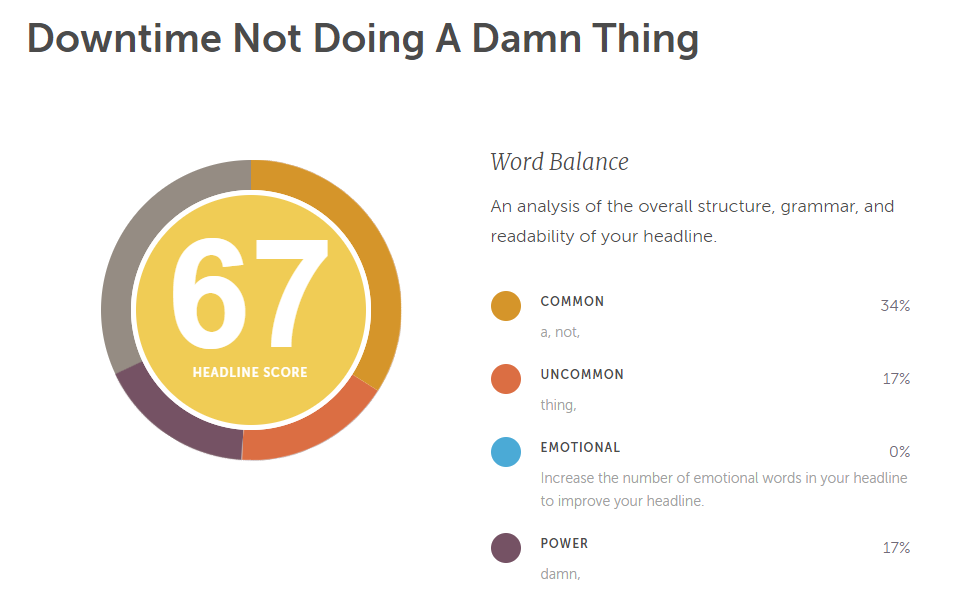
Coschedule.com will analyze your title (if you give them a few pieces of info about yourself and your business) and tell you if it’s too weak. It didn’t like the title I came up with for this blog post:

blogtitle analyzer

Nicole suggests that you want your book to be at 80 or better. She even admits that she might spend more time thinking up a good headline or title than actually writing the post. That seems crazy, but on the other hand, no one is going to read what’s inside if the title isn’t appropriate, so she isn’t that far off the mark. Being she’s a HUGELY popular writer on Medium, I would take her word for it.

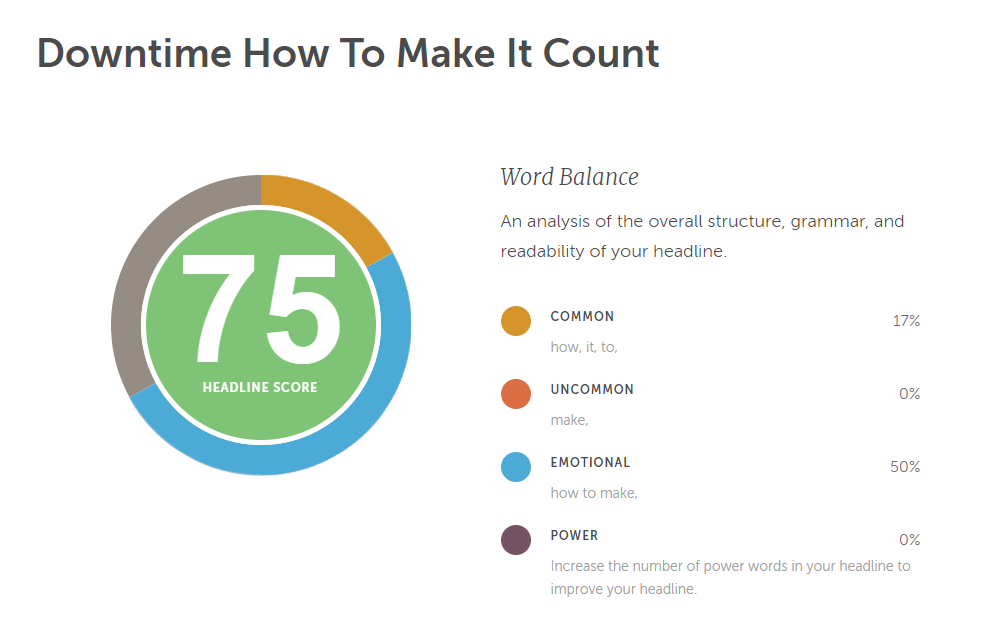
You can plug in titles forever, but just to see what I could do, I changed my title:

blogtitle analyzer2

That’s actually a vast improvement, but a lie. That’s not what this post is about. Mainly it’s about not feeling guilty if you don’t feel like doing anything, but also keeping those feelings under control so your to-do list doesn’t look like Mount Kilimanjaro by the end of the week/month/year. Everyone knows how fast time goes.

Anyway, if you’re interested in writing for Medium.com I suggest you take a look at Nicole’s book. She offers you some great tips on how to get started, how to follow and pick up followers, and how to write for a pub. If you’re on the fence about blogging, but feel you should be giving out content in some way to get your name out there, writing for Medium could be a good way to do that.

What am I going to do now? I still haven’t shaken off my blahs, but I did take some Aleve for my mouth and made a cup of coffee.  I could work on my blurb or watch another episode of Outlander.

I’ll let you guess which one.

Have a great week!

thank you for your patince

Changing your Point of View: How you write, and thoughts on 1st, 3rd, past and present tense

change pov blog post

Change comes whether we want it to or not. Sometimes change happens so slowly you don’t know it’s happening. Sometimes you’re not paying attention and the old way you’ve taken for granted is suddenly gone.

This happened to me, though I think I was more in denial this was happening than embracing the change. Maybe I was hoping it would go away, or maybe I was hoping the old way would hang in there. The latter may still have a chance, but the former isn’t going to happen.

What am I talking about? The way fiction is being written. Not even by indies, as this change has been happening with the traditionally published books in the past couple of years as well.

To explain, let me go back.

Like all writers, I grew up reading. Nancy Drew, The Babysitters Club, Sweet Valley High. Slowly, I graduated to Sweet Dreams romances, VC Andrews and Harlequin Desires and Temptations.

And looking back, I realize there is one thing all those books have in common–they were written in third person past tense.

It stands to reason then, that when I began writing my own stories, I too, wrote in third person past since I grew up reading it. Never would I think this way would become outdated, but I’m afraid that it has.

Now books today are written in first person present, and that doesn’t seem like that’s going to change any time soon. Take a look at any new book, especially a romance in Kindle Unlimited, and you’ll see what I mean. I liken this to how Mike Campbell loses all is money in the The Sun Also Rises by Ernest Hemingway:

“How did you go bankrupt?” Bill asked.
“Two ways,” Mike said. “Gradually and then suddenly.”

It seems as if first person snuck up on us, and then suddenly it was everywhere.

And as a writer who writes in third person past, this is troubling because this isn’t about catching a trend or even writing to market, it’s about adapting to change as not to be left behind.

It used to be first person, be it past or present, served one purpose–the sole reason why the writer chose to use first person when writing their novel: to tell the story of “I.”

change pov blog post2

Who was the “I?” A girl with magical powers? A young boy out to seek his fortune? The author chose that way as a device to tell that ONE person’s story through their eyes. Middle grade and YA were (are) written in that fashion so the young readers could more easily envision themselves in that role.

I can’t remember the first person book I ever read–and I must have read some; they weren’t non-existent as I was growing up, but they obviously didn’t make an impact on me. And when I was a young adult, and now a “real” adult myself, I don’t read much YA.

And maybe this is the point.

I’m outdated. At forty-four years old, I’m writing in a way that is being used less and less, except by the authors who have been writing for as long as I’ve been reading. Nora Roberts, Brenda Novak, Robin Carr.

When you read and enjoy first person books, that is what you’ll probably write. Books like the Hunger Games, Twilight, 50 Shades of Gray took the lead of a style of writing that is prominent now. You may be shaking your head, but think to when those books were written and how popular they were. The first book in the Hunger Games Trilogy was published in 2008. Twilight, 2005. Divergent, 2011.

I’m an old lady.

When thrillers and romances are now being written in first person (and present, too) where do you fit in if you like to write in 3rd person past tense, or even 3rd person omniscient?

I write contemporary romance, and when others who write in my genre use first person, it confuses me. There is no “I” in contemporary romance, there are two characters. His and hers. Or his and his. Or hers and hers. Depending on what you write. There is no single “I” on a journey to a happily ever after. Writing a two-sided romance using first person, to me, defeats the purpose of using first person.

Is this an old way of thinking?

Some of the greats still use 3rd person past, Nora Roberts holds true. So does Susan Mallery. Brenda Novak still does, and Robyn Carr as I mentioned above. The Harlequin lines, though they are going through some rearranging at the moment, still seem to publish 3rd person past romances, at least their little pocket romances like their Intrigue and Desire lines.

And to really confuse me, authors are starting to use a mix of points-of-view, and what’s even more mind-numbing is that it’s becoming popular, like The Mister by EL James. Maxim tells his story in first person present, but Alessia shares her story in third person present. I would love to ask Erica why she wrote it this way.

It seems like these days authors use POV as an artistic tool. Does it work, does it not? I have no idea. They say anything that takes your reader out of the story is bad. But what is bad is subjective.

Dark Places by Gillian Flynn tells two stories. One story is present day and written in first person past, the other story took place while the female main character was a child and it’s told in third person past. She obviously choose this as a stylistic choice. Does being with the “I” character makes us feel more intimate with her? I don’t feel it would have changed the story much had she written the present day timeline in third person past. But with the popularity of her books, no one seems to mind what tense she chooses.

Have I had any complaints when it comes to my third person books? No, not that I’m aware, but nor would I know how many sales I’m either gaining or losing because of my choice.

So what is a writer to do? Keep writing in a style you like and are good at? Practice a different POV? I’ve tried writing first person present, and I liked writing it as much as I like reading it, and that’s to say, none.

And I will always believe writing a romance in first person POV when the author intends to show both sides of a relationship doesn’t make sense, and you can pry my opinion out of my cold, bloody fist.

change pov blog post3

But it’s obvious that what is coming out by younger romance writers that my viewpoint is not shared, and it’s not shared by their readers, either.

We need to adapt with change, though. When will my dislike turn into simple stubbornness? And when will that stubbornness keep me from reading books I may otherwise have enjoyed? I can’t be an old curmudgeon waving my cane hollering “3rd person past” at every writer I meet.

Point of view can bring on choices that you need to make besides just how you want to write your book. If there’s an “anything goes” with what’s between the covers, our blurbs and ads need to reflect that. Blurbs have always been written in third person present. Some unspoken, unwritten rule has ordained this since the beginning of time, and it didn’t matter if your books were written in first, third, or alien.

Now though, if your book is written in first person, blurbs are changing to reflect that. The first book I grabbed off Amazon that is self-published and in KU happens to be written in first person past and the blurb is also written in first person. Maybe a coincidence, maybe not. Is this how blurbs need to be written now? When did the rules change, and where do you read them in the updated Author Handbook?

What about ads? Ad copy isn’t the same as writing your book, though blurbs and ad copy are cousins, I guess. Ad copy is supposed to be snappy, hook your reader into buying the book. If you sell a book with snappy first person ad copy, but your book is written in third person, will that go over well with your reader?

I have no idea. You’ll hear it in reviews though, guaranteed. Or at the very least, wasted ad money for clicks that don’t turn into sales.

Looking at “how it always used to be done” may not help in these quickly changing publishing times. For another look at how to write blurbs and in what POV look at this blog post by Writer Unboxed. The author of the article mulled it over a lot more eloquently than I did. Marketing Copy: The First- Versus Third-Person Debate


I’ll keep writing in 3rd person past. It’s how I write best.

Write how you write at your best because after all, it doesn’t matter if you write in first, third, or alien, it comes down to giving your readers a good story.

But I caution you using POV as a stylistic choice to cover up lazy, or poor, writing. If you’re going to experiment, make sure you have plenty of betas on hand to tell you if it’s working or not.

You can do whatever you want to do with your book, but you still want people to read it too. Even aliens.

change pov blog post4

That was some really bad Sunday night humor. And with that I am going to bed. I hope you all have a lovely week of writing ahead!


thank you for your patince

graphics made with font and photos from canva.com

The age-old question, ‘what do you want from your writing?’ isn’t the real question at all. The REAL question? What can your writing GIVE YOU?

We’ve all been asked the $50,000 dollar question: Why do you write? Do you write for success? For the fame and fortune? Do you have a story that must come out no matter what? We all write for a reason, the reason that keeps us coming back to the laptop again and again.

But the fact is, after the writing is done, what can, what WILL, writing give us?

There are different kinds of writing, and each medium gives us different things:

  1. Blogging. Blogging gives us a place to vent, a place for our voice to be heard. Blogging lets us share information, be an authority. (That’s where the word AUTHOR comes from, don’tcha know?)  But blogging can only give you those things if you have an audience. Also known as, a reader who will read your blog post, maybe share it, maybe leave a comment. Your voice can only be heard if someone is listening. Will the blogger make a sound if no one is around to hear it? Yeah, and her voice sounds like this:
    wah wah wah
    You have to have good content, consistently, to find an audience who will enjoy your posts and keep coming back to you. And that’s difficult. I’ve blogged for the past few years, and finding consistent things I like to blog about and that I think others would enjoy hearing about, is downright hard. I’m not complaining, I love blogging. I wouldn’t do it if I didn’t. I put a lot of my heart, soul, and time into my website, and I blog to keep it current. That’s something I get out of blogging. Good SEO. Everyone once in a while someone will tell me they learned something on my blog. That’s great, too. But I understand when bloggers give up, because the time it takes, money (let’s get rid of that pesky .wordpress.com at the end of our domain addresses, okay?) and the pounding our heads into the walls to come up with ideas. Well. There’s not a lot of return on investment there, is there?
  2. Other social media. You’re writing when you post a picture on Instagram and tell your audience the story behind it. You’re writing when you update your Facebook Author page. You’re writing when you tweet. What kind of payback is there from spending time on social media? There is some. You find camaraderie, you find support. You can find people who will help you publish, both indie and traditionally. You network. You support the “big guys” by buying their books and promoting them. But besides being involved on social media for all those things, you hope one day you meet the right person who can introduce you to the next right person (hello agent!), you tweet something that goes viral, and that maybe, because you cultivated a social media following, you might sell some books. But realistically, the “might” is pretty big. Skyscraper big. Authors learn early on that joining social media and screaming
    BUY MY BOOK
    will annoy everyone very quickly, and eventually get you muted or blocked. Which, by the way, is the exact opposite of what you want to be doing. Just a little FYI in case you’re doing it wrong. Stop it!
  3. Writing books. If you ask any writer, they’ll tell you that they would still write even if no one were to ever read anything they’ve ever written ever again. And I believe that because there is something that keeps us writing. The innate human need to tell stories and to listen to stories. It’s how we learn, it’s how our cultures are passed down from generation to generation. Someone may not read our stories now, but maybe in 50 years? 60? You never know! Storytelling is in our blood. There is satisfaction in storytelling. There is happiness in typing THE END to a book or a short story or a novella. There is joy in it.
    cricket
    But anyone who has ever published a book to crickets will tell you that sometimes you better be happy with self-satisfaction because that’s all you’re going to get. I was reading my friend Dave’s blog post right before I wrote this, and he gave me the idea for this post. He went through a lot with his release. A lot of anxiety and lot of pushing through panic publishing his book. And I wonder, if you asked him, if he knew what the outcome would be, if he knew that after all he went through publishing his book, if he would do it again.
    Was the payoff big enough?
    What was the payoff? That’s different for different people. Maybe it’s simply holding it in your hand. Maybe it’s seeing it “out in the wild” when your friends and family buy it to show their support. Maybe it’s that first review. Maybe it’s that first review by someone you don’t know.

But this is what this whole post is about–this is what it took 791 words to say. Those small things, they better the hell get you through, because in this day of self-publishing, in this day when 50,000 new books are published on Amazon every month, THAT’S ALL YOU’RE GOING TO GET.

You might not believe me when I tell you this isn’t a bitter post. You probably won’t after all the whining I’ve done about sales these past few months, and the huffing and puffing I’ve done about Amazon and KU. Those days are gone because I’ve made some decisions that feel right, and come hell or high water, I’m going to stick with the choices I’ve made. (My publishing career isn’t a ball in a pinball machine–I need to stay steady to gain ANY traction.)

This isn’t a bitter post, but it is realistic. You’re not going to set the world on fire when you hit publish. Anywhere. Not on FB when you publish an updated author post, not in a Tweet, though you may get a few hundred likes, and good on you if you can. You’re not going to change the world with a blog post. Someone did that already, back in 2011.

This is a new age of publishing, and you HAVE TO find little things you love about it to keep going, or you might as well quit. You’re not going to strike it rich with a book, or two, or even six, as I can tell you. 50 might be the new 30, but it used to be you could make okay money if you had 6-10 books out, and you can’t do that anymore. Indies making any kind of money have 10+ books out. Sure there are outliers, like Jami Albright, but for us little people who don’t have the means to go to an RWA conference and rub elbows with big authors who will put us in their newsletter, success is going to come much slower. We’re talking years. And the slower you write, well . . . you don’t need me to do that math.

So the question of this blog post wasn’t what do you get out of writing? It was, what does writing and publishing give you? 

Besides bills from hiring editors and formatters and graphic designers to do your book covers, what DOES writing give you, and is it enough to keep you going until it finally gives you what you want?

And what is it you want?

Fame and fortune, of course. Fame and fortune.


thank you for your patince

My Wide Adventures AKA Sales so far

Almost two months ago I went wide. Has it paid off?

Not so much.

I put All of Nothing, and Wherever He Goes wide through Draft2Digital as soon as they dropped out of KU. I put The Years Between Us on all platforms as soon as it was finished–it never went into KU at all.

Because of an oversight, I missed one of my books in the trilogy, and I thought I would have to wait for them to drop out, but everyone encouraged me to just email Amazon and ask for them to be pulled out, and I did. They were polite about it, and the minute I had the email saying they were out of Select, I put them wide.

For simplicity’s sake, I can say all six of my contemporary romances have been wide since April first.

And well, nothing happened.

Actually, something did happen.

My KU reads dried up, but sales on other platforms didn’t make up that loss. I kind of knew that would happen, but it’s different seeing it. They even talked a little about it at the summit during the wide panel–that dip where page reads go from a waterfall to a trickle, and where no one knows your books are on other platforms.

It takes time, and seeing that money, no matter now small, disappear, makes you sick inside.

Also, listening to Jami Albright talk about her success at the summit in KU with only three books didn’t help me feel any less bitter when I had just pulled my own books out of KU and made them wide.

But like a life-style change to beat a sugar addiction that will make you feel better for the rest of your life, I feel going wide will be the same for my career. Is Amazon cake? I guess if you’re you in the 20booksto50k group on FB and see everyone’s earnings in KU, you can feel like Amazon is a giant piece of gooey cake with a huge scoop of ice cream, too.

amazon vs cake

Hello, type-2 diabetes!

I might have taken that too far.

But, as always, this isn’t about whether going wide is smart or not–always go back to your business plan and decide for yourself what you want out of your writing career.

As for sales: I put Don’t Run Away permafree the minute I could, and asked Amazon to price match when the free price on other platforms kicked in. This is supposed to help introduce a reader to my books. Being that Don’t Run Away isn’t as strong as the books I’m writing now, that’s a plan that may not pan out. But I’ll be publishing  a new series this year after I get them all written and edited, and eventually book one will be permafree, too.

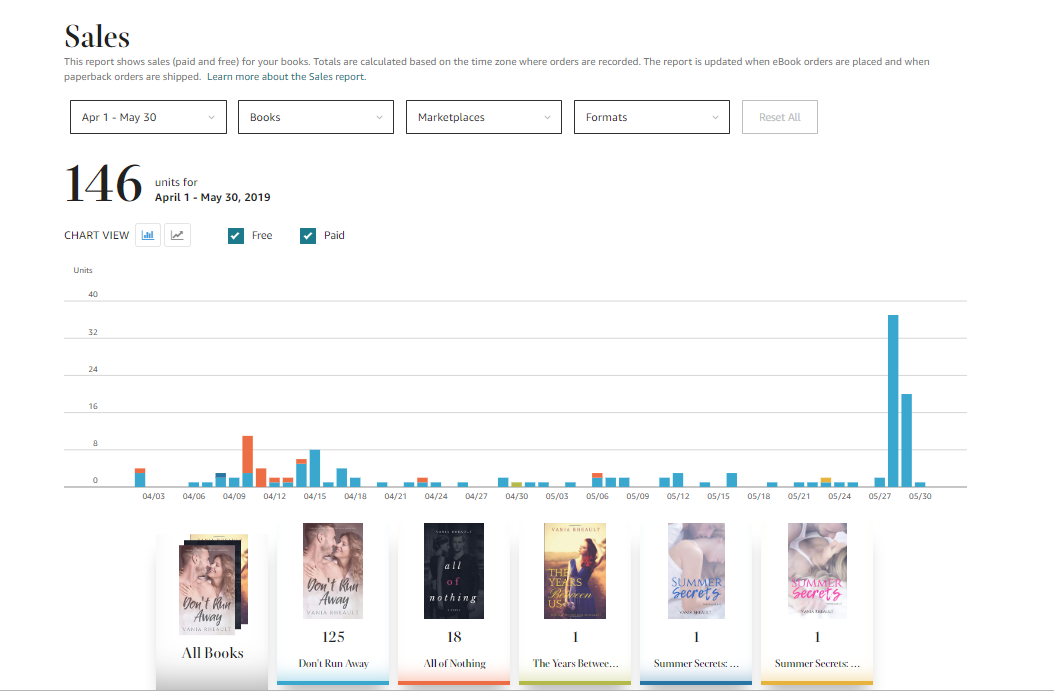
For sales from April 1st to the day I’m writing this blog post, May 30th (rather, the 29th since that’s the way reporting goes).

Amazon:

Free:
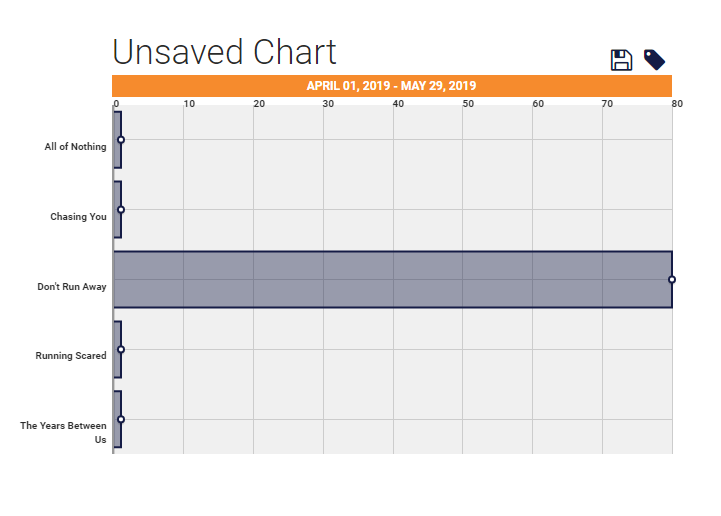
Don’t Run Away: 125
Paid:
All of Nothing: 18
Wherever He Goes: 0
The Years Between Us: 1
Summer Secrets Novellas 1-3: 1
Summer Secrets Novellas 4-6: 1

Out of the 125 copies of Don’t Run Away, no one bothered to go on to books two or three of the trilogy. It takes time for people to read, so maybe they haven’t gotten around to reading the book yet. I don’t like to think they didn’t like the first book and don’t want to read the other two. (But when you’re writing a series, that’s always a possibility.)

amazon sales for blog post

So, sales aren’t all that great. Those two little spikes you see? Those are me fiddling around with BookBub ads. I’ll write another post about that later.

How about on Kobo?

On Kobo, I gave away 32 copies of Don’t Run Away. I had 0 organic sales of any of my other books on there. Meaning, I didn’t get any read through to my other books in the trilogy. Bummer.

kobo graphic for blog post

Draft2Digital

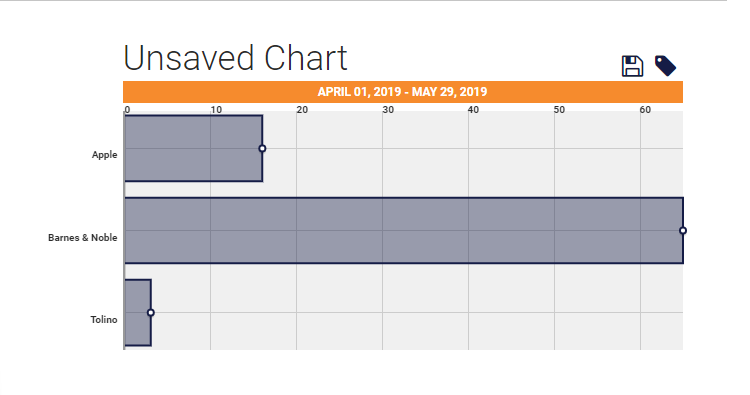
Draft2Digital publishes my books in a lot of places, but the top two are Apple and Nook. It’s easier to give you the charts. But I’m sure you can imagine that giving away Don’t Run Away dominated my “Sales.”

draft to digital chart for blog

I sold one copy of All of Nothing, Chasing You, Running Scared, and The Years Between Us. I liked the Chasing You and Running Scared. It means out of the 80 people who downloaded Don’t Run Away, ONE person read the other two. I mean, that’s progress, right?

draft to digital chart for blog 2

As you can see, I gave away the most copies of Don’t Run Away on Nook. I’m not sure why, but maybe one day those will turn into sales of my other books.

Here are the chart breakdowns:
Nook:

draft to digital chart for blog nook sales

And Apple Books:

draft to digital chart for blog apple sales

I feel like I got a little bit of something going everywhere, but not a lot of anything.

As I experiment with ads, and put more books out, maybe that will help. I mean, after all, I haven’t really done much marketing letting readers know my books are everywhere. I use my FB author and personal page to let people know as much as I can without sounding like a harpy.

I use the end of this blog post to let people know my books are wide, but let’s be honest. I’m writing for writers who probably won’t buy my books, and that’s okay. That was the path I chose when I decided to blog on these topics.

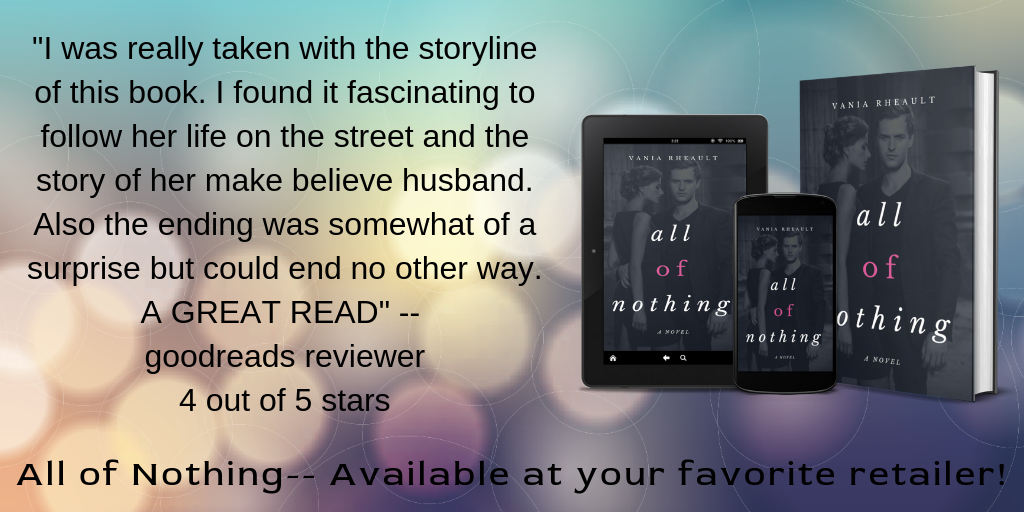
And it’s the same with Twitter. I have this as my pinned tweet, and it does absolutely nothing:

All of Nothing promo with goodreads review

I boosted this post on Facebook and it got me 3 new likes to my author page. One of them was my sister. Go me. But the ad is pretty, no? (If you want to make your graphics, use this website; Derek Murphy is so great for the writing community. Be sure to save it as a PNG though, so you have the transparent background. Otherwise, you’ll save it with the white background underneath. I did the rest in Canva. Search for [your color] bokeh if you like the background.)

I do have a Freebooksy scheduled for the middle of next month for Don’t Run Away since it’s permafree. That will be my first real ad aimed at all the platforms I’m on. We’ll see if it makes a difference.

To be honest, this was pretty much what I expected. I’m willing to experiment with ads for now while I’m working on my series. Maybe working with ads over the summer will help me grow a small audience and they’ll be willing to buy my quartet when it’s done.

Slow and steady wins the race, and all that, right?

Have you tried going wide? What has been your experience? Let me know!

Thanks for reading!

Don’t Run Away: books2read.com/dont-run-away
Chasing You: books2read.com/Chasing-You
Running Scared: books2read.com/running-scared

Wherever He Goes: books2read.com/whereverhegoes1
All of Nothing: books2read.com/allofnothing1
The Years Between Us: books2read.com/the-years-between-us

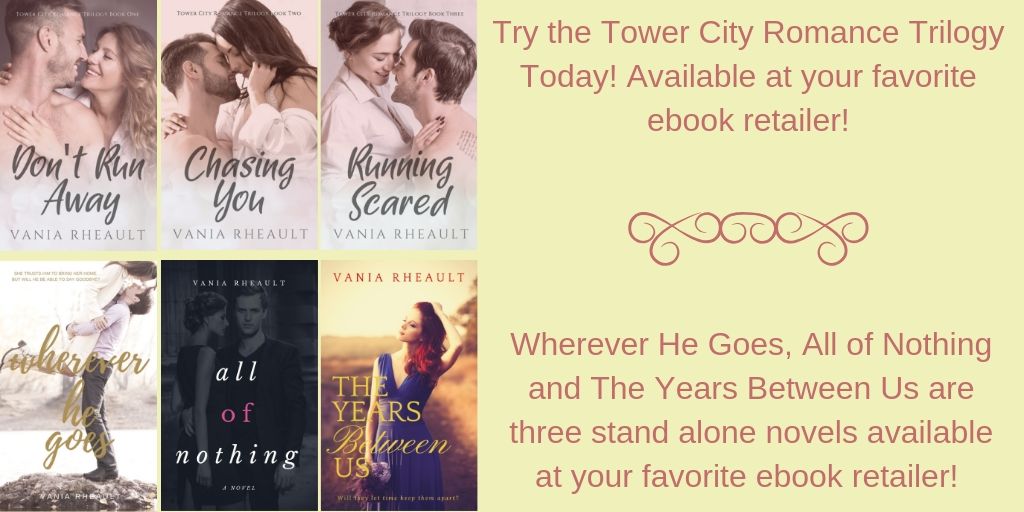
Try the Tower City Romance Trilogy Today!

May Goals :)

I didn’t have May Goals, so my title is a bit deceptive.

The only goal I really had was to finish book 2 of my series, and I did that. I’m taking a little breather before I start editing book one. I would like to edit books one and two, so when I finish book four, the editing won’t be such a massive undertaking. Book two finished out at 76,000 words, which is 6,000 more words than book one. But now that I know the characters better, when I edit book one, I could easily add a few more words to that, and write in some foreshadowing of other books since I failed to do that the first time around.

I did manage to change the covers to my trilogy, on all the ereader platforms, and even Ingram, which was pretty cool. I won’t rehash any of that–I’ve written other blog posts about it so . . .

next

The problem is, there isn’t any next. I mean, nothing I wouldn’t be doing anyway.  Outlining books three and four, and just editing my life away, while try to stay on top of this blog.

Speaking of blogs, I need to type out some of Autumn’s blog posts. She’s a character in the series who writes a blog for the newspaper. I thought it would be fun extra content to type out the blog interviews of other characters that she talks about in the books. I don’t have a good place to post those. I thought about creating a free website for her using something like Wix, and trying to make that look like her newspaper’s website, but I don’t know how much time I want to take doing that. Especially since I have a standalone book brewing in the back of my mind already for when this series is complete. I could add a tab to my own website, but how long do I want to keep them up?  I’ll keep writing them and transcribing them, and after I get them all done, I’ll decide then.

I’ll continue to look at stock photos to see what i can come up with for covers. I hated doing my trilogy. Four books should be even more fun.

I did attend that Sell More Books Show Summit, and that put me behind a few days. The experience was wonderful though, and you can read about it here.

I edited for a friend, and that took a bit of time, but I like editing, and her story is sounding fantastic!

I guess that’s about all I have for my May goals. I always know what needs to be done if I want to propel my career forward. That usually means writing fast and writing good, quality work while still being anchored to the land of the living.

I bought a promo for Don’t Run Away for the middle of June. It’s permafree, and I purchased it from Freebooksy. I plan to mark down my other two books in the trilogy to .99 for the rest of the month to encourage read-through rates. My main goals while finishing this series and preparing it for release is pushing my books out there. I need reviews and exposure.

I got turned down again for another Kobo promotion, but I’ll keep trying. As a new author without reviews on that site for any of my books, it will be difficult to be approved, I think.

But, it is what it is.

mountain of success

I’ll share how my wide adventures are going in another blog post.

Thanks for reading!

Don’t Run Away: books2read.com/dont-run-away
Chasing You: books2read.com/Chasing-You
Running Scared: books2read.com/running-scared

Wherever He Goes: books2read.com/whereverhegoes1
All of Nothing: books2read.com/allofnothing1
The Years Between Us: books2read.com/the-years-between-us

Try the Tower City Romance Trilogy Today!

graphics made with photos and font from canva.com

Mistakes I See New Authors Making

Indie books versus traditionally published books

I’ve been reading a little indie lately. I hate splitting up the two — indie vs. traditionally published. Books should be books no matter who has written them or how they were published and printed.

But I have been reading some books I’ve found on Writer Twitter and in some author Facebook groups.

Even though we shouldn’t separate books by who has written them or how they’ve been published, there is still a little issue of what does make them different.

Quality.

Indies say taste is subjective and that quality means different things to different people. I certainly say this when it comes to my own writing. But I’m not blind to the issues my books have–especially Don’t Run Away, my first “real” book I count toward my backlist. I’ve gotten good reviews and bad reviews. The bad reviews have a point. I didn’t know as much about plot as I do now. I didn’t have as much practice in character arc as I do now.

Indie books versus traditionally published books (1)

And that’s too bad because it’s the start of a trilogy, and I’ve said this before. If you don’t have a strong start to a series, no one will read the others because your readers will assume the other books are more of the same.

But I also have positive reviews suggesting the book isn’t a total train wreck and investing a little money in promos and a little time redoing the covers hopefully won’t be a total waste down the road.

I went into this blog post with the information about my own book to let you know I understand. I understand the mistakes new authors make because I have made them myself.

The problem is, we have to move beyond those mistakes if we hope to attract readers. With six books in my backlist, I’m hoping this is something I can start doing. And soon. Attracting readers that is.

What have I noticed in the indie books I’ve been reading? Here’s a short but important list:

Telling, not showing. I’ve seen this in 99% of the indies I’ve read. In fact, I’ve read it so much I’m willing to go out on a limb and say this is probably the biggest thing that sets indies apart from traditionally published authors. No matter how bad you (or I) think a traditionally published book is, it will never be bad because the culprit is telling.

Indie books versus traditionally published books (2)

Telling is 100% an indie problem because a book full of telling will never make it past an agent or an editor at a publishing house.

The book I just ordered has a letter to the reader in the front matter, and she even states she enjoyed being the narrator of her characters’ story. And her book reads exactly like that. Two hundred and fifty pages of her telling us what her characters are doing and feeling.

No thanks.

I’ve worked with some writers in an editing capacity and unfortunately telling is probably the hardest part of writing to stop doing. There are whole books written on showing vs. telling, and I have no interest in writing one. The best way you can stop telling is write a lot, find your voice, listen to feedback, know your telling words, and write more.

  1. Write a lot. Find your voice. James Scott Bell has a lovely book about finding your voice. He explains it so well it will turn your writing around. It really will.
  2. Know who your characters are. Who are they as people? Their likes, dislikes. How they react to certain situations. What are their tragic backstories? Characters are people, not puppets. Part of finding your voice is knowing how your characters sound when they think and talk and being able to translate that onto paper.
  3. Know your telling words. Think, thought, feel, felt, see, saw, know, knew, heard, could hear. Felt is horrible. Search for it. In lots of instances just deleting those words will take the telling away.
    She realized he was lying to her.
    He was lying to her. All this time she’d believed whatever he told her. Now she was paying the price.

    We’re already in her point of view. You don’t need to tell your reader she realized he was lying. Just say he was lying to her. We understand she realized it because we’re in her head and she thought it. When you use these words you slip out of your character’s POV.

  4. If you’re still having a problem, work with an editor or a beta reader. Lots of writers can’t see it in their own work, but they can see telling in other writer’s work. Choose betas and editors who won’t lie to you. The book full of telling I’m reading now? It has 17 4-5 star reviews. That means 17 people lied to her.

Speech tags. I made it to Chapter 4 of a different book. It popped up in my Twitter feed so often I decided to give it a chance. I ordered the paperback, and wow. By Chapter 4, I counted more than 35 speech tags. I couldn’t read any more. I think we’re all victims of speech tags at some point in our careers. I know I was when I wrote Summer Secrets. My editor helped me with a few–but she should have been much, much harder on me. Since I’ve written more and honed my dialogue skills, I rarely use speech tags anymore. If you find you use speech tags, work on stronger actions and better dialogue to evoke emotion. Don’t depend on speech tags for clarity.

Here’s a before and after. Tell me which kind of dialogue you’d like to read for an entire book:

“I did. Just not the way he thought. A couple of goons caught me outside the hospital—” Callie bit off.

“The hospital. Jesus Christ,” Brandon snapped. “Do I have to check myself out and drive up there?”

“No! Just listen to me,” Callie yelped, pulling over in the middle of a residential section. She should’ve driven with Mitch. She had no idea where the police department was and couldn’t use her phone’s GPS while she was talking on it.

“I defended Mitch on the ice a couple days ago,” she stated, “and I dumped one guy on his ass. Tonight he and two of his friends caught me outside the hospital. Mitch happened to be right behind me and stopped them before they could do anything. I’m on the way to the station to give my statement,” she explained.

“Are you hurt?” he asked urgently. “You beating up guys? Callie, you’re supposed to be having tea parties and watching strippers. What the fuck?” he growled.

There are seven speech tags in this little section. They don’t sound terrible, in fact, upon reading this, you might think they actually lend something to the scene. But this is just one small section of a book. When you have a book that’s heavy on dialogue like my books are, reading all those dialogue tags can be tiring.

Look at that section again. These two characters are talking on the phone having a heated discussion. How did the writer make the dialogue sound? Do they sound like real people? A brother and sister who care about each other? Do you need the tags? Most sections of dialogue don’t need tags if you write the characters well enough the readers don’t need to be told who is speaking. Read the same section without tags. Does what they are saying draw you closer in because there’s nothing taking you out of the moment?

“I did. Just not the way he thought. A couple of goons caught me outside the hospital—”

“The hospital. Jesus Christ. Do I have to check myself out and drive up there?”

“No! Just listen to me.” Callie pulled over in the middle of a residential second. She should have driven with Mitch. She had no idea where the police department was and couldn’t use her phone’s GPS while she was talking on it.

“I defended Mitch on the ice a couple days ago, and I dumped one guy on his ass. Tonight he and two of his friends caught me outside the hospital. Mitch happened to be right behind me and stopped them before they could do anything. I’m on the way to the station to give my statement.”

“Are you hurt? You beating up guys? Callie, you’re supposed to be having tea parties and watching strippers. What the fuck?”

Sound better? If not, that’s cool.

Exercise: Take a book you particularly enjoyed. Find a dialogue section (the longer the better) and count how many tags the author used. You might be surprised.

Nothing is happening, or the author tries to make a big deal out of nothing. I did this with Don’t Run Away, much to my sincere regret. I made Dane make a big deal about being married before and how nasty his divorce had been. And now I look back and think, who cares? Everyone goes through a divorce (or it seems like it, anyway), and yes, those divorces can be nasty. Especially when kids are involved. I understand small things can be a big deal, but they should still be only a small piece of the whole puzzle. And readers have called me out on it, calling Dane a weak character for not being able to move past his divorce. That’s what the book was about, but I still should have made him more ready to be in a relationship than I did. Or made Nikki smarter so she steered clear of him.

In the book where I only reached Chapter 4, all the characters had done up until that point was sit around and talk. And not about anything particularly interesting. Ask for feedback from someone who won’t lie to you. If the beginning of your book is boring, if there’s nothing happening, no one is going to get to the part where it finally does.

If you have a too slow of a start, people will bail before they get to the good stuff. If you want help with your first pages, read Your First Page by Peter Selgin. He walks you through what will make your first pages pop!

Bad formatting. I buy paperbacks because when it’s slow at work, I can read. We’re not allowed tablets, but I prefer paperbacks anyway. That being said, a lot of paperbacks I see are a mess inside, and all I can think is I hope to God they never host a book signing or do a giveaway on Goodreads. Maybe authors don’t put much time into their formatting because they don’t think they’ll sell many books. But the problem is, you will sell some at a convention, or you’ll want them for giveaways, or you may want to stock them at your indie bookstore. If the manager of that bookstore flipped open a poorly formatted book, he’d probably tell you to fix it first. Draft2Digital has a free paperback formatting tool. Or give someone a $25 gift card to Amazon and ask they do it on their Vellum software.

It’s a sad fact that you could have the most entertaining story in the whole world but no one will want to read it if your book doesn’t look like a book inside. I struggled with this too, when I published 1700. I cried, literally, until someone reminded me about the KDP Print template. Back then it was CreateSpace, but they do offer a free interior template. There weren’t the easy and free tools available there are today. (It’s crazy how the industry has changed, even in three years.) Even if you don’t know how, there is no reason why your book should look like a mess. And if you really can’t find the means to format a paperback book, you’d be one step ahead not offering one at all.


These are only four things I’ve found in the latest indie books I did not finish (or DNF in shorthand), but they are doozies and enough to turn away any reader. In the case of the woman whose book is all telling–she’s putting herself in a tough spot. She wants to write a series, but she’s waiting to see if her first book takes off before working on a second. Her book will never take off, but not for the reasons she thinks. It’s too bad.

Reading indie is a valuable experience. I love to support my friends, and of course, there are some fabulous writers out there making a living off their books.

The issues I’ve outlined can be fixed over time by studying craft and writing a lot. It’s not a coincidence that a lot of indie books I find fault with are an author’s first book.

We all mess up our first book. Unfortunately it’s a really important book. You can’t build on a crumbling foundation.

What are some things that you’ve noticed in indie books? Anything that has turned you off?

Let me know!

Thanks for reading!


My books are available everywhere! Check them out!

Don’t Run Away: books2read.com/dont-run-away
Chasing You: books2read.com/Chasing-You
Running Scared: books2read.com/running-scared

Wherever He Goes: books2read.com/whereverhegoes1
All of Nothing: books2read.com/allofnothing1
The Years Between Us: books2read.com/the-years-between-us

Try the Tower City Romance Trilogy Today!

all graphics made in canva. all photos taken from canva except for the horse meme that i don’t feel guilty grabbing online because it’s everywhere.