Mid-March progress . . . going wide . . . The Years Between Us . . . series update

The Years Between Us and E-book Update

The Years Between Us

The tentative front cover for The Years Between Us. Tired of looking at it yet? 

Slowly but surely I’m making progress with The Years Between Us. I’ve been having Word read it to me to catch typos and concentrating to find discrepancies and inconsistencies. I’m trying not to get bogged down in little stupid things, and when I take out a comma then put it back in then take it back out, I can only assume my brain is tired of the story and it’s time to pass it on and publish already. I feel like I have been working on it longer than some of my other books, but only because I’ve dealt with so much while writing and editing it. Had I not had surgery and not had to deal with this crappy weather, I would have had it out long ago. But, in any case, I have a proofer lined up and rarin’ to go, and using Vellum and making a cover in Canva won’t take any time at all once the book is ready to be published. I was thinking of doing a pre-order, but there’s already been enough time between The Years Between Us and All of Nothing, so I’ll just put it up for sale. I don’t have any promos or marketing lined up at the moment. I’m reluctant to do that since all my ebooks are everywhere and nowhere. Going wide is a stupid waiting game that has been made even longer by the fact mistakes were made.

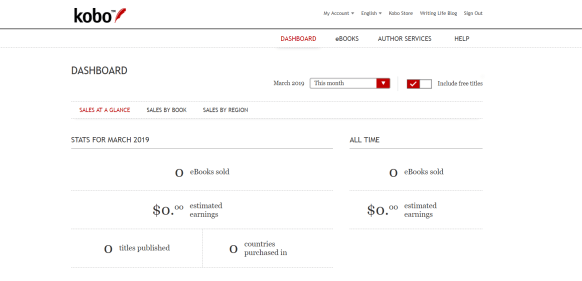
All of Nothing and Wherever He Goes are up on Kobo, and doing a bang up job with no promotion:

2019-03-12 That is as far as I’ve gotten so far. I should put them on Nook and iBooks, and Draft2Digital for the rest. Then I’ll have those two done at least, and do The Years Between Us when it’s released.  It will be a couple months before I can do my trilogy, but it is what it is.

Paperback Updates

Things are moving slowly with paperbacks. Ingram isn’t as hard to work with as everyone says they are, yet they present challenges in their own way.

One of the first things they dinged me for was having a price not match what was on the back cover. I put all my prices above the barcode. I think it looks professional, and I just like to do it. But, Ingram looks, and if your retail price does not match what you put on the cover, they won’t approve your files. So, note to self for future books–remain consistent. That’s a good policy to go by, anyway. You want to look professional, and you want your books to be the same across the board.

Consistency is key.

So after I received that warning, I thought, how do I want to price my books going forward? I redid all my paperback covers (tweaking them in Canva is really easy) and changed the prices on the back. I needed to price my books in a way I’ll remember, and I decided to price books in a series at $9.99, and stand-alones at $12.99. I don’t sell many paperbacks anyway, but I thought if someone were to want to buy them, buying a series shouldn’t break the bank, stand-alones can be priced a bit higher. After printing and distribution costs, Ingram barely pays you anyway, so I didn’t feel the need to worry about cost. I just needed something I could remember so when it comes to pricing books I remained consistent.

That holds true for covers, too. I had lightened up All of Nothing‘s paperback cover for printing reasons, and I uploaded that file to Ingram without changing the one in KDP Print. So, again, my covers looked a bit different. At one point, Ingram DID accept that file for my cover, but I didn’t order the proof. I wanted my books to look the same, no matter where someone ordered it, so I changed the brightness back to the original and resubmitted the cover file.

But after I resubmitted, they emailed me an error:

ingram errror email

Of course, I had no idea what this meant. When I read the GENERAL INTERIOR ISSUE I thought I had formatting issues. But that couldn’t be the case, since I formatted in Vellum, and that program is very very good. Then I saw that I didn’t own the SKU. That SKU is incorrect–the front part of the number is missing. So I had to chat with an Ingram Spark associate. It was quick and easy, but I still have to wait for my issue to be resolved:

ingram chat

I buy my ISBNs from Bowker. There’s no reason why my number should have been rejected. Especially since it had been accepted once before.

She was nice, but running into issues isn’t fun, and I can see where people would be intimidated by working with Ingram. It’s a benefit real people are behind the scenes working on your books and making sure all is well. But there is a certain simpleness when all you’re dealing with is an automated system like KDP Print. The automated system also allows for scammers to publish their books, so you have to take the good with the bad for each company.

Anyway, I want to get All of Nothing figured out and a proof ordered. I’m doing the covers in GIMP working with their template, and I want to make sure it will print well before I do the others. I’m hoping by spring this will all be over, and when I decided to go wide, I had no idea it would take so long or be such a pain in the ass.

Lessons learned so far:

  1. Be consistent. Prices, how your covers look. You want it all the same across the board. Not just for you and your readers, but because in the end, it’s just easier to deal with.
  2. Be patient. In the scheme of things, how much money am I losing not having my books for sale while I’m messing with Ingram? Not many. How many sales am I missing not having my e-books everywhere I want them to be? I don’t know. I’m waiting for my books to be where I want them to before I invest in any more promos. I’m losing sales, I’m losing sales. Once my books are wide I can concentrate on finding a readership on all the platforms. Will I miss KU money? Sure. But while this isn’t a debate on KU vs. Wide, I would never be comfortable trusting one source for all my royalties.  I already do that–it’s called my day job.
  3. Keep looking forward. I’m still working on The Years Between Us, and I’m looking forward to opening Jared and Leah’s file again and filling in some blanks. Besides blog posts, I haven’t written for a while, and I’m starting to get antsy. I did edit for someone, and she’s been going through them. After she makes the changes and does some rewriting, I’ll probably do a second sweep. That’s okay. I adore her, and I don’t mind at all helping her out.

I’m a bit closer to do some tutorials about doing a full paperback cover in Canva. I found a software for recording screen time I think that will work, and I’ve started watching tutorials on how to use it. I’ve been posting a couple covers I’ve made in a FB group dedicated to indie covers, and they’ve all said a tutorial would be helpful. My friend Aila said I should start selling them, but my range is very narrow, and for now I just prefer helping a friend here and there when I can, and practicing to make my own covers better.

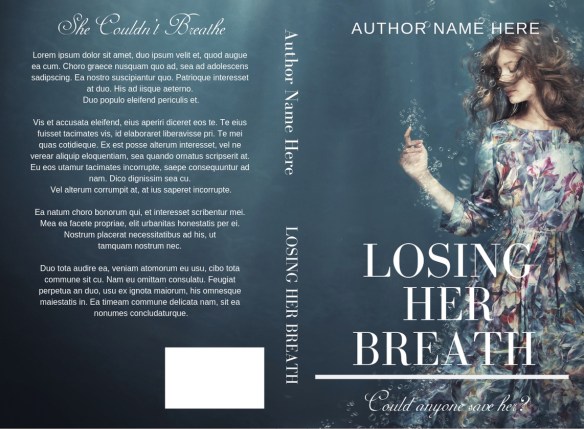
losing her breath fake cover

Do you trust me fake cover

Mostly it’s finding a good photo in canstockphoto.com. I have fun, and I’m developing an eye. Now I only wish it were so easy to do my own covers.  Doing my cover for my series is going to give me hives.

What do I want to get done before March?

I’d like to have a proof of All of Nothing ordered through Ingram. I’d like to have The Years Between Us published. But we’ll see. When you are working with other people, you need to be flexible, and like I said, in the scheme of things, waiting isn’t going to make my whole career fall into shambles. I’d like to have Jared and Leah plumped up and maybe an editing pass completed. We’ll just have to see how things go. The weather here seems to be perking up a bit, with highs in the thirties all week. The sunshine will help. I just hope it doesn’t storm again. We’ve had enough snow.

What do you want to get done before March?

Let me know!


jared and leah for end of blog posts


What do you do when you publish a bad book? 5 Ideas.

Writing tools_ What can you do when you publish a bad book_

As indies, this is bound to happen. Hell, if you’re traditionally published, this can happen too. See my blog post on The Wedding Date.  (Spoiler Alert, I wasn’t impressed.)

As indies, we rush to put out content. Maybe it wasn’t edited the way it should have been, or maybe you didn’t catch a plot hole before you hit Publish. Maybe there’s more telling in there than you thought, or maybe you had some head hopping and you didn’t know you were doing it.

No matter what the issue is, you’re getting bad reviews. People don’t like your book. If you have more than one book out, maybe you feel like it’s not a big deal. But the problem is, if a reader happens along that book–they may not give you another chance to redeem yourself.

bad star reviews

So, what can you do?

  • First, admit your book still needs work. I see lots of people in denial over this. They don’t want to see the truth that their book was published before it was ready. It’s a scary and sad thing to admit. It’s especially heartbreaking when you thought it WAS ready, like The Corner of 1700 Hamilton. I had beta readers. I had an editor. It was as good as I could do at the time. But, now, after writing so many more words and getting better, it wasn’t that great. This can happen to anyone.
  • You can fix it. 
    This presents its own issues with ISBN numbers, and other little things like feeling like you’re ripping off the people who have already purchased it. Time is also a factor because depending on how big of a mess your book is, it could take a few months to rewrite, get it edited again, reformat it, and maybe redo the paperback cover if the number of pages changed. Fixing your book is almost as time-consuming as the launch.
    There is also the ethical question of is it right? Like I said, will you feel like you’re cheating the readers who have paid for your book? What if those reads resulted in bad reviews? Fixing it won’t make those bad reviews go away, and the only thing you can do is add to your blurb on your selling page that your book has been re-edited. This isn’t such a problem if not many people have bought your book, or you caught your mistakes before you started to promote it. This is the ideal scenario, but then you have to ask yourself if you’re going to pull it while you fix it, or hope that no one buys it while it’s in edits.
  • You can unpublish it.
    If your book really sucks, like, it should be hidden in a box under your bed with the dust bunnies and not the plot bunnies, then you can take it down. If you published a paperback, your book will always be there. Goodreads won’t take your books down. Bad books can linger, and there’s nothing you can do about it. I don’t recommend unpublishing. At some point you believed in your book enough to publish it. So deal with the consequences and learn from your mistakes.
  • You can write more books and hope you bury it. 
    If you don’t promote it at all, and never talk about it, there’s a good chance you can bury it. I’ve heard the stat bandied about that 50,000 books are published every month. That’s a lot of books, and it’s not so hard to think that if you never, ever, talk about your book, people will forget you wrote it. In fact, (and I know this to be true) you can soft launch quite a few books and no one will ever know you’re a writer if you don’t say anything.
  • You can leave it alone and start a pen name. 
    Starting over is hard. It means new social media. It means new business cards, new email. It means starting from ground zero. And maybe that’s your thing. Maybe that’s what it takes to feel better, have a fresh start. Lots of people write under different pen names. They abandon series that aren’t working. They want to write in different genres. They have no problem leaving the past behind. They have the time to make a new pen name work–and actually write under that pen name. I listen to  lot of podcasts, and this seems to be quite common. Letting the chips fall where they may and never looking back.
    This certainly is a viable option. If I ever get around to editing my fantasy books, I’ll release those under a pen name. That doesn’t mean I’ll be letting go of my contemporary romance name (which is my real name) but sometimes taking on a different name is smart. Can you do it every time you make a mistake with a book? Probably not. You won’t get anywhere. It’s hard enough as it is to make it under one name consistently putting out quality content. If you keep changing up your names because you keep making mistakes, that’s just wasting time. Time you may not have. As Mark Lefebvre says in The 7 Ps of Publishing, the golden age of Kindle is over. You can’t make a living publishing a couple of books. Making any kind of profit from your writing takes dedication and commitment. It takes consistency and quality work. You have to ask yourself, is the time it takes to let go of that book and start over worth it? Or is it better to take a month and edit the old book, and make it the book it should have been in the first place?


choice

The great thing about being an indie is choice. You have the freedom to do whatever you think is right for your business. And, if presented these choices you feel your book isn’t that bad after all? That is up to you. Promote it. See where it goes. In the scheme of 50,000 books a month, your book really may not be that bad. That’s your choice an author. Take the risk.

This same advice holds true for the authors who are not just publishing but querying. If you’re getting rejection after rejection, or the feedback indicates that your book just isn’t up to par, you have to decide if you want to keep hammering away, fix it, or if you want to put it aside and write something new.

It never ceases to amaze me how many first time authors think their book is wonderful. I was one of them. I learned better, and you will too. It’s what you do with that knowledge that will shape the rest of your career.


A long time ago I  listened to a podcast where the author talked about revamping his series because it wasn’t selling. I was new the indie scene, and I thought that just sounded so wrong. Unfortunately, redoing and rebranding books is an old practice and not just for indies. Traditionally published books have done that for their authors for years. I wrote a pretty in-depth blog post about it, and you can read it here. 

What are your thoughts on redoing books? Worth the time? Or is it better just to forget? Do you still promote your book even though you know it can be better?

For more opinions on what you can do with a bad book check out these links:

https://chrismcmullen.com/2013/09/25/unpublishing-republishing-and-updating-your-book/

https://www.thecreativepenn.com/2015/04/28/changing-book-titles/

https://selfpublishingadvice.org/why-i-unpublished-my-back-catalog/

Going Wide: The Saga Continues

going wide is like riding a bike

Can these guys save me? No? I guess they have better things to do! (Photo taken from Pinterest)


I didn’t think going wide with my books would be such a pain in the neck. Granted, it was my error, and something I should have checked and double checked, but I didn’t, so here we are. It’s not such a big thing, but it does push back my plans. A lot.

I didn’t pull one of my books out of Select. I thought I had. I thought I had pulled them all out. But I didn’t. And it wouldn’t have been a big deal, but it was the last book in my trilogy. I guess I just checked the wrong book one too many times, and was I surprised when I went to make sure they were all out to see that Running Scared had been automatically renewed for another three months.

That means I can’t go wide with my trilogy until May. Fine. Whatever. I could have still gone wide with the other two books, but that would have looked weird. So I put the other two back in Select and I’m just going to keep a better eye on it this time.

What am I doing, then?

I put All of Nothing and Wherever He Goes on Kobo. That’s the best I can do right now. I don’t have OCD, but I do have a certain way I like to do things, and having bits and pieces of my books all over the place would definitely give me anxiety.

I wanted to try out the Kobo landscape anyway, and uploading books to publish was surprisingly easy. The uploading process was smooth, and the online viewer worked quickly. I admit, I used a Kobo-ready file from Vellum, so that might have helped a lot. But I just put in my info, my bank stuff, uploaded, and there you go. Of course, one nice thing about Kobo is that it is run by actual human beings. Which means my book won’t be ready in the standard 72 hours KDP gives you. Kobo is closed for a holiday on Monday, and I don’t anticipate my books being fully published until next week. While that might irritate some, I think it’s great.

But this also pushed back a giveaway I wanted to do, and I don’t want to spoil it, so I’ll just say I’m disappointed I had to do that. But when The Years Between Us is finally edited, I’ll put it both on Amazon and Kobo.

I’m not very interested in KU. While All of Nothing got a bit of traction from my Freebooksy giveaway, I need to explore more promos that don’t involve giving my book away–at least not to that extreme. I gave away over 6,000 copies. I want those to be sales.

think big start small

Next steps in going wide? Wait. Wait for my trilogy to drop out. Put up The Years Between Us on Amazon (but not KU) and Kobo. Try a new promo. Maybe do a Goodreads giveaway for it since I haven’t done that yet. Otherwise, yeah. Just wait, keep writing my series so I can rapid release that wide and see how sales go.


If you have questions about Kobo, they have a ton of resources.

Look on the Kobo Writing Life Blog for helpful articles and podcast episodes.

Killing it on Kobo by Mark Lefebvere. The creator of Kobo Writing Life, Mark knows the ins and outs of Kobo and how to maximize sales with your books.
Order his book on Amazon.
And Kobo, of course.


Where I’m at with my Wedding Party Series

jaredandleah

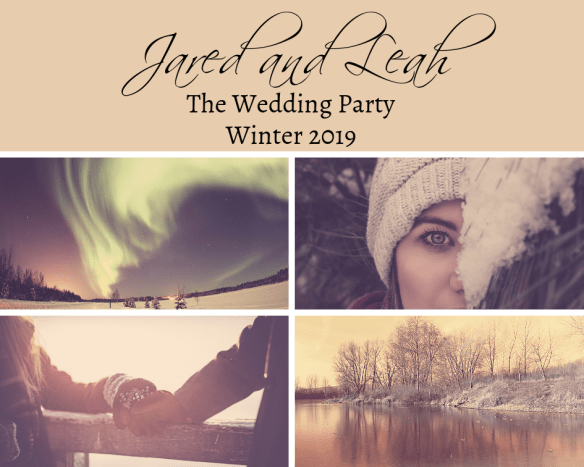
My first try at creating an aesthetic. All pictures taken from Pexels/Pixabay/Unsplash


I said since there is going to be such a long time between releases, I would try to update my fabulous readers better on my writing process while I write my Wedding Party Series. It used to be called my Bridesmaid Quartet, but as I was planning out my characters, I realized I was writing about only three bridesmaids and a groomsman. The Wedding Party series is a little more accurate, and more than likely that’s what I’ll call it when I publish it.

So where am I at?

Okay, well, first of all, I had carpal and cubital tunnel surgery on January tenth. I was able to write 35,000 words (about half of my book) before that, and I was pleased the book sounded as well as it did as a first draft. Had I not had to take time to recuperate, I more than likely could have had the first book done by now.

But I did something I don’t like doing.

I left a previous book undone. The Years Between Us was technically done when I opened the file for Jared and Leah (I always name the file by my characters’ names because it takes a while for me to think up a title), but it wasn’t edited. That’s what I had planned to do while I was in recovery.

Recovery took a little longer than I had expected, and I slept a lot. I watched a lot of Netflix. Luckily, I had thought ahead and planned out a few blog posts, so my website didn’t go neglected. I tried to tweet when I could. But mostly I gave myself a pass and took two weeks of a needed break from a very hectic publishing schedule so far.

The Years Between Us

The unofficial cover for The Years Between Us. Made with Canva.com and photo from canstockphoto.com

I have been able to give The Years Between Us two on screen editing sweeps. I usually print it out and edit it on paper, but I’m thinking this time I’ll skip that step and go straight to the listening part of it. Thinking about this after writing this section of my post, I realized I can’t skip this step. When I edit on paper, that is when I break up my book into chapters. I don’t write my book with chapters in mind, only breaking up my POV changes with scene breaks, and when I print out my book, it’s easier to “chunk it up” while in paper form.  

I’ll be working on two books simultaneously, and I don’t particularly care for it, but I like writing Jared and Leah and there’s no rush to put out The Years Between Us. When I DO get it done, it will be going on a long preorder, just so I don’t have so long between books, though by romance indie publishing standards, since I published All of Nothing in October, I should have another book out now.

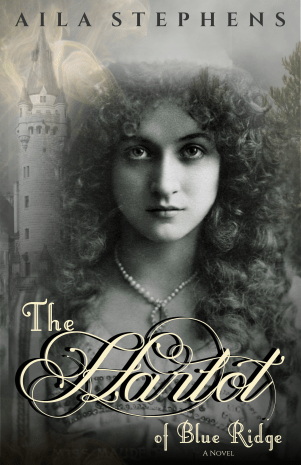
Anyway, I did realize not long ago while I was reading my friend Aila’s blog, I’ll need to change a few things, and the sooner the better. Most of the time I don’t care what I name my characters as long as I haven’t used the name before, and it matches what I think the character looks like. Towns are the same. Sometimes I look up names, sometimes I steal them from work. (I work in a call center and see names of cities and towns all day long.) Sometimes I use a name generator. I didn’t think anything of using Blue Ridge, Minnesota for my small town’s name. Until I was reading a blog post of Aila’s. Color me surprised when I saw this:

Harlot of Blue Ridge

Beautiful! (And used with permission. Thanks, Aila!)

All I can think is that the name of her book kind of got stuck in my mind. I mentioned it to her, and she was very gracious, saying I didn’t need to change it. But she thought of it first, she’s further into her WIP than I am, and seriously, there are so many other names to choose from, I don’t need to steal borrow anyone else’s. I can’t tell you how excited I am to read her book though, and if you want to follow along with her writing journey, you should follow her blog and give her a follow on Twitter. I can’t tell you enough how impressed I am with what she gives to the indie writing community.

I am not going to lie: it’s been hard to get back into the swing of things. I’m not 100% healed, meaning, I’m not 100% pain free. My doctor said it could take my body up to 12 months to repair itself. On the bright side, I don’t feel any worse than when I did before my surgery, and if I could type through the pain then, I can type through it now.

I went back to work last week, so I’m hoping that returning to a schedule will help me make better use of my time.

In my next blog post, I’ll break down what I’m doing with Jared and Leah, and maybe share an excerpt or two of what’s been going on!

Until next time!

jared and leah for end of blog posts


Where do you find readers for your books? Part Four

finding readers for your books blog posts part 4

This is just a quick blog post to finish up the series. We talked about cheap promo sites like eSoda, starting slow with Amazon and BookBub ads, and saving up for giveaways like Goodreads, if money is tight.

This last blog post will be a catch-all of things I’ve blogged about in the past such as going wide, going local, things like that.

Going Wide

You would think that only selling your book on one platform would be limiting. And again, this goes back to what you want for your business. If your books are hot, and they are in Kindle Unlimited, are you okay with trusting Amazon with your sole income for your books?

I have 5 contemporary romance books out now, and I recently pulled them out of Select. As my backlist grows, I will feel more comfortable with my books being sold many places. This is a good move for me now because I’m not making that much money on KU, so I don’t feel bad about leaving that income behind.

I’ve listened to a few podcasts recently with Mark Lefebvre who used to head Kobo Writing Life and is now working at Draft2Digital. There’s great things going on in the great wide world of indie-publishing, and I don’t want to be left behind.

Going wide is a different animal than just staying on Amazon, and Mark even said to expect to wait 6 months to a year to find any traction. As I’m building my backlist, I don’t mind waiting.

Kobo has over 28 million readers.

An Author Earnings report indicates that iBooks may be back in the game.

This isn’t a blog post to convince you to go wide. I’m just saying, eventually, if you want to reach more readers, moving your books to other platforms and using the promotional tools they give you (like Kobo’s promo dashboard) may be something to consider.

Looking Local

think local

We always think big when we think of marketing, but you can do something simple like go to your indie bookstore and ask them to carry your book. Or send a book to the Lifestyles section of your town’s newspaper and ask if they would interview you (and/or what it’s like to be an indie author) or review your book. If you have an area magazine, ask to be profiled. Maybe ask if you can teach a class at your local library on how to self-publish.

Writers are introverts by nature, but asking your library if they can carry your book in the local author’s section could be a chance at marketing for you. (Having a photo taken while you’re standing in the stacks holding your book? Cool!)  At least perhaps a chance at a signing and photo op. Even Joanna Penn said if you have a signing and no one shows up, take a ton of pictures. You’re getting some photos for marketing out of it, anyway.

It takes baby steps to market your books, and remember, throughout all this, always be writing more books.

This blog series was intended to help you break out of Writer Twitter. Auto DMs saying take a look at my book and tweeting about your book all the time isn’t going to make your career.

We’ve all been warned to not build your author platform on someone else’s real estate–meaning, get your own website so you are in charge. A Facebook Author page, or even a group is great, but you are handing Mark Zuckerberg control of your author platform when you use Facebook to promote your books. The same with Twitter. Instagram and Pinterest are fun to use, but they should make up a minimal part of your platform.

I didn’t add blogging as a free way to sell books, mainly because blogging takes a long time. I’ve blogged for years and feel like my blog is just gaining some traction. That’s partly my fault, since I know I don’t blog nearly enough. But on the other hand, I have five books published I’m proud of, another in editing, and 30,000 words into the first book of a four book series (all this in two and a half years). Could I do all that if I blogged all the time? Probably not.

Newsletters are the same. All the big indies still swear by them. But they take years to build (if you do it the right way) and should be part of building your author platform. I attempted to start a newsletter a long time ago, but the fact is, I don’t know what to put in it, and even though MailChimp is free (for the first 2,000 subscribers) you still need to pay extra for certain features. (Like an automatic welcome newsletter sent out to new subscribers.) When you weigh time versus all the little extras (newsletters, blogging), I will almost always choose to write books.

twitter jail

You need to do what’s right for you and your business. Sometimes that means saving up for a promo. Sometimes that means writing instead of posting on Instagram. Maybe that means buying a box of $9.99 business cards from VistaPrint and handing them out or leaving them places (one hack I read about was leaving your business card with your receipt when you pay for lunch/dinner). Asking to leave a box of bookmarks at your library’s information desk. Or your indie bookstore. Little things over time can add up.

But think outside of Writer Twitter; even think outside Facebook and Amazon.  You’ll be glad you did.

Please let me know if any of this series helped you find more readers!

Thanks for reading!


Where do you find readers? Part 3

finding readers for your books blog posts part 3

BookBub

Not everything is about Amazon and Facebook. I’ve heard about them the most, and maybe you have too, but another ad platform you can try is BookBub. I’m not talking about the Featured Deal that is notoriously difficult to be approved for. BookBub ads are ads for your book that run in a BookBub newsletter. You pay a Cost per Click, or Cost per Impression.

If you’re not familiar with BookBub, I suggest you go on there and at least claim your author profile if you’ve published and put up a photo at the very minimum of involvement. You can find authors to follow, and also encourage readers to follow you. BookBub will email your followers when you release a book or they feature you. Similar to Amazon. To read more about what following authors and what readers following you can do for you, click here.

Anyway, if you’re interested in going for a BookBub featured deal, click here for guidelines and prices. Books that are published wide, have pleasing covers, and have lots of reviews generally have a better chance of getting approved. In other words, books that are already doing fine. But, you can always try.

If you want to know more about buying ad space and the process, you can read about it here.

And if you do decide to go for it and place a couple ads, research what makes a good ad, by reading this blog article. I’m all about researching before you spend any money, and you’ll go into it with a better understanding and a better chance of being more successful. The BookBub blog can help you market any book on any platform, so be sure to bookmark it, or sign up for emails.

Giveaways

free books

There are lots of opinions about giveaways. We shouldn’t train readers to want free books as it drives down the prices of books. People don’t value things for free. Free books don’t work anymore because there is so much free content out there. You don’t have to give away all your books all the time. That’s just not good business sense. But I did a Freebooksy for All of Nothing, and 6,000 people downloaded it. Would I have liked those be sales, especially since I paid to give away those books? Yes! But when I did a BargainBooksy for Wherever He Goes, it didn’t do nearly as well, and I dropped the price of that book to .99 especially for the promo.

When you think about giveaways, you need to decide what your business plans are. If you only want sales and you only have one book out, then giving it away won’t be an option for you. If you give away a Book One in a 7 book series, hoping to cash in on the other 6 books, that’s something else.

I agree that giving a book away may be better if you have a backlist so if a reader falls in love with your freebie, you have other books they can buy.

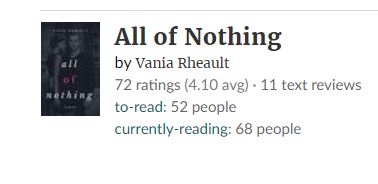
But even if you have one book, and it’s a solid book, and you may be releasing anothergoodreads stats one soon, giving a book away once could work for you. I don’t mind giving books away every once in a while–I usually do some kind of promo for each book I release then move on. After I did my giveaway for All of Nothing, I got a few reviews (the book has 11-12 depending on which platform you look at, and that’s the most any of my books have ever gotten) and there are some readers who have added it to their shelves on Goodreads.
So again, think about what your plans are if you’re going to give your book away.

There is only one place that I would think about doing a giveaway (besides my Freebooksy promos), and that’s Goodreads. Since they changed the way they do their giveaways, (there was a big to-do about it, and you can read it here) there is a cost involved. But because Goodreads is a site for readers, there’s a good chance anyone who wins your book will actually read it and review it. There are some people who just want to win stuff, but you’re going to encounter those kinds of people no matter what you’re giving away.

The standard giveaway is $119.00 now. If you have to save up a few months for that, work that into your marketing strategy, or begin saving when you know you’re going to have your next release. I know that $119.00 will feed my family for a week. But I also know I can skip a trip to Barnes and Noble and save that money, or skip my Starbucks run for a month and save that money, too.

If your interested in the pricing, guidelines, and perks of doing a giveaway with Goodreads, you can read here for the FAQs on the Goodreads page, and here, for a blogger’s perspective. Personally, I think since the giveaways are paid now, it reduces how many books are available, and gives you a better chance at discoverability. I always approved of the change, and I wouldn’t mind trying it out on my next release The Years Between Us, or I may wait and use it for the first book in my series.

You can do giveaways from your book’s sell page on Amazon. I have tried that a couple times with no apparent benefit. I blogged about it, and you read about it here. It didn’t do anything for me, and while it’s little work and it didn’t cost me anything, if there’s no value, I don’t see the point in doing it.

That’s all that I have for today! I hope you found a bit of value in this post, and join me for the last part of Where do you find readers in my next post. We’ll talk just a little bit about going wide. I hope to see you there!

Where do you find readers? Part 2

finding readers for your books blog posts part 2


In part one, I wasted your time went over a few things you can do to draw in readers. Starting with a quality product. That’s mandatory, but not everyone does. You’ve seen the poor covers, bad blurbs, and horribly written look insides. But no one is immune, and if you’re not selling books, or not selling as many books as you think you should be, try to find an unbiased opinion and see if you can find where the problem is.

Now, with that being said, readers are out there. But how do you find them?

Start Small

There are promo sites that don’t cost an arm and a leg. How well they work, I have no idea. But if you listen to lots of podcasts of author interviews like I do, you’ll slowly build a list of promo sites that are used by other authors. Some of these require a certain number of reviews. Almost all of them vet books so if your cover doesn’t look nice, or the person who runs the promo site thinks your writing is terrible, they won’t promote your book, no matter how much you pay them.

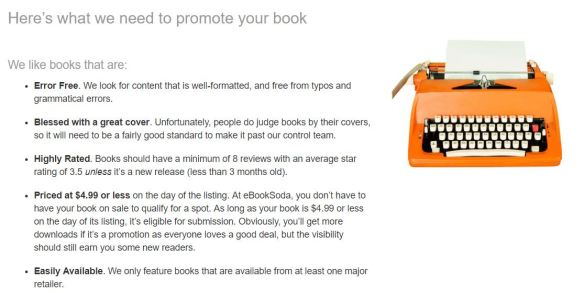
eBookSoda. Their prices have gone up since I’ve checked into them last. They review your book before they promote, and they do have a few guidelines you have to meet for them to accept your book.

ebook soda promo site

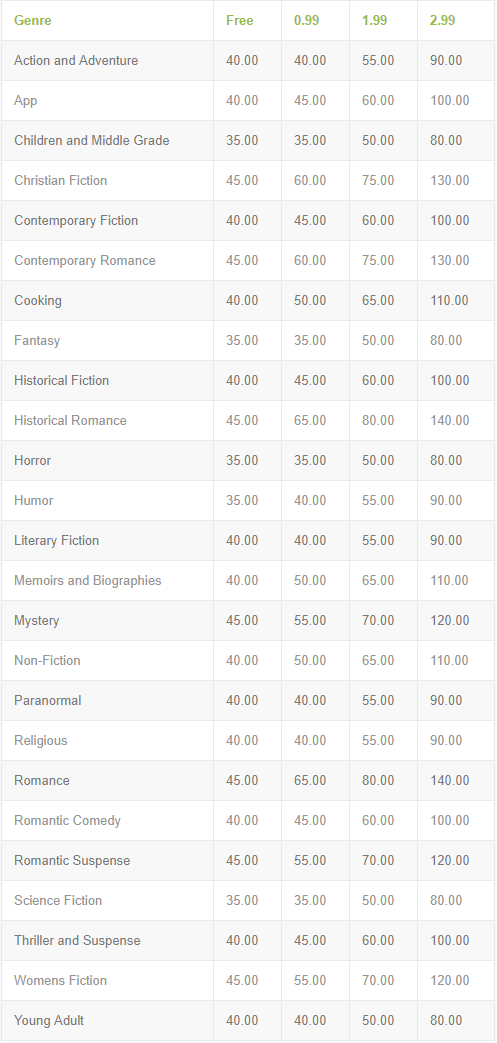
ebook soda promo site2

At twenty dollars to give it a try, that doesn’t seem like a huge investment. I’ve spent more and have gotten nothing in return.

eReader News Today.

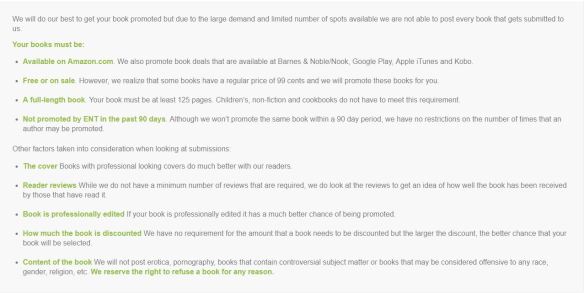
They are a little spendier, but I’ve heard good things about them. They also vet, so be prepared for an actual person to look at your book.

ereader-pricing-table-heading

ereader news today requirements

I’m not going to go through every single promo site out there. I’ve only used Freebooksy and BargainBooksy for my promos, but when I release my next book, I may spread my wings a bit. There are promo sites out there that cost less than what they charge, and they may expose me to new readers.

Dave Chesson has a very large list of promo sites if you want to browse. But the main idea is that putting money into the marking of your book doesn’t have to break the bank.

Paying to Play

Indie readers don’t want to accept that to find readers (especially if they are on Twitter and tweet about their book for free all the time) that at some point you are going to have to invest in your books. There is no other way for anyone to know your books are out there. There’s billions of people in the world. How are you going to reach them if you can’t break out of Writer Twitter? It’s next to impossible.

Richard Blake had this to say about the current state of advertising:

2018 ushered in a time when visibility we used to take for granted on Amazon basically disappeared. The long tail on new releases has been compressed to only weeks, and with the elimination of free books from the also boughts and from the search functions, it’s almost impossible to get any free visibility now on the largest seller of books in the world.

So what’s left?

Paying to play, also known as advertising. The rest of this blog will be devoted to my experience with Zon advertising, and the conclusions I’ve drawn after reluctantly beginning a concentrated effort about mid-year.

If you’re interested in what else he has to say, you can check out and subscribe to his blog here.

I’ve written about my success, or lack thereof, about Amazon before, and you can check out my blog post here. So I’m not going to bother rehashing old ground. If you want to learn how to do them, there are a lot of authors who provide courses and books. My favorite is Brian Meeks. He has a book about Amazon Ads, and I used to recommend it a lot. I’ve heard that Amazon has changed the way they do ads, so his step-by-step instructions are no longer applicable. Concepts of patience, testing, and slowly building your ad, however, are still great advice. Despite not being able to point you in the direction of his book, he’s done several interviews for podcasts as well, and he spoke at the 20 Books to 50K Conference in Vegas this past November. Check out his talk!


If you want more details, check out Chris McMullen’s blog post about the recent changes and how to work with them.

I’ve had a little success–meaning my bids are getting clicks, I’m seeing some buys, and I’m not spending a huge amount of money (not in enough to put me in the black with ROI, but you have to start somewhere). Figuring out ads is like learning to swim. You’re going to get a lot of water up your nose before you can float without drowning. This is a bad metaphor for me, as I still only know how to doggy paddle, but such is life.

I haven’t tried Facebook ads, mainly because I’ve heard they will take your money and run, unlike Amazon. Plus, I don’t have that many books out yet. I’ve read Michael Cooper’s book, Help! My Facebook Ads Suck! and that was extremely helpful. He, too, was at the 20 Books to 50K conference and you can watch his talk. 🙂

I’ll do a Part 3 later. I’ve given you lots to consider right now. Please go through those promo sites. If you can save five dollars a week and buy a $20 dollar promo for a reader newsletter once a month, that’s a great start when you thought you couldn’t afford to run ads at all.

Thanks for reading, and let me know if you have any thoughts, ideas, or things you’re going to try going in to 2019 and selling your books!


Good luck!

KDP Select/KU vs. going wide, IngramSpark and other musings

GOING WIDE VS KDP SELECT

The other day I pulled my books out of KU. For those of you who may not know what that is, Kindle Unlimited is a program through Kindle Direct Publishing that is offered to authors who don’t publish their ebooks anywhere else. They get paid from a giant slush fund for “pages” read.  Some authors think that Amazon is the best, and there isn’t anywhere else to publish. But where is there to go if you decide you don’t want to give Amazon exclusivity? Kobo, Books (aka iBooks), Nook, Google Play, and a few others that can be reached through an aggregator like Draft2Digital or PublishDrive are available for indie authors. Thank goodness indie authors have a choice.

choice street signs

It’s a little scary, since I have been getting a few page reads here and there, mostly since I paid for a FreeBooksy promo not long ago. Usually that will put my book on the radar for a while, but tends to taper off. Like today, I’ve only made $4.81 in page reads, compared to my highest day ten days after my promo, which made me $56.80. That’s just for All of Nothing, when I ran a free promo for it on November 9th. It’s been a pretty long tail, still getting page reads more than a month after my promo, but I’m thinking I can do better.

It is scary, thinking about losing even those meagre page reads, but there is one thing I have to remember: even if my books aren’t in KU anymore, anyone shopping on Amazon who wants to read my books, can still buy them. What I’ve made today in page reads would calculate into 2.5 people buying my book at $2.99. Sometimes I think authors forget about that part of it. Just because you’re not in KU anymore doesn’t mean authors can’t buy your book. That is really a powerful thing for me to remember, and it makes it easier to feel better about the decision I made to go wide.

I’m really excited about the opportunity publish my books on Kobo. Kobo is growing and right now, according to an old 2016 stat, they have 26 million users worldwide. That’s a lot of readers. And with Kobo Writing Life, I’ve heard they are very friendly and want to work with indie authors.

Some indies go wide from the start, but lots more, not knowing how or where to publish, stick with only Amazon. Neither of these paths is wrong. When I first moved into publishing, I was happy to deal with one vendor. I only had to deal with one file to format, and one upload. One price. I stuck my books in KU and mainly forgot about them as I wrote the next.

But as you publish more books, and you start to learn what other successful indies are doing, you have to think about where your want your business to go. You hear about the risks of putting all your eggs into one basket. But then you hear about authors making hundreds of thousands of dollars in KU reads. (And you also hear about how Amazon can, at random, target one of those authors and essentially take all their income away with a single push of a button.)

Joanna Penn continually says you need to think about more than one stream of income. For her that means speaking gigs, writing non-fiction, her podcast, and other things she has going on in her career, but for indies who don’t do as much as she does, it could simply mean not counting on one company for all your income.

I’ll be going direct with Kobo, since that is how you access their promotions tab. But I’ll likely use Draft2Digital to publish my books everywhere else.

If you’re interested in going wide, and you want to learn what Kobo can do you for you, Joanna Penn recently had a guest on her podcast who works at Kobo, Camille Mofidi. You can click here to listen to it. Mark Lefebvre used to work at Kobo, but now has moved to Draft2Digital. I love Mark and used to listen to the Kobo Writing Life podcast where he would frequently talk about what works on Kobo to sell books. He also wrote a book, Killing It On Kobo: Leverage Insights to Optimize Publishing and Marketing Strategies, Grow Your Global Sales and Increase Revenue on Kobo (Stark Publishing Solutions) on how to use Kobo to sell your books. Mark also did a recent interview on The Science Fiction and Fantasy Marketing Podcast hosted by Lindsay Buroker, Jeff Poole, and Jo Lallo. You can check it out here

My books won’t completely drop out of KDP Select until February, so I have to wait. You don’t want to make Amazon mad at you, so if you decide to go wide, please make sure that your books have completed their three months within the program. If you have several books like I do, you’ll need to wait until they have all dropped out before going wide, as their months could overlap. Plus, they don’t do that automatically–you have remember to uncheck the box in your KDP dashboard.

As for my paperbacks, I am changing that up, too. I’ve seen first hand that if you don’t use KDP Print to distribute to Amazon (or CreateSpace before) Amazon can play hardball and sometimes make your book unavailable or out of stock. To me, this would be a pain in the butt because who has time to police their books all day? I’ve published all my books through CreateSpace/KDP print, and I have found no issues with quality as I’ve heard some complain about. But I have moved my books out of Expanded Distribution on KDP Print and only use them to supply to Amazon. Then, after they drop out of their system, I’m going to publish my paperbacks with IngramSpark and use them for Expanded Distribution. The reason I’m doing this is because I want to approach my local bookstores about carrying my books.

Seeing the benefits of going wide may take a while. But I’m in this for the long haul, and I don’t mind waiting. I need to start thinking about what I want for my business as I grow my backlist, and going wide and using IngramSpark for paperback expanded distribution feels like the right way to go. But only time will tell.

Wish me luck!

Blog signature

for a little while longer. 🙂 


Laying the Groundwork for a (Romantic) Series

Series sell. Us indies are told this all the time. Write a strong first book in a series, hook the reader, and have natural read-through to the next three or four or five plus books. While my trilogy hasn’t taken off, (i.e. I can’t pay the rent with royalties yet) I do have some read through–people I have reading book three who wouldn’t be around had the first book been a standalone.

But there are a lot of questions to consider when thinking about a series:

  • Where is it going to take place?
    You need a setting that is interesting enough that the place of your books will hold

    interesting setting

    An interesting setting becomes a character in and of itself.

    the reader’s attention for that amount of time, lends plot potential, and is a place that you won’t get sick of as an author. A detective series could take place in a large city. There’s enough fodder for lots of crime, and the possibility of cops sitting around playing poker in a city full of millions of people is low. Lots of romances take place in small towns, but if you’re working with a small town, you need to make sure your characters have something to do. A town with one stoplight, where the only gas station closes at 8pm, doesn’t leave much opportunity to use setting as a character, unless something happens like a natural disaster such as a tornado. So when you’re planning your series, you have to keep the setting in mind. Susan Mallery’s Fool’s Gold series is based in a town called Fool’s Gold and its Mayor proves to be quite the matchmaker.


  • How many people are you going to start with at first?
    A series will evolve and change as you write (new characters will be introduced, for

    group of people

    Plan your characters.

    instance), but when you sit down to write the first book you’ll need to keep in mind where you want the first few books to go so you can lay the groundwork. Weaving future plots and characters into current narrative will clue your reader into the fact that yes, there will be more books about the characters they will come to care about, and yes, they will want to read the next and the next and the next. But you can only do that when you know what’s going to happen in the first handful of books. It can be a woman and her three best friends, or a guy and his two sisters. Nora Roberts does this well, and my Four Bridesmaids Quartet I’m planning is modeled after her Bride Quartet. (I’m not copying her–I’ve read Nora since I was a teenager, and I admire her plotting skills and the construction of her books. I wouldn’t be the writer I am today had I not read so much Nora Roberts growing up. She’s definitely influenced my writing for the better. :))


  • What are the characters’ backstories?
    Your characters’ backstories need to be related to the plot somehow. Say your three sisters had an abusive mother and their relationship with her bleeds into their relationships with their boyfriends. If you go bigger (a longer series) and it’s your town that has the problems, like a tornado, or hurricane, or a flood, your characters need to have personal problems associated with the town to create conflict. A popular romance trope is a stranger comes to town, and he’s got a ton of secrets. Only the widow in the falling down ranch house can breech his rough exterior to his secrets beneath. But he’s he’s also an electrician and can help rewire the school after the fire! That helps the town accept him and he feels like he belongs and he stays after he falls in love with your FMC (female main character).


  • What is your plot?
    Is your main plot going to be wrapped up in each book (like the detective solves the crime, and the next book would be the detective solving a new crime?) or is your main plot going to arc over a few books? If you’re hoping to write so a reader can pop in at book eight and not feel like they’ve missed anything, you’ll need to wrap up the plot at the end of each book while foreshadowing your next story. This is why it’s always best to know what your next book is going to be about so you can weave in those clues.


Publishing Your Series

The bullet points above are the writing part of it, but before you begin a series, it’s best to have some kind of idea about publishing.

  • Your publishing schedule.
    As an indie, you have complete control of your publishing schedule. Are you goingwaiting for a series to publish them as you write them, or are you going to save up a couple and publish them together? A week apart? Two weeks apart?In this case, being an indie author is definitely a perk. You don’t have to make your readers wait a year between books like the traditionally published authors do. But because of impatience, many indies publish as they write, without a thought as to making a reader wait for the next book. I haven’t met one author who likes to sit on books. (But I have heard of plenty of stories about the benefits to the authors who do.) The minute the book is ready, they hit publish. But what does this mean if you’re writing a series? How fast can you write the next book? Do you do this full-time and can publish the next one in two months, one month? Do you have a team that will edit and format and do your covers for you? What is the point of publishing a book one if it’s going to take you two years to publish the next?


  • Consistency.It’s really hard to go back and make changes to a book that’s already been
    changes

    This is a pretty kind of change. The kind made to your book after already publishing isn’t this pretty, and it’s time-consuming.

    published. Not that it’s hard from a technical standpoint–just make the fixes and upload the new file. But what about those readers who have read it already? Your plot and characters are already in their heads, and you want to ask them reread your book for the new information so the next book will make more sense? Sorry. It doesn’t work that way. If you write a book one, and something happens in book two to make your consistency fade away like fog in the sun, you’ve got a problem, if you’ve already published. But if you haven’t–good news! Just make the changes. As you add to the series, this isn’t realistic, I know that. You’re not going to sit on seven books. No one would. But in all practicality, sitting on two or three books to make sure your plot is going smoothly and you don’t have any big plot holes or changes that need to be addressed is pretty darn smart.


  • Covers 
    If you’re doing your own covers, or if you’re going to be buying premades, orbride_quartet nora roberts working with a designer, it’s very very very important that your covers not only fit the genre, but that your series will look like a series. That means your author name looks the same, that your pictures you choose are cohesive. It means that the series name is on all the books.Here’s Nora Roberts’ Bride Quartet I was telling you about earlier. It’s a lot easier to plan how your covers will look–at least the first few, if you wait to publish.
    It’s also helpful with titles. If you’re doing a trilogy, or a quartet, or even a quintet, it will give you a chance to think of titles that match the theme of your plots.


After my May/December romance, I am going to write a quartet. Yes, I will wait to publish until they are all done. I will do my own covers, and I’ve already thought of titles that will match the theme of the books. I have my town chosen, I’m mulling over characters now. It will take a lot of patience to write this series, but as I stated at the beginning of the post, series sell. I’ll have a trilogy and three standalones in my backlist, and it’s time for another series.

Are you writing a series right now? Are you publishing as you go? How much time is between them? Let me know!


Blog signature

Happy November!

Happy November


November is finally upon us, and that means we only have 61 days until the New Year!

I’ve been moving steadily along with my goals. In fact, I disappeared from social media for a bit while I released my new book, All of Nothing.

Here’s the lovely cover:

All of Nothing Paperback Cover

I did the entire cover in Canva, and I bought the photo on Canstockphoto for seven dollars. It’s not very fancy, but I do take pride in the fact that I did it myself. and it printed just as nicely as it looks online. It’s in KU, and I’m running a free promotion on it November 9th. It will be included in the Freebooksy newsletter that day. Because  I tried a Bargain Booksy on Wherever He Goes that didn’t do too well, I’m also putting that book for free that day to see if I can’t piggyback some downloads from All of Nothing‘s promotion.

As an early birthday present, a dear friend of mine gifted me a Mac and the formatting software Vellum. I was very excited in that since I had been doing all my own formatting, I could replace the interiors of all my books, and that’s what I’ve spent the last three days doing for Summer Secrets, my erotica novella series, and my Tower City Romance Trilogy. Because formatting is so easy with it, I put together a box set of my trilogy, so that is finally being offered on Amazon as well.

Nothing is ever easy though, and since I was doing the covers and insides, I went ahead and moved my trilogy over from CS to KDP Print. I hadn’t done that yet, so I wanted to get it all out of the way.

The second book in my series got lost in the conversion, and it took KDP four days to find it. It was over the weekend, and they did eventually restore it, so I was grateful for that. 🙂 If you haven’t moved your books over yet, I recommend you do so. My book was still for sale on Amazon, so it didn’t completely disappear, but it’s better to get all that taken care of sooner rather than later.

But I did redo the covers for Summer Secrets, being that I’m a bit better at covers now, and I redid the box set I created, inside and out. Though someone pointed out a typo on the first line of the first paragraph, {rolling eyes hard here} I’m still very happy with they turned out:


It wasn’t a big change, but I think it’s a step in the right direction, nonetheless. I didn’t get so different with my trilogy, so I won’t post them here. But I did redo them in Canva, which gives them a higher quality than when I used to do my covers in Word. A very warm shoutout to my friend Aila Stephens who told me about Canva so long ago. She’s just starting up a blog series about covers herself, so make sure you follow her blog for indie tips and publishing tips!

Anyway, so next up for me is my May/December romance that I’m already 8,000 words into. I’m so excited for this book! I’ve been thinking about a May/December romance for a long time now, and I was delighted when a plot popped into my head. All of Nothing is over 80,000 words long, and I don’t think Matthew and Zia (my book doesn’t have a title yet) will end up being quite so long. But I’m still excited to be mulling subplots and backstory as I get into writing.


This kind of sums up the whole story, and as a contemporary romance author, you know I’ll always dish up a nice happily ever after. I just make my characters go through hell to get there first.

In other news, I’m going to submit All of Nothing into the RITAs, a contest sponsored by the Romance Writers of America. The contest is open to both trad-pubbed and indie-pubbed authors, so in reality, I know I don’t stand a chance. But if my book could move on to a second round, or if the judges have some good feedback for me, I’d consider it a success. At any rate, it something I’m going to try, and I think All of Nothing is a solid book. It’s getting good feedback already, and my betas didn’t have anything bad to say about it. So, wish me luck!

Along with entering the contest, you also have to judge books in the first round, so I’ll be needing to dig out my Kindle and settle in for some serious reading coming up. Which suits, because I’m going to have carpal and cubital tunnel surgery on my left hand/elbow in the middle of January. I’m going to try to get Matthew and Zia at least written by then, so while I recover I can do some small edits. It will do me good to rest my hands while I help in the judging of the first round. I’m very much enjoying being part of the romance writing community!

What else is going on? NaNoWriMo starts tomorrow! I won’t play, I haven’t played for a couple years now, but I may meet up with my group. Sometimes it’s nice to see people in person, talk shop. Catch up. I used to work with a couple of the members, so it will be fun to see them, too. But after the colder weather hits (I’m in MN) it gets harder to get out of the house. Even for pie and coffee at the local coffee shop.

I guess that’s all I have to report! I hope you all are doing well, and tell me what your end of the year goals are! Remember, you have 61 days! Do your best!

2019 is right around the corner! What do you have left to do in 2018_


Drop me a comment, and have a great weekend!